Overview
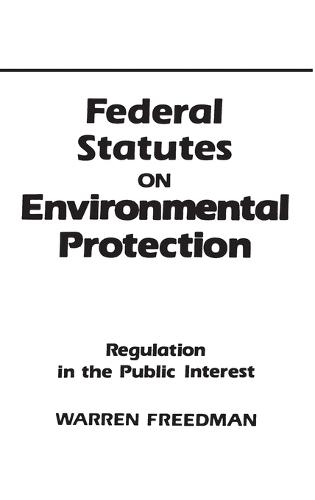
A brief yet comprehensive and clearly written compendium of the most important federal energy, environmental, and natural resource statutes through 1982. Freedman's special talent is the ability to relate Congressional intent to the policy context within each act was written. . . . [This] is a sweeping panoply of statute summaries replete with citations, and is thus highly suitable as a reference work. Choice This book discusses 69 major federal environmental laws that have a direct impact on companies operating in the United States. Coverage includes every major statute from the Refuse Act of 1899 through recent laws governing nuclear waste policy and solid waste disposal. The statutes discussed included those designed to provide compensation based upon proof of liability and those that establish statutory prohibitions and penalties. For each, the author provides an incisive analysis of the statute itself and of supporting court decisions to show how these statutes have been interpreted in practice.
Full Product Details
Author: Warren Freedman
Publisher: Bloomsbury Publishing Plc
Imprint: Praeger Publishers Inc
Dimensions:
Width: 15.00cm
, Height: 1.90cm
, Length: 23.00cm
Weight: 0.431kg
ISBN: 9780899301907
ISBN 10: 0899301908
Pages: 181
Publication Date: 14 August 1987
Recommended Age: From 7 to 17 years
Audience:
College/higher education
,
Undergraduate
,
Postgraduate, Research & Scholarly
Format: Hardback
Publisher's Status: Active
Availability: Manufactured on demand

We will order this item for you from a manufactured on demand supplier.
Reviews
A brief yet comprehensive and clearly written compendium of the most important federal energy, environmental, and natural resource statutes through 1982. Freedman's special talent is the ability to relate Congressional intent to the policy context within which each act was written--e.g., to ... change the attitude and posture of federal agencies toward environmental preservation' (National Environmental Protection Act, NEPA), or to cover both the emergency spill of discharge of a hazardous substance and the long-term release of [such] substance into the environment' (Superfund). Statutes are listed in separate chapters alphabetically by common name (e.g., Superfund' rather than Comprehensive Environmental Response Compensation and Liability Act'). Each chapter depicts major requirements of acts by subsection and includes an analysis of litigation upon subsequent statutory interpretation and application. A particular strength is the author's penchant for noting connections between laws, e.g., the fact that the Trans-Alaska Pipeline Act (1973) which authorized transport of North slope oil precludes judicial challenge ... by expressly stating that [environmental impacts] were in full compliance with NEPA.... [This] is a sweeping panoply of statute summaries replete with citations, and is thus highly suitable as a reference work. Of interest to students of environmental law and policy as well as specialists. -Choice
"""A brief yet comprehensive and clearly written compendium of the most important federal energy, environmental, and natural resource statutes through 1982. Freedman's special talent is the ability to relate Congressional intent to the policy context within which each act was written--e.g., to ... change the attitude and posture of federal agencies toward environmental preservation' (National Environmental Protection Act, NEPA), or to cover both the emergency spill of discharge of a hazardous substance and the long-term release of [such] substance into the environment' (Superfund). Statutes are listed in separate chapters alphabetically by common name (e.g., Superfund' rather than Comprehensive Environmental Response Compensation and Liability Act'). Each chapter depicts major requirements of acts by subsection and includes an analysis of litigation upon subsequent statutory interpretation and application. A particular strength is the author's penchant for noting connections between laws, e.g., the fact that the Trans-Alaska Pipeline Act (1973) which authorized transport of North slope oil precludes judicial challenge ... by expressly stating that [environmental impacts] were in full compliance with NEPA.... [This] is a sweeping panoply of statute summaries replete with citations, and is thus highly suitable as a reference work. Of interest to students of environmental law and policy as well as specialists.""-Choice ?A brief yet comprehensive and clearly written compendium of the most important federal energy, environmental, and natural resource statutes through 1982. Freedman's special talent is the ability to relate Congressional intent to the policy context within which each act was written--e.g., to ... change the attitude and posture of federal agencies toward environmental preservation' (National Environmental Protection Act, NEPA), or to cover both the emergency spill of discharge of a hazardous substance and the long-term release of [such] substance into the environment' (Superfund). Statutes are listed in separate chapters alphabetically by common name (e.g., Superfund' rather than Comprehensive Environmental Response Compensation and Liability Act'). Each chapter depicts major requirements of acts by subsection and includes an analysis of litigation upon subsequent statutory interpretation and application. A particular strength is the author's penchant for noting connections between laws, e.g., the fact that the Trans-Alaska Pipeline Act (1973) which authorized transport of North slope oil precludes judicial challenge ... by expressly stating that [environmental impacts] were in full compliance with NEPA.... [This] is a sweeping panoply of statute summaries replete with citations, and is thus highly suitable as a reference work. Of interest to students of environmental law and policy as well as specialists.?-Choice"
?A brief yet comprehensive and clearly written compendium of the most important federal energy, environmental, and natural resource statutes through 1982. Freedman's special talent is the ability to relate Congressional intent to the policy context within which each act was written--e.g., to ... change the attitude and posture of federal agencies toward environmental preservation' (National Environmental Protection Act, NEPA), or to cover both the emergency spill of discharge of a hazardous substance and the long-term release of [such] substance into the environment' (Superfund). Statutes are listed in separate chapters alphabetically by common name (e.g., Superfund' rather than Comprehensive Environmental Response Compensation and Liability Act'). Each chapter depicts major requirements of acts by subsection and includes an analysis of litigation upon subsequent statutory interpretation and application. A particular strength is the author's penchant for noting connections between laws, e.g., the fact that the Trans-Alaska Pipeline Act (1973) which authorized transport of North slope oil precludes judicial challenge ... by expressly stating that [environmental impacts] were in full compliance with NEPA.... [This] is a sweeping panoply of statute summaries replete with citations, and is thus highly suitable as a reference work. Of interest to students of environmental law and policy as well as specialists.?-Choice A brief yet comprehensive and clearly written compendium of the most important federal energy, environmental, and natural resource statutes through 1982. Freedman's special talent is the ability to relate Congressional intent to the policy context within which each act was written--e.g., to ... change the attitude and posture of federal agencies toward environmental preservation' (National Environmental Protection Act, NEPA), or to cover both the emergency spill of discharge of a hazardous substance and the long-term release of [such] substance into the environment' (Superfund). Statutes are listed in separate chapters alphabetically by common name (e.g., Superfund' rather than Comprehensive Environmental Response Compensation and Liability Act'). Each chapter depicts major requirements of acts by subsection and includes an analysis of litigation upon subsequent statutory interpretation and application. A particular strength is the author's penchant for noting connections between laws, e.g., the fact that the Trans-Alaska Pipeline Act (1973) which authorized transport of North slope oil precludes judicial challenge ... by expressly stating that [environmental impacts] were in full compliance with NEPA.... [This] is a sweeping panoply of statute summaries replete with citations, and is thus highly suitable as a reference work. Of interest to students of environmental law and policy as well as specialists. -Choice
Author Information
WARREN FREEDMAN, a member of the New York, Federal, and U.S. Supreme Court bars, served as corporate counsel to Bristol-Meyers Company for 20 years in addition to his private law practice.