Reviews
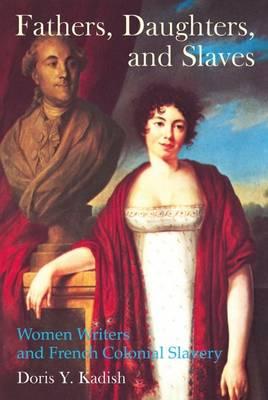
A powerful and important contribution to 19th century French studies as well as colonial/postcolonial and francophone studies. Doris Y. Kadish's book examines French women's writing on colonial slavery in the early nineteenth century, a period marked by the turbulent aftermath of the French and Haitian revolutions, the abolition of the Atlantic slave trade by the Congress of Vienna, and the collapse and resurgence of the French abolitionist movement. It builds on Kadish's earlier co-edited volume, Translating Slavery: Gender and Slavery in French Women's Writing, 1783-1823 (1994, 2009) and on her more recent editions of nineteenth-century French narratives bearing on colonial slavery: Marceline Desbordes-Valmore's Sarah (with Deborah Jenson) (2008); Charles de Remusat's Saint-Domingue Plantation (with Norman R. Shapiro (2008); Charlotte Dard's La Chaumiere africaine (2005) and Sophie Doin's La Famille noire suivie de trois Nouvelles blanches et noires (2002).[1] Collectively, these publications represent an important contribution to research on the history and literature of race and slavery, the interconnections of the French and Haitian Revolutions, and the emergence of transcontinental francophone culture. Fathers, Daughters, and Slaves examines the lives and work of five women who wrote about slavery in genres including fiction, poetry, political essays, travel narratives and memoirs. Three of them (Germaine de Stael, Marceline Desbordes-Valmore and Claire de Duras) are well known literary figures, or at least writers whose work has become widely known as a result of the ""canon revision"" undertaken by feminist scholars. The other two (Charlotte Dard and Sophie Doin) are more obscure. Each had some kind of personal connection to the colonial world. Dard, Doin and Desbordes-Valmore's stories in particular capture what Linda Colley has called the 'underbelly of empire': the hardships and traumas experienced by settlers from the lower social orders.[2] Dard, for example, was a survivor of the notorious wreck of the Medusa, which ran aground off the coast of West Africa in 1816 while transporting people and goods for the recolonization of Senegal (the colony was seized by the British in 1809 but returned to France in 1815). She ultimately spent several years in West Africa, where she put in strenuous physical labor on a cotton plantation and later became a teacher. At sixteen the poet Marceline Desbordes-Valmore spent a short and traumatic few months in Guadeloupe, where she traveled with her mother, an actress who hoped to find work in the colonial theater. They arrived in 1802 in the midst of both a slave uprising and a yellow fever epidemic to which her mother quickly succumbed, leaving her to return across the Atlantic alone. Later, Desbordes-Valmore translated her Caribbean experience into literature. She wrote ""Creole"" poems, imitating songs she had heard during her travels. Claire de Duras, the liberal aristocrat and influential salonniere who wrote the powerful novella Ourika (1823), also traveled to the Americas as a young woman. In the wake of her father's execution during the Terror, she accompanied her mother to Philadelphia. The two women reconnected with her mother's Saint-Domingue family and reclaimed a portion of their colonial inheritance. These various stories make for fascinating reading and illustrate the value of integrated approaches to colonial, metropolitan, and literary history. Kadish performs a valuable task in bringing them to light and inviting further reflection on French women's involvement with empire and slavery. She also deserves credit for bringing early nineteenth-century French women's writing about slavery and race into dialogue with the perspectives of colonized writers. Adopting Edward Said's principle of ""contrapuntal reading,"" she reads Stael's Caractere de M. Necker alongside the Memoires d'Isaac Louverture, fils de Toussaint, two works of filial piety in which hostility to Napoleon is an important thread.[3] She considers how contemporary writers from the Caribbean, e.g. Daniel Maximin and Maryse Conde, have responded to texts such as Ourika.[4] As these paired readings illustrate, colonial slavery created the conditions for a decentered and creolized francophone literary tradition that flourishes today. But while there is much of interest in this book, there are also some significant weaknesses. These include an overall lack of historical and intellectual contextualization-works are read individually, without much attention to the ways in which they express or depart from wider cultural and political currents-and inadequate conceptualization of the project's feminist approach. As the book's title suggests, Kadish foregrounds the role of father-daughter relations in shaping nineteenth-century French women writers' response to slavery. Several of her subjects were extremely close to their fathers and wished either to emulate their political example, including their antislavery leanings, or to defend them against criticisms and accusations. At the same time they rejected what they saw as illegitimate patriarchal authority, including, in some instances, the power exercised by colonial officials. As gender theory and psychoanalysis have shown, it is important to consider how social/political issues are entwined with personal and family dynamics. Nonetheless, this form of interpretation also calls for caution. There is, for one thing, a well-known tendency to focus more on personal factors when considering female writers and historical figures. Could we imagine a parallel study on how abolitionist men felt about fathers (or for that matter mothers)? Since the focus on paternal influence goes, at least on the surface of things, against the grain of a feminist approach, one might anticipate a robust defense of this methodology. Instead, Kadish invests in the opposition between ""good"" and ""bad"" fathers-antislavery fathers who should be emulated (as Stael perceived her father, Necker) and authoritarian figures whose power and influence should be overturned (Stael's view of Napoleon). This polarity, however, overlooks essential issues such as the limitations of benevolent paternalism as a framework for opposition to slavery. A second problem lies in the presumption of congruence between the experience of women subordinated to paternal authority and the lives of people enslaved in French colonies. In her previous book, Translating Slavery, Kadish and her co-authors argued that women writers were more sensitive to the plight of slaves and more open to human diversity than their male counterparts because they had themselves experienced marginalization and oppression. This claim is called into question by Christopher L. Miller, who argued in his 2007 book, French Atlantic Triangle, that French women did not write earlier or more about slavery than male authors and that the work of Stael and other female antislavery writers manifested the same Europeanizing and assimilationist tendencies as that of men.[5] Though a short response to Miller is included in the 2009 re-edition of Translating Slavery, Kadish does not comment further on this issue in Fathers, Daughters, and Slaves. This is surprising given that in this study she argues not only that women felt empathy for slaves but also that they experienced similar forms of domination. She states at one point, for example, that ""The life of Marceline Desbordes Valmore provides a striking instance of the congruence of fathers, daughters and slaves"" (p. 80). At another she comments (perhaps more ambiguously) that ""It says something about the condition of women that it has been so easy for critics to put an aristocratic woman such as Duras in the place of the slave!"" (p. 107). Kadish states in the book's Introduction that the texts she examines ""remind us of the imperative for ever-renewed gender and feminist research in the colonial archive"" (p. 1). It is clearly important to consider how gender impacts both historical situations and scholarly practices. But it is also necessary to reflect critically on the deployment of gender. Scholars including Jennifer L. Morgan have argued that gender is not always a useful category of analysis to apply to slavery.[6] In company with scholars in many other fields, she points to Liberal feminism's propensity to approach gender as a stable and uniform category, thereby erasing differences of class, culture, religion and racial identity. This tendency is unfortunately much in evidence in Fathers, Daughters, and Slaves. In the chapter on Claire de Duras, for example, Kadish explains that she wants to show ""what we can learn from listening to the voices of women and blacks, while also measuring the significant extent to which patriarchal authority remains intact in Duras's world"" (p. 104). Should the voices of ""blacks"" and ""women"" automatically be placed on the same footing (assuming, contra Spivak, that the voices of enslaved subalterns can in fact be heard)?[7] Did French women across various social classes share the same concerns with regard to patriarchal authority as slaves? Though the issue of marriage and slavery is certainly a legitimate topic of historical research, I feel uncomfortable with Kadish's claim that Duras's protagonist Ourika escapes the fate of patriarchal marriage that was forced upon French women (p. 116). Since Ourika dies feeling unloved and unlovable, believing that her black skin makes marriage and a family impossible, it seems hard to view her as an embodiment of feminist escape from matrimony. Although several of the core concepts deployed in Fathers, Daughters, and Slaves, including ""sentimentality"" and ""empathy,"" have been subject to intense scrutiny, the difficulties associated with them are not accorded much attention. Kadish follows Naomi Schor and Margaret Cohen in arguing for a revaluation of ""sentimental"" writing, which, since the mid nineteenth century, has been widely associated with women writers and largely dismissed as aesthetically insignificant.[8] Acknowledging the gender politics of literary history does not, however, evacuate questions about the use of the sentimental register in representations of slavery. In fact, both men and women used sentimental narrative to draw attention to the plight of the slave. It was typically imbued with a paternalistic outlook that emphasized the benevolence of white Europeans while neglecting the capacity for agency of slaves themselves. We hear echoes of this attitude near the end of Kadish's book, when she observes that a portrait of Stael standing next to a bust of Necker conveys ""The message of sentimentalism, benevolence, and empathy that this book has sought to illustrate: she is a mother and defender of those below her including slaves. Above all, she is a daughter"" (p. 159). Several scholars have argued that sentimental antislavery writing should not be read on its own terms. Jonathan Lamb, for example, proposes that sentimentality and poignancy operated less as contestations of the injustice of slavery than as justifications of the sentimental slave owner and the affective bond between owner and chattel.[9] In my own work on sentimentalism and slavery, I argue that sentimental depictions of slaves, whether authored by men or by women, were consistently interwoven with a Liberal economic outlook that condemned slavery while promoting renewed colonial expansion in Africa, a vision is exemplified by Stael's short story, Mirza (published in 1795 but written before the Revolution). [10] Fathers, Daughters, and Slaves explores a fascinating corpus of texts that straddle French and colonial history. It contains many wonderfully narrated passages that convey Kadish's commitment to telling the story of empire ""from below,"" that is, from the point of view of female actors and witnesses who were on many levels obscure and vulnerable. But it would have benefitted from greater analytical and historical precision and from an effort to engage with current scholarship on feminism and social and cultural difference. NOTES [1] Doris Y. Kadish and Francoise Massardier-Kenney eds., Translating Slavery: Gender and Slavery in French Women's Writing, 1783-1823 (Kent, OH: Ohio State University Press, 1994, 2009), Sophie Doin, La Famille noire, suivie de trois Nouvelles blanches et noire, ed. Doris Kadish (Paris: L'Harmattan, 2002); Charlotte Dard, La Chaumiere africaine, ed. Doris Kadish (Paris: L'Harmattan, 2005); Marceline Desbordes-Valmore, Sarah, eds. Doris Y. Kadish and Deborah Jenson (New York: Moden Language Association, 2008); Charles de Remusat, Saint-Domingue Plantation, or, The Insurrection, eds. Doris Y. Kadish and Norman R. Shapiro (Baton Rouge: Louisiana State University Press, 2008). [2] Linda Colley, Captives: Britain, Empire and the World, 1600-1850 (London: Jonathan Cape, 2002). [3] Edward W. Said, Culture and Imperialism (London: Vintage, 1993). [4] See Maryse Conde, La Parole des femmes (Paris : L'Harmattan, 1979) and the same author's La migration des coeurs (Paris : Robert Laffont, 1995); and Daniel Maximin, L'Isole soleil (Paris : Seuil, 1981). [5] Christopher L. Miller, The French Atlantic Triangle (Durham: Duke University Press, 2007). [6] Jennifer L. Morgan, Laboring Women: Reproduction and Gender in New World Slavery (Philadelphia: University of Pennsylvania Press, 2004). [7] Gayatri Chakravorty Spivak, ""Can the Subaltern Speak,"" in Cary Nelson and Lawrence Grossberg, eds., Marxism and the Interpretation of Culture (London: Macmillan, 1988). [8] Naomi Schor, George Sand and Idealism (New York: Columbia University Press, 1993) and Margaret Cohen, The Sentimental Education of the Novel (Princeton: Princeton University Press, 1999). [9] Jonathan Lamb, ""Modern Metamorphoses and Disgraceful Tales,"" Critical Inquiry 28:1 (2001), 133-166. [10] Madeleine Dobie, Trading Places: Colonization and Slavery in Eighteenth-Century French Culture (Ithaca: Cornell University Press, 2010). Fathers, Daughters, and Slaves explores a fascinating corpus of texts that straddle French and colonial history. It contains many wonderfully narrated passages that convey Kadish's commitment to telling the story of empire ""from below"". Fathers, Daughters, and Slaves offers a feminist reflection that showcases French women's voices forgotten amid the praise of their more celebrated male counterparts. Doris Kadish questions the ""historical neglect"" of women in French and Francophone studies, investigating the French colonial empire and the Atlantic world before and after the French Revolution, from the 1780s to the 1820s. She interrogates the omnipresent father figure in the works and lives of three canonical writers-Germaine de Stael, Claire de Duras, and Marceline Desbordes-Valmore-and two lesser-known but important figures, Charlotte Dard and Sophie Doin. She probes their sentimental discourse around the search for a legitimate father figure to serve as a political tool following the French Revolution and contends that their empathy toward the oppressed, black slaves, or other subjected colonial subjects, breaks down patriarchal discourse through their representations of family life and slavery. Kadish connects these ""women writers' sensitivity to broader issues such as memory, hybridity, creolization, identity formation, and the ideological implications of pity, paternalism, and sentimental discourse"" (p. 7). They may not have directly challenged the patriarchal order, but their sentimental literature offers a counter-discourse to such colonial representations as those found in Victor Hugo's Bug-Jagal or Prosper Merimee's Tamango. These women faced the dwindling power of their biological fathers, and dealt in their writing with symbolic paternal figures through the notions of the benevolent and irresponsible patriarchs. Indeed, Rousseau's Julie and Bernadin de St Pierre's Paul et Virginie stand as the favored intertext in the feminine sentimental literature around paternal authority, women's autonomy, race relations, and abolitionism. Yet this empathy with the plight of black slaves, which echoes women's subjection, stems from a place of privilege. Eventually, Kadish wonders how these writers navigated social dictates to propose their own views of abolition and femininity and asks how their feminine subjectivity could organize itself around paternal figures. To answer this question, she contrasts white feminine authors to black writers in the nineteenth- and twentiethcenturies who address the same themes. This contrapuntal approach reveals the women's agency and commitment to both race and gender issues. The book's introduction adopts a cross-disciplinary approach to questions of subservience and agency. Kadish draws on the work of feminist scholars such as historian Gerda Lerner to assert the historical links among slavery, patriarchy, and the subordination of women. Postcolonial critics such as Edward Said influence her interrogation of discursive formations around race, gender, and agency, illustrating how cultures shape writers and writers shape cultures. Chapter 1, ""Patriarchy and Abolition,"" puts Germaine de Stael's work and Isaac Louverture's defense of his father in dialogue. In their texts, the imagery of tyrannical patriarchs such as Napoleon Bonaparte that negatively affect the condition of women and slaves is at odds with good paternal figures. Chapter 2, ""Fathers and Colonization,"" complicates interactions between father figures and their daughters in colonial Africa. Charlotte Dard's rehabilitation of her father in postrevolutionary French history destabilizes the literary representations of the sexual politics around signares. These African women, often biracial paramours of affluent European patriarchs such as Dard's father and husband, come to symbolize a problematic mixing of cultures that questions European colonialism and sexism. Chapter 3, ""Daughters and Paternalism,"" concentrates on Marceline Desbordes-Valmore's 1820s corpus about slavery. This actress who lives precariously empathizes with the oppressed slaves. Her praise of ""maternal"" fathers and her critique of despotic paternal figures construct a problematic feminine empowerment and subjectivity associated with the black condition. Here, Desbordes-Valmore's work and life enter into conversation with literary representations by Minette, a celebrated mixed-race actress from Saint-Domingue. Chapter 4, ""Voices of Daughters and Slaves,"" opens with a discussion of Claire de Duras's life and novel Ourika, which Kadish compares to Henriette de la Tour Dupin's works. It closes with an examination of the way twentieth-century Caribbean writers have read Duras and underscores Aime Cesaire's lack of empathy toward this female writer, contrary to Maryse Conde and Daniel Maximin. Chapter 5, ""Uniting Black and White Family,"" examines the theme of unity within the marital sphere through the association of women's conditions and black experience in Sophie Doin's abolitionist corpus and autobiographical writings. Then, Doin's texts are contrasted to those of black Caribbean artists Guillaume Guillon-Lethiere and Juste Chanlatte to reveal the exclusion of women in their fight for equality. The postscript contrasts Anne-Louis Girodet's Portrait du citoyen Belley, ex-representant des colonies to the painting Mme de Stael a cote du buste de son pere Jacques Necker, attributed to Firmin Massot. This intriguing comparison denotes the textual power of painted representations and insists on the diversity of the literary constructions of fathers, daughters, and slaves. Kadish's study proves that white women's sentimental literature contributed to the larger discourse about race, colonialism, and gender. The perspective of nineteenth-century black writers shows that their main concern was race and not gender equality, an issue white men also neglected. Envisioning the story of slavery by accounting for white women writers' empathy alone might have led one to conclude that black voices were unable to talk about their own experience. Adding twentieth-century novels to this study allows Kadish to show how representations of fathers, daughters, and slaves have been revisited and how acknowledging feminine contributions remains problematic. Yet, the claim that ""neo-slave narratives such as Maximin's are especially important since no authentic slave narratives have survived in the Francophone world"" (p. 17) might be seen as contentious. Fictional narratives such as L'isole soleil, no matter how enlightening in their promotion of gender equality and racial pride, should not overshadow other avenues through which black slaves and their descendants expressed their concern and agency in the nineteenth century, such as essays, pamphlets, or court proceedings, even if this means grappling with the alleged sexism of these documents. That said, Fathers, Daughters, and Slaves is a valuable contribution to scholars committed to illuminating the gender issues at play in the understanding of white and black women in the French and Francophone colonial and postcolonial world. Fathers, Daughters, and Slaves is a valuable contribution to scholars committed to illuminating the gender issues at play in the understanding of white and black women in the French and Francophone colonial and postcolonial world.
A powerful and important contribution to 19th century French studies as well as colonial/postcolonial and francophone studies. -- Professor Deborah Jenson, Co-Director, Haiti Humanities Laboratory Doris Y. Kadish's book examines French women's writing on colonial slavery in the early nineteenth century, a period marked by the turbulent aftermath of the French and Haitian revolutions, the abolition of the Atlantic slave trade by the Congress of Vienna, and the collapse and resurgence of the French abolitionist movement. It builds on Kadish's earlier co-edited volume, Translating Slavery: Gender and Slavery in French Women's Writing, 1783-1823 (1994, 2009) and on her more recent editions of nineteenth-century French narratives bearing on colonial slavery: Marceline Desbordes-Valmore's Sarah (with Deborah Jenson) (2008); Charles de Remusat's Saint-Domingue Plantation (with Norman R. Shapiro (2008); Charlotte Dard's La Chaumiere africaine (2005) and Sophie Doin's La Famille noire suivie de trois Nouvelles blanches et noires (2002).[1] Collectively, these publications represent an important contribution to research on the history and literature of race and slavery, the interconnections of the French and Haitian Revolutions, and the emergence of transcontinental francophone culture. Fathers, Daughters, and Slaves examines the lives and work of five women who wrote about slavery in genres including fiction, poetry, political essays, travel narratives and memoirs. Three of them (Germaine de Stael, Marceline Desbordes-Valmore and Claire de Duras) are well known literary figures, or at least writers whose work has become widely known as a result of the canon revision undertaken by feminist scholars. The other two (Charlotte Dard and Sophie Doin) are more obscure. Each had some kind of personal connection to the colonial world. Dard, Doin and Desbordes-Valmore's stories in particular capture what Linda Colley has called the 'underbelly of empire': the hardships and traumas experienced by settlers from the lower social orders.[2] Dard, for example, was a survivor of the notorious wreck of the Medusa, which ran aground off the coast of West Africa in 1816 while transporting people and goods for the recolonization of Senegal (the colony was seized by the British in 1809 but returned to France in 1815). She ultimately spent several years in West Africa, where she put in strenuous physical labor on a cotton plantation and later became a teacher. At sixteen the poet Marceline Desbordes-Valmore spent a short and traumatic few months in Guadeloupe, where she traveled with her mother, an actress who hoped to find work in the colonial theater. They arrived in 1802 in the midst of both a slave uprising and a yellow fever epidemic to which her mother quickly succumbed, leaving her to return across the Atlantic alone. Later, Desbordes-Valmore translated her Caribbean experience into literature. She wrote Creole poems, imitating songs she had heard during her travels. Claire de Duras, the liberal aristocrat and influential salonniere who wrote the powerful novella Ourika (1823), also traveled to the Americas as a young woman. In the wake of her father's execution during the Terror, she accompanied her mother to Philadelphia. The two women reconnected with her mother's Saint-Domingue family and reclaimed a portion of their colonial inheritance. These various stories make for fascinating reading and illustrate the value of integrated approaches to colonial, metropolitan, and literary history. Kadish performs a valuable task in bringing them to light and inviting further reflection on French women's involvement with empire and slavery. She also deserves credit for bringing early nineteenth-century French women's writing about slavery and race into dialogue with the perspectives of colonized writers. Adopting Edward Said's principle of contrapuntal reading, she reads Stael's Caractere de M. Necker alongside the Memoires d'Isaac Louverture, fils de Toussaint, two works of filial piety in which hostility to Napoleon is an important thread.[3] She considers how contemporary writers from the Caribbean, e.g. Daniel Maximin and Maryse Conde, have responded to texts such as Ourika.[4] As these paired readings illustrate, colonial slavery created the conditions for a decentered and creolized francophone literary tradition that flourishes today. But while there is much of interest in this book, there are also some significant weaknesses. These include an overall lack of historical and intellectual contextualization-works are read individually, without much attention to the ways in which they express or depart from wider cultural and political currents-and inadequate conceptualization of the project's feminist approach. As the book's title suggests, Kadish foregrounds the role of father-daughter relations in shaping nineteenth-century French women writers' response to slavery. Several of her subjects were extremely close to their fathers and wished either to emulate their political example, including their antislavery leanings, or to defend them against criticisms and accusations. At the same time they rejected what they saw as illegitimate patriarchal authority, including, in some instances, the power exercised by colonial officials. As gender theory and psychoanalysis have shown, it is important to consider how social/political issues are entwined with personal and family dynamics. Nonetheless, this form of interpretation also calls for caution. There is, for one thing, a well-known tendency to focus more on personal factors when considering female writers and historical figures. Could we imagine a parallel study on how abolitionist men felt about fathers (or for that matter mothers)? Since the focus on paternal influence goes, at least on the surface of things, against the grain of a feminist approach, one might anticipate a robust defense of this methodology. Instead, Kadish invests in the opposition between good and bad fathers-antislavery fathers who should be emulated (as Stael perceived her father, Necker) and authoritarian figures whose power and influence should be overturned (Stael's view of Napoleon). This polarity, however, overlooks essential issues such as the limitations of benevolent paternalism as a framework for opposition to slavery. A second problem lies in the presumption of congruence between the experience of women subordinated to paternal authority and the lives of people enslaved in French colonies. In her previous book, Translating Slavery, Kadish and her co-authors argued that women writers were more sensitive to the plight of slaves and more open to human diversity than their male counterparts because they had themselves experienced marginalization and oppression. This claim is called into question by Christopher L. Miller, who argued in his 2007 book, French Atlantic Triangle, that French women did not write earlier or more about slavery than male authors and that the work of Stael and other female antislavery writers manifested the same Europeanizing and assimilationist tendencies as that of men.[5] Though a short response to Miller is included in the 2009 re-edition of Translating Slavery, Kadish does not comment further on this issue in Fathers, Daughters, and Slaves. This is surprising given that in this study she argues not only that women felt empathy for slaves but also that they experienced similar forms of domination. She states at one point, for example, that The life of Marceline Desbordes Valmore provides a striking instance of the congruence of fathers, daughters and slaves (p. 80). At another she comments (perhaps more ambiguously) that It says something about the condition of women that it has been so easy for critics to put an aristocratic woman such as Duras in the place of the slave! (p. 107). Kadish states in the book's Introduction that the texts she examines remind us of the imperative for ever-renewed gender and feminist research in the colonial archive (p. 1). It is clearly important to consider how gender impacts both historical situations and scholarly practices. But it is also necessary to reflect critically on the deployment of gender. Scholars including Jennifer L. Morgan have argued that gender is not always a useful category of analysis to apply to slavery.[6] In company with scholars in many other fields, she points to Liberal feminism's propensity to approach gender as a stable and uniform category, thereby erasing differences of class, culture, religion and racial identity. This tendency is unfortunately much in evidence in Fathers, Daughters, and Slaves. In the chapter on Claire de Duras, for example, Kadish explains that she wants to show what we can learn from listening to the voices of women and blacks, while also measuring the significant extent to which patriarchal authority remains intact in Duras's world (p. 104). Should the voices of blacks and women automatically be placed on the same footing (assuming, contra Spivak, that the voices of enslaved subalterns can in fact be heard)?[7] Did French women across various social classes share the same concerns with regard to patriarchal authority as slaves? Though the issue of marriage and slavery is certainly a legitimate topic of historical research, I feel uncomfortable with Kadish's claim that Duras's protagonist Ourika escapes the fate of patriarchal marriage that was forced upon French women (p. 116). Since Ourika dies feeling unloved and unlovable, believing that her black skin makes marriage and a family impossible, it seems hard to view her as an embodiment of feminist escape from matrimony. Although several of the core concepts deployed in Fathers, Daughters, and Slaves, including sentimentality and empathy, have been subject to intense scrutiny, the difficulties associated with them are not accorded much attention. Kadish follows Naomi Schor and Margaret Cohen in arguing for a revaluation of sentimental writing, which, since the mid nineteenth century, has been widely associated with women writers and largely dismissed as aesthetically insignificant.[8] Acknowledging the gender politics of literary history does not, however, evacuate questions about the use of the sentimental register in representations of slavery. In fact, both men and women used sentimental narrative to draw attention to the plight of the slave. It was typically imbued with a paternalistic outlook that emphasized the benevolence of white Europeans while neglecting the capacity for agency of slaves themselves. We hear echoes of this attitude near the end of Kadish's book, when she observes that a portrait of Stael standing next to a bust of Necker conveys The message of sentimentalism, benevolence, and empathy that this book has sought to illustrate: she is a mother and defender of those below her including slaves. Above all, she is a daughter (p. 159). Several scholars have argued that sentimental antislavery writing should not be read on its own terms. Jonathan Lamb, for example, proposes that sentimentality and poignancy operated less as contestations of the injustice of slavery than as justifications of the sentimental slave owner and the affective bond between owner and chattel.[9] In my own work on sentimentalism and slavery, I argue that sentimental depictions of slaves, whether authored by men or by women, were consistently interwoven with a Liberal economic outlook that condemned slavery while promoting renewed colonial expansion in Africa, a vision is exemplified by Stael's short story, Mirza (published in 1795 but written before the Revolution). [10] Fathers, Daughters, and Slaves explores a fascinating corpus of texts that straddle French and colonial history. It contains many wonderfully narrated passages that convey Kadish's commitment to telling the story of empire from below, that is, from the point of view of female actors and witnesses who were on many levels obscure and vulnerable. But it would have benefitted from greater analytical and historical precision and from an effort to engage with current scholarship on feminism and social and cultural difference. NOTES [1] Doris Y. Kadish and Francoise Massardier-Kenney eds., Translating Slavery: Gender and Slavery in French Women's Writing, 1783-1823 (Kent, OH: Ohio State University Press, 1994, 2009), Sophie Doin, La Famille noire, suivie de trois Nouvelles blanches et noire, ed. Doris Kadish (Paris: L'Harmattan, 2002); Charlotte Dard, La Chaumiere africaine, ed. Doris Kadish (Paris: L'Harmattan, 2005); Marceline Desbordes-Valmore, Sarah, eds. Doris Y. Kadish and Deborah Jenson (New York: Moden Language Association, 2008); Charles de Remusat, Saint-Domingue Plantation, or, The Insurrection, eds. Doris Y. Kadish and Norman R. Shapiro (Baton Rouge: Louisiana State University Press, 2008). [2] Linda Colley, Captives: Britain, Empire and the World, 1600-1850 (London: Jonathan Cape, 2002). [3] Edward W. Said, Culture and Imperialism (London: Vintage, 1993). [4] See Maryse Conde, La Parole des femmes (Paris : L'Harmattan, 1979) and the same author's La migration des coeurs (Paris : Robert Laffont, 1995); and Daniel Maximin, L'Isole soleil (Paris : Seuil, 1981). [5] Christopher L. Miller, The French Atlantic Triangle (Durham: Duke University Press, 2007). [6] Jennifer L. Morgan, Laboring Women: Reproduction and Gender in New World Slavery (Philadelphia: University of Pennsylvania Press, 2004). [7] Gayatri Chakravorty Spivak, Can the Subaltern Speak, in Cary Nelson and Lawrence Grossberg, eds., Marxism and the Interpretation of Culture (London: Macmillan, 1988). [8] Naomi Schor, George Sand and Idealism (New York: Columbia University Press, 1993) and Margaret Cohen, The Sentimental Education of the Novel (Princeton: Princeton University Press, 1999). [9] Jonathan Lamb, Modern Metamorphoses and Disgraceful Tales, Critical Inquiry 28:1 (2001), 133-166. [10] Madeleine Dobie, Trading Places: Colonization and Slavery in Eighteenth-Century French Culture (Ithaca: Cornell University Press, 2010). -- Madeleine Dobie H-France Review Vol. 13, No. 192 201312 Fathers, Daughters, and Slaves explores a fascinating corpus of texts that straddle French and colonial history. It contains many wonderfully narrated passages that convey Kadish's commitment to telling the story of empire from below . H-France Review Vol. 13, No. 192 201312
A powerful and important contribution to 19th century French studies as well as colonial/postcolonial and francophone studies. -- Professor Deborah Jenson, Co-Director, Haiti Humanities Laboratory