Overview
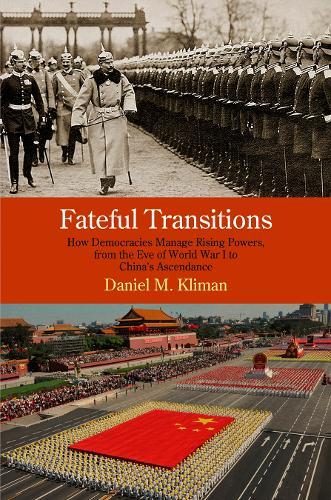
As China emerges as a global force in the twenty-first century, questions of how existing great powers will navigate the geopolitical transition loom large. In Fateful Transitions, Daniel M. Kliman revisits historic power shifts to shed light on enduring patterns in international relations, demonstrating that the regime type of ascendant powers greatly influences global interactions. Since the late nineteenth century, the world's major democracies have tended to accommodate or conciliate ascendant democratic states. Certain attributes of democracy, such as a free press and domestic checks and balances, encourage trust during power shifts, whereas closed and autocratic regimes on the ascent tend to produce a cycle of suspicion, competition, and confrontation. Drawing on democratic peace theory and power transition theory, Kliman compares Great Britain's embrace of U.S. ascendancy in the early twentieth century to its confrontational stance toward autocratic Germany and later U.S. mistrust of the Soviet Union. Within this geopolitical context, he evaluates the interactions between China and current great powers, the United States and Japan. Building on this analysis, Kliman offers new insights into the dynamics of power shifts and explores their implications for how today's established and emerging powers can successfully navigate fateful transitions.
Full Product Details
Author: Daniel M. Kliman
Publisher: University of Pennsylvania Press
Imprint: University of Pennsylvania Press
Dimensions:
Width: 15.20cm
, Height: 2.00cm
, Length: 22.90cm
Weight: 0.499kg
ISBN: 9780812246537
ISBN 10: 0812246535
Pages: 248
Publication Date: 28 November 2014
Audience:
College/higher education
,
Tertiary & Higher Education
Format: Hardback
Publisher's Status: Active
Availability: Out of stock

The supplier is temporarily out of stock of this item. It will be ordered for you on backorder and shipped when it becomes available.
Reviews
Nothing will be more important to twenty-first century strategy than a global approach to managing the rise of both China and India as their economies and strategic options increase. The wisdom and history in Fateful Transitions is a good place to start. -Admiral James Stavridis, Dean of The Fletcher School of Law and Diplomacy at Tufts University
Nothing will be more important to twenty-first-century strategy than a global approach to managing the rise of both China and India as their economies and strategic options increase. The wisdom and history in Fateful Transitions are a good place to start. -Admiral James Stavridis, Dean of The Fletcher School of Law and Diplomacy at Tufts University This is an important book leveraging history to understand the problem of declining U.S. hegemony and a rising China. With its lucid writing style and accessible approach, Fateful Transitions should have wide appeal for scholars, students, and policymakers. It may well be the best book on relations among the great powers in the coming global transition. -Bruce Russett, Yale University How do democracies respond to the emergence of new great powers? Daniel Kliman's timely, informative, and persuasive new book shows that the answer depends on a rising state's domestic political system. Fast-growing powers that are transparent and open will be less threatening to other democracies than closed and secretive authoritarian regimes. This finding has important and potentially troubling implications for China's future relations with the United States, Japan, and the world's other major democracies. -Aaron L. Friedberg, Princeton University
""Katagiri's excellent study joins a growing body of literature that tries to explain how non-state actors defeat powerful nation-state opponents in asymmetric contests. Adapting to Win is unique in its approach."" * <i>Choice</i> * ""Nothing will be more important to twenty-first-century strategy than a global approach to managing the rise of both China and India as their economies and strategic options increase. The wisdom and history in Fateful Transitions are a good place to start."" * Admiral James Stavridis, Dean of The Fletcher School of Law and Diplomacy at Tufts University * ""This is an important book leveraging history to understand the problem of declining U.S. hegemony and a rising China. With its lucid writing style and accessible approach, Fateful Transitions should have wide appeal for scholars, students, and policymakers. It may well be the best book on relations among the great powers in the coming global transition."" * Bruce Russett, Yale University * ""How do democracies respond to the emergence of new great powers? Daniel Kliman's timely, informative, and persuasive new book shows that the answer depends on a rising state's domestic political system. Fast-growing powers that are transparent and open will be less threatening to other democracies than closed and secretive authoritarian regimes. This finding has important and potentially troubling implications for China's future relations with the United States, Japan, and the world's other major democracies."" * Aaron L. Friedberg, Princeton University *
Nothing will be more important to twenty-first-century strategy than a global approach to managing the rise of both China and India as their economies and strategic options increase. The wisdom and history in Fateful Transitions are a good place to start. -Admiral James Stavridis, Dean of The Fletcher School of Law and Diplomacy at Tufts University This is an important book leveraging history to understand the problem of declining U.S. hegemony and a rising China. With its lucid writing style and accessible approach, Fateful Transitions should have wide appeal for scholars, students, and policymakers. It may well be the best book on relations among the great powers in the coming global transition. -Bruce Russett, Yale University Katagiri's excellent study joins a growing body of literature that tries to explain how non-state actors defeat powerful nation-state opponents in asymmetric contests. Adapting to Win is unique in its approach. -CHOICE How do democracies respond to the emergence of new great powers? Daniel Kliman's timely, informative, and persuasive new book shows that the answer depends on a rising state's domestic political system. Fast-growing powers that are transparent and open will be less threatening to other democracies than closed and secretive authoritarian regimes. This finding has important and potentially troubling implications for China's future relations with the United States, Japan, and the world's other major democracies. -Aaron L. Friedberg, Princeton University
Nothing will be more important to twenty-first century strategy than a global approach to managing the rise of both China and India as their economies and strategic options increase. The wisdom and history in Fateful Transitions is a good place to start. -Admiral James Stavridis, Dean of The Fletcher School of Law and Diplomacy at Tufts University This is an important book leveraging history to understand the problem of declining U.S. hegemony and a rising China. With its lucid writing style and accessible approach, Fateful Transitions should have wide appeal for scholars, students, and policymakers. It may well be the best book on relations among the great powers in the coming global transition. -Bruce Russett, Yale University How do democracies respond to the emergence of new great powers? Daniel Kliman's timely, informative, and persuasive new book shows that the answer depends on a rising state's domestic political system. Fast-growing powers that are transparent and open will be less threatening to other democracies than closed and secretive authoritarian regimes. This finding has important and potentially troubling implications for China's future relations with the United States, Japan and the world's other major democracies. -Aaron L. Friedberg, Princeton University
Author Information
Daniel M. Kliman is Senior Adviser for Asia at the German Marshall Fund of the United States and a fellow at the Truman National Security Project.