|
|
|||
|
||||
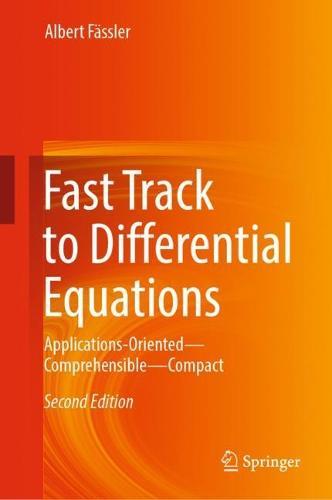
OverviewThe second edition of this successful textbook includes a significantly extended chapter on Climate Change with an analysis of the CO2 budget. It also contains a completely new part on Epidemiology, treating the SEIR-model which describes the behavior and dynamics of epidemics. In particular, COVID-19 with actual data is discussed. This compact introduction to ordinary differential equations and their applications is aimed at anyone who in their studies is confronted voluntarily or involuntarily with this versatile subject. Numerous applications from physics, technology, biomathematics, cosmology, economy and optimization theory are given. Abstract proofs and unnecessary formalism are avoided as far as possible. The focus is on modelling ordinary differential equations of the first and second orders as well as their analytical and numerical solution methods, in which the theory is dealt with briefly before moving on to application examples. In addition, program codes show exemplarily how even more challenging questions can be tackled and represented meaningfully with the help of a computer algebra system. The first chapter deals with the necessary prior knowledge of integral and differential calculus. 103 motivating exercises together with their solutions round off the work. “I am happy to see such a book. It will serve as a support for many students, professors and faculty.” Dr. Alessio Figalli, Professor at the ETH Zürich and Fields medalist 2018 Full Product DetailsAuthor: Albert FässlerPublisher: Springer Nature Switzerland AG Imprint: Springer Nature Switzerland AG Edition: Second Edition 2021 Dimensions: Width: 15.50cm , Height: 1.40cm , Length: 23.50cm Weight: 0.524kg ISBN: 9783030834494ISBN 10: 3030834492 Pages: 221 Publication Date: 05 October 2021 Audience: Professional and scholarly , Professional & Vocational Format: Hardback Publisher's Status: Active Availability: Manufactured on demand We will order this item for you from a manufactured on demand supplier. Language: German Table of ContentsReviewsAuthor InformationAlbert Fässler studied mathematics at the ETH Zürich (after a bachelor’s degree in mechanical engineering) and received his doctorate in 1976 with a thesis on Applied Group Theory. In addition to his teaching activities at the ETHZ and his many years of teaching at the Bern University of Applied Sciences, he has always been internationally active - sabbaticals have taken him to the USA and China. Since his retirement, he has repeatedly taught in China, India and Switzerland. He is a co-author of the book entitled Group Theoretical Methods and Their Applications. Tab Content 6Author Website:Countries AvailableAll regions |
||||