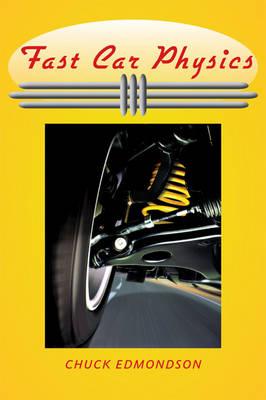
Fast Car Physics

Author:   Chuck Edmondson (United States Naval Academy, Stop 9c)
Publisher:   Johns Hopkins University Press
ISBN:  

9780801898235


Pages:   248
Publication Date:   26 April 2011
Recommended Age:   From 17
Format:   Paperback
Availability:   Available To Order   Availability explained
We have confirmation that this item is in stock with the supplier. It will be ordered in for you and dispatched immediately.

Our Price $74.99 Quantity:  
Add to Cart

Share |

Fast Car Physics


Overview

Full Product Details

Author:   Chuck Edmondson (United States Naval Academy, Stop 9c)
Publisher:   Johns Hopkins University Press
Imprint:   Johns Hopkins University Press
Dimensions:   Width: 15.20cm , Height: 1.50cm , Length: 22.90cm
Weight:   0.340kg
ISBN:  

9780801898235


ISBN 10:   0801898234
Pages:   248
Publication Date:   26 April 2011
Recommended Age:   From 17
Audience:   Professional and scholarly ,  Professional and scholarly ,  Professional & Vocational ,  Professional & Vocational
Format:   Paperback
Publisher's Status:   Active
Availability:   Available To Order   Availability explained
We have confirmation that this item is in stock with the supplier. It will be ordered in for you and dispatched immediately.

Table of Contents

Preface Acknowledgments 1. Torque or Horsepower? Finding the Shift Points 1.1. Acceleration and Newton's Second Law 1.2. Velocity, Speed, Rotation, and Engine rpm 1.3. The Car, Horsepower, and Torque 1.4. Tire Markings 1.5. Calculations 1.6. First Gear, It's All Right. Second Gear . . . 1.7. Summary 2. Horsepower, 0 to 60 mph, and the Quarter Mile 2.1. Horsepower 2.2. How Does Drag Force Affect Shift Points? 2.3. Gear Ratios 2.4. Calculating 0 to 60 mph Times 2.5. Assumptions and Results 2.6. What Is the Limit for 0 to 60 mph? 2.7. Aerodynamic Drag 2.8. Correction Factors 2.9. The Quarter Mile 2.10. Flat Torque Curves 2.11. Top Fuel Dragsters 2.12. Summary 3. Finding the Racing Line: Road Racing 3.1. The Traction Circle 3.2. Ninety Degree Right-Hand Turn 3.3. General Turn 3.4. Constructing a Track Model 3.5. Types of Turns 3.6. Type 1 Turn 3.7. Type 2 Turn 3.8. Type 3 Turn 3.9. Turning While Speeding Up 3.10. Summary 4. Basic Vehicle Dynamics: Load Transfer and Tires 4.1. Center of Gravity 4.2. Longitudinal and Lateral Center of Gravity 4.3. Height of the Center of Gravity 4.4. Load Transfer and the Static Stability Factor 4.5. Tires and Forces 4.6. Tire Construction 4.7. Wheels 4.8. Tires under Static Load 4.9. Tires under Dynamic Load 4.10. Contact Patch Friction 4.11. Material Properties and Testing 4.12. Longitudinal Force and Longitudinal Slip 4.13. Lateral Force and the Slip Angle 4.14. Aligning Torque 4.15. Summary 5. Steering and Suspension 5.1. More on Steering 5.2. Bicycle Model: Oversteer and Understeer 5.3. Wheel Alignment 5.4. Suspension Basics 5.5. Double A-arm or Wishbone Suspension 5.6. MacPherson Strut Suspension 5.7. NASCAR-Type Solid Rear Axle 5.8. Springs and Dampers 5.9. Shock Absorbers 5.10. Lateral Load Transfer: Advanced Approach 5.11. Correcting Handling Problems 5.12. Understeer Correction 5.13. Oversteer Correction 5.14. Summary 6. Green Racing 6.1. What Is Green Racing? 6.2. Regenerative Braking 6.3. Mechanical Energy Storage: Flywheels 6.4. Mechanical Energy Storage: Batteries 6.5. Mechanical Energy Storage: Capacitors 6.6. What Type of Hybrid Is It? 6.7. Parallel Configuration Hybrid: Toyota Prius 6.8. All-Electric Vehicles 6.9. Fuel Cells 6.10. Alternative Fuels 6.11. Summary Conclusion Get Off the Streets and Go Racing! Suggested Reading Index

Reviews

You don't have to be an engineer to build a fast race car but that certainly helps. Fast Car Physics helps enthusiasts apply the knowledge they gained in high school and college physics courses to the operation and tuning of a track car. Best of all, he does it in a clear and easy-to-follow manner. Grassroots Motorsports 2011 Fans of fast wheels and science alike will get a charge from this look at motor sports. Science News 2011 If motor racing and physics are your thing, you will love this book -- Ken Zetie Physics Education 2011


You don't have to be an engineer to build a fast race car but that certainly helps. Fast Car Physics helps enthusiasts apply the knowledge they gained in high school and college physics courses to the operation and tuning of a track car. Best of all, he does it in a clear and easy-to-follow manner. Grassroots Motorsports Fans of fast wheels and science alike will get a charge from this look at motor sports by a physicist and amateur race car driver. Science News If motor racing and physics are your thing, you will love this book. -- Ken Zetie Physics Education Editor's Pick. Fast Car Physics is an excellent book for understanding the science and engineering behind car racing. Choice A fine pick for any science of racing fan's collection! California Bookwatch The book functions well as a deep look into auto racing as well as a good description of applied physics. -- Mark Bollman Mathematical Association of American Online


Author Information

Chuck Edmondson is a professor of physics at the United States Naval Academy and an avid amateur race car driver. He was the engineer on the submarine filmed in The Hunt for Red October.

Tab Content 6

Author Website:  

Countries Available

All regions
Latest Reading Guide

NOV RG 20252


Shopping Cart
Your cart is empty
Shopping cart
Mailing List