Overview
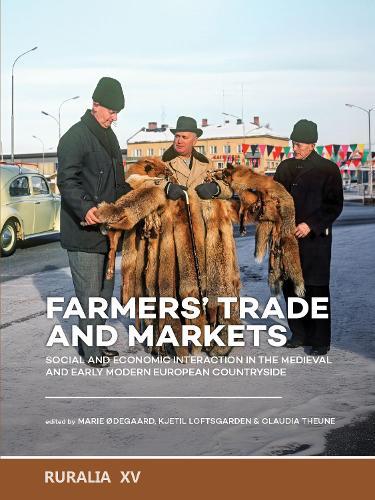
This volume brings together a series of case studies on the social and economic interaction and organisation in the medieval and early modern European countryside. In particular, it focuses on rural and smaller trade and markets that have remained relatively underexposed so far. It provides comprehensive presentations of new research on rural socio-economic interactions and networks, and how these are integrated into regional, trans-regional and even global exchange systems. The volume is characterised by an interdisciplinary scope and a broad geographical range, and provides new insights into the diversities and complexities of trade and rural landscape organisation. The exchange of goods and services were integrated in cultural patterns and social strategies, which were part of the mechanisms of regionalisation and the formation of common cultures and identities. Markets and trading places were also important in terms of noneconomic aspects of society, with different types of social ties and networks, all essential components for dissemination of innovation and ideas. The volume investigates who benefitted, and who controlled the trade. The more or less unresolved question of how we can identify these smaller and informal trading places is a central topic of discussion in this volume. Presented research suggests a considerably higher complexity in social and economic organisations and networks in rural areas than has previously been assumed. Both on local and regional as well as temporal scales. Local and regional differences in organisation and trade networks can highlight different modes of social organisation. Recognising how rural trade and markets were organised, and why, is fundamental for an understanding of the complexities of societies and regional variations in Europe as a whole.
Full Product Details
Author: Marie Ødegaard ,
Kjetil Loftsgarden ,
Claudia Theune
Publisher: Sidestone Press
Imprint: Sidestone Press
ISBN: 9789464271331
ISBN 10: 9464271337
Pages: 376
Publication Date: 08 September 2025
Audience:
Professional and scholarly
,
Professional & Vocational
Format: Hardback
Publisher's Status: Active
Availability: In Print

This item will be ordered in for you from one of our suppliers. Upon receipt, we will promptly dispatch it out to you. For in store availability, please contact us.
Author Information
Marie Ødegaard is an associate professor at the Museum of Archaeology, University of Stavanger, with a focus on Iron Age and medieval archaeology. Research interests include settlement archaeology, assembly sites and state formation processes. She is currently project leader of Viking Beacons – militarism in northern Europe, granted by the Research Council Norway (2021-2025). Kjetil Loftsgarden is an associate professor at the Museum of Cultural History, University of Oslo. His main area of expertise is iron and iron production, trade, meeting- and marketplaces, as well as the societal consequences of climatic and environmental changes in Iron Age Scandinavia. He is currently leader of the project ‘Eidsborg rock – production and trade of whetstone in the Viking Age’ (2023-2027), funded by the Norwegian Research council. Claudia Theune is Professor of Historical Archaeology at the University of Vienna with a focus on contemporary archaeology, on medieval and post-medieval marginal landscapes and on early medieval funeral and social archaeology. She studied Prehistoric and Early Medieval Archaeology, Social Anthropology, Christian Archaeology and Geology at the Universities in Marburg and Bonn, Germany (1979-1988). In 1988 she received her PhD at the University of Marburg for her thesis on Early Medieval graves in the western part of the lake Constance published in 1999: Frühmittelalterliche Grabfunde im Hegau (Habelt: Bonn). She did her Habilitation in 2001 on the Changes of structures in the Alamannia on the basis of archaeological sources, published in 2004: Germanen und Romanen in der Alamannia (de Gruyter: Berlin, New York). In 1994 she became Assistant Professor at the Department of Prehistoric and Medieval Archaeology at the Humboldt-University, Berlin. Since 2007 she is Full Professor of Historical Archaeology at the University of Vienna, Department of Prehistoric and Historical Archaeology. Main Research Fields: Archaeology of the contemporary past: research projects in the former concentration camps, and sub-camps in Germany and Austria, and others sites of national socialist terror-sites in Europe; the material culture of internment camps. Medieval and post-medieval marginal landscapes. Early medieval funeral and social archaeology. Esteem factors: President of the European Association: RURALIA The Jean-Marie Pesez Conferences on Medieval Rural Archaeology (since 2014) and National Representative of Austria (since 2010). President of the Austrian Association for Medieval Archaeology (since 2012-2022). Dean of the Faculty Historical and Cultural Studies at the University of Vienna (2021-2018) Member of scientific boards: Deutscher Verband der Archäologen: Committee of experts: Archaeology of Modern times (Fachausschuss Archäologie der Moderne): 2015 – 2018 University of Brno: Archaeological committee Pohansko, 2013 – ongoing. Bezirkeshauptmannschaft Perg: Expert advisor for the National Socialist tunnel system in St. Georgen / Gusen „Bergkristall“ – Section Archaeology and Analyses of Aerial Photographs: 2014 – 2015. Peer reviewing activities for funding organizations: Czech Science Foundation / Grantová Agentura České Republiky; National Science Center Poland / Narodowe Centrum Nauki; Croatian Science Foundation / Hrvatska zaklada za znanost; Deutsche Forschungsgemeinschaft; Wissenschaftliche Kommission des Landes Niedersachsen; Bundesministerium für Bildung und Forschung, Berlin; Österreichische Nationalbank; National Geographic Society. Peer reviewer for several national and international journals. International scientific co-operations: Book-Project: Archaeology of Destruction. Investigations at Sóbibor; chapter: Sobibór in relation to archaeological research on sites of terror in a broader perspective and in connection with interdisciplinary scientific research (since 2022) Head of the working group: The Viennese barracks during the National Socialist era – the historical reappraisal of the barracks in the 2nd and 12th districts of Vienna (Heckenast-Burian-Kaserne and Erzherzog-Albrecht-Kaserne) (since 2022) Maly Trostenec, an extermination site in Belarus. Cooperation with the Geschichtswerkstatt Minsk, the University of Osnabrück (financed by Stiftung Erinnerung – Verantwortung – Zukunft) (2021-2023) Project: Archaeology and history of internment camps in the Caribbean: The Five Islands: (Trinidad and Tobago) / Camp Gibraltar (Jamaica). Cooperation with the University of the West Indies, Campus St. Augustine, Trinidad and Tobago; and Campus Mona, Jamaica (2015-2022) Recent key publications (see also academia.edu) Cl. Theune, Spuren von Krieg und Terror. Archäologische Forschungen an Tatorten des 20. Jahrhunderts (Böhlau: Wien 2020) J. Haubold-Stolle, Th. Kersting , Cl. Theune, Chr. Glauning, A. Riedle, Fr. Schopper, K. Wagner, A. Drecoll (eds), Exclusion. Archaeology of the Nazi internment camps (be.bra Verlag: Berlin 2020). Cl. Theune, Transformations in the Roman West. The case of the Alamanni. In: S. James / St. Kmnicek (eds), The Oxford Handbook of the Archaeology of Roman Germany (Oxford University Press: Oxford 2020) N. Brady / Cl. Theune (eds.), Settlement change across medieval Europe. Old paradigms and new vistas. (Sidestone Press: Leiden 2019) Cl. Theune, Climate change and economic development in the Alps during the Middle Ages and the early modern Period. In: N. Brady / Cl. Theune (eds.), Settlement change across Medieval Europe. Old paradigms and new vistas Ruralia XII. (Sidestone Press: Leiden 2019) 435-444. Cl. Theune, Local and global history on the Five Islands (Trinidad and Tobago): Cooperation between Austria and Trinidad and Tobago. In: The SHA Newsletter 52/3, 2019, 9-11. Cl. Theune, Iris Winkelbauer. Erinnerung an Maximilian I. auf Schloss Hanfelden in der Steiermark. In: Memo 4, 2019: Objekte der Erinnerung. Cl. Theune, A shadow of war (Sidestone Press: Leiden 2018). Chr. Bis-Worch, Cl. Theune, Religion, Cults & Rituals in the medieval rural environment. Ruralia XI (Sidestone Press: Leiden 2017). Th. Kersting / Cl. Theune / A. Drieschner / A. Ley / Th. Lutz, Archäologie und Gedächtnis. NS-Lagerstandorte: Erforschen – Bewahren – Vermitteln. Denkmalpflege in Berlin und Brandenburg, Arbeitsheft 4/2016. (Imhof-Verlag: Petersberg 2016) Cl. Theune, An der Grenze. Die spätmittelalterliche und frühneuzeitliche Burg Klausegg im Lungau. Museumsportal. Zeitschrift des Lungauer Museumsvereins 3 (2012-2014) (Selbstverlag: Tamsweg 2014). Cl. Theune, Archaeology and remembrance: the Contemporary Archaeology of Concentration camps, Prisoner-of-war-camps and Battlefields: In: N. Mehler (ed.), Historical Archaeology in Central Europe. Society of Historical Archaeology Special Publications (SHA: Rockville 2013) 241-260. Cl. Theune, Goldbergbau im Gasteiner Tal. In: Cl. Theune / G. Scharrer-Liška / E. H. Huber / Th. Kühtreiber (Hrsg.), Stadt – Land –Burg. Festschrift für Sabine Felgenhauer-Schmiedt zum 70. Geburtstag. (Marie-Leidorf-Verlag: Rahden / Westf. 2013) 395-404. Cl. Theune, Identity Establishing Heritage Sites? Memory, remembrance and commemoration at monuments and memorials. In: R. O’Ríagáin / C. N. Popa, Archaeology and the (de)construction of national and supra-national polities. Archaeological Review from Cambridge Vol. 27.2 November 2012, 161-177.