Overview
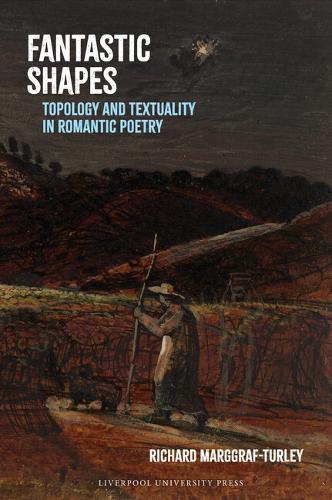
An exciting topological foray into Romantic textuality, Fantastic Shapes shows how poetic form participates in a broader reimagining of space and spatial relations at the turn of the nineteenth century. It reveals how the textual surface, far from being a passive carrier wave of content, emerges as an active, shaping force: a dynamic, self-reflexive site of meaning-making. Focusing on four poets – John Keats, Charlotte Smith, Percy Shelley and Felicia Hemans – the book engages with developments in non-Euclidean geometry to argue that far-reaching reconceptualizations of space not only form the backdrop to Romanticism’s challenge to classical order, but come to constitute that very challenge. This book’s wider aim is to offer fresh perspectives on key Romantic signatures: irony, fragmentation, non-orientability, recursion, and spatial paradox. These formal tendencies, Richard Marggraf-Turley argues, are not merely aesthetic or rhetorical effects but expressions of a deeper epistemic rupture – one that unfolds against a mathematical revolution that was testing, and ultimately disrupting, the constraints of Euclidean spatial logic.
Full Product Details
Author: Richard Marggraf-Turley (Department of English & Creative Writing, Aberystwyth University (United Kingdom))
Publisher: Liverpool University Press
Imprint: Liverpool University Press
Volume: 104
ISBN: 9781805965848
ISBN 10: 1805965840
Pages: 224
Publication Date: 28 February 2026
Audience:
Professional and scholarly
,
College/higher education
,
Professional & Vocational
,
Postgraduate, Research & Scholarly
Format: Hardback
Publisher's Status: Forthcoming
Availability: Not yet available

This item is yet to be released. You can pre-order this item and we will dispatch it to you upon its release.
Reviews
'Fantastic Shapes is an exceptionally interesting book: brilliant, dense, and startlingly original. The author proposes a wholly new understanding of poetic form, one that could only have been devised by someone who, like the author, is both a distinguished poet and a dazzlingly inventive interdisciplinary thinker.' Margaret Russett, Professor of English, University of Southern California 'An appealing, lively, and well-informed exploration of the ways in which non-Euclidean geometry helped shape various late-eighteenth and early nineteenth-century poems. This study meticulously examines how the non-Euclidean imagination influenced emerging complex poetic forms. The discussion of this revised conception of space in select poems by such writers as Felicia Hemans, Samuel Taylor Coleridge, John Keats, Percy Bysshe Shelley, and Charlotte Smith is engaging.' Ann C. Colley, SUNY Distinguished Professor, Emerita
Author Information
Richard Marggraf-Turley is Professor of English Literature at Aberystwyth University. He is the author of several books exploring themes from Medieval to Romantic literature and culture, and has also published a novel as well as a number of poetry collections.