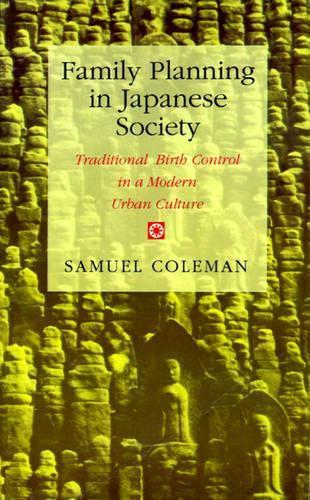
Overview
The description for this book, Family Planning in Japanese Society: Traditional Birth Control in a Modern Urban Culture, will be forthcoming.
Full Product Details
Author: Samuel Coleman
Publisher: Princeton University Press
Imprint: Princeton University Press
Edition: Revised edition
Dimensions:
Width: 12.70cm
, Height: 1.60cm
, Length: 20.30cm
Weight: 0.312kg
ISBN: 9780691028651
ISBN 10: 0691028656
Pages: 288
Publication Date: 16 February 1992
Audience:
Professional and scholarly
,
College/higher education
,
Professional & Vocational
,
Tertiary & Higher Education
Format: Paperback
Publisher's Status: Active
Availability: Manufactured on demand

We will order this item for you from a manufactured on demand supplier.
Language: English
Reviews
Family Planning in Japanese Society is not another success story about Japan... Samuel Coleman discloses the fact that Japan is unique in its reliance upon induced abortion among married women as the primary means of birth control... [This book is) strongly recommended as an original contribution to social science, work on family planning, women's studies, and Japanese studies. -- Takie Sugiyama Lebra Journal of Asian Studies For anyone seeking the most comprehensive picture of fertility control in Japan in the 1980s and a sensitive portrayal of the role of sex in marital relations in at least one segment of contemporary Japanese society, the book cannot be recommended too highly. Were there more like it, anthropologists, demographers, and family planning specialists would be well on the way to more sensitive comparisons of the intangible whys of fertility control as well as the technical hows. -- Robert J. Smith Medical Anthropology Quarterly Here are the answers to the questions that one wishes to ask Japanese friends but can never seem to find the right words, the proper time, or the necessary courage to do so. Do yourself and these friends a favor: read this book. -- Betty Sisk Swain The Japan Christian Quarterly A very readable and excellent introduction to the subject of contraception in Japan today. -- Susan B. Hanley Contemporary Sociology
Family Planning in Japanese Society is not another success story about Japan... Samuel Coleman discloses the fact that Japan is unique in its reliance upon induced abortion among married women as the primary means of birth control... [This book is) strongly recommended as an original contribution to social science, work on family planning, women's studies, and Japanese studies. -- Takie Sugiyama Lebra, Journal of Asian Studies For anyone seeking the most comprehensive picture of fertility control in Japan in the 1980s and a sensitive portrayal of the role of sex in marital relations in at least one segment of contemporary Japanese society, the book cannot be recommended too highly. Were there more like it, anthropologists, demographers, and family planning specialists would be well on the way to more sensitive comparisons of the intangible whys of fertility control as well as the technical hows. -- Robert J. Smith, Medical Anthropology Quarterly Here are the answers to the questions that one wishes to ask Japanese friends but can never seem to find the right words, the proper time, or the necessary courage to do so. Do yourself and these friends a favor: read this book. -- Betty Sisk Swain, The Japan Christian Quarterly A very readable and excellent introduction to the subject of contraception in Japan today. -- Susan B. Hanley, Contemporary Sociology
A very readable and excellent introduction to the subject of contraception in Japan today. --Susan B. Hanley, Contemporary Sociology Here are the answers to the questions that one wishes to ask Japanese friends but can never seem to find the right words, the proper time, or the necessary courage to do so. Do yourself and these friends a favor: read this book. --Betty Sisk Swain, The Japan Christian Quarterly For anyone seeking the most comprehensive picture of fertility control in Japan in the 1980s and a sensitive portrayal of the role of sex in marital relations in at least one segment of contemporary Japanese society, the book cannot be recommended too highly. Were there more like it, anthropologists, demographers, and family planning specialists would be well on the way to more sensitive comparisons of the intangible whys of fertility control as well as the technical hows. --Robert J. Smith, Medical Anthropology Quarterly Family Planning in Japanese Society is not another success story about Japan. . . . Samuel Coleman discloses the fact that Japan is unique in its reliance upon induced abortion among married women as the primary means of birth control. . . . [This book is) strongly recommended as an original contribution to social science, work on family planning, women's studies, and Japanese studies. --Takie Sugiyama Lebra, Journal of Asian Studies
Author Information
Samuel Coleman is Assistant Professor of Anthropology at the University of Oregon.