Overview
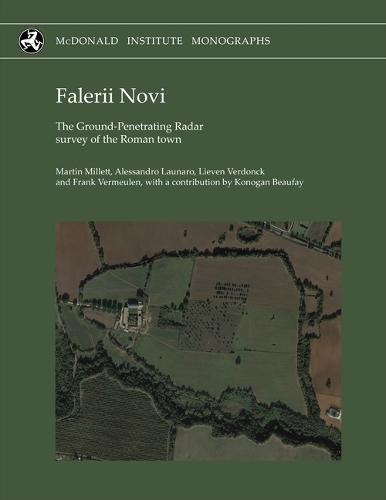
The Roman town of Falerii Novi was founded after Rome defeated the Faliscans in 241BC, and features widely in modern discussions of Roman expansion in Italy, with its town walls and defences often illustrated in accounts of architecture. Its site is now largely farmland, with the only buildings within the Roman walls being a Medieval church and associated structures, now used as a farm. The site attracted attention of 19th century antiquarians and was explored in limited excavations during the later 20th century, but its history and development remains only partially understood. In the late 1990s it was the subject of one of the first large-scale geophysical surveys completed in Italy using magnetometry. The publication of that work in 2000 formed the basis for an historical and archaeological interpretation that has subsequently been widely debated. The present volume results from a second innovative large-scale survey which deployed Ground-Penetrating Radar. This book presents the spectacular results of that work combined with evidence from the earlier magnetometry and integrated with information from excavation and past finds. The resulting account provides a full and new discussion of the town and its topographical and historical development, placed in the broader setting of Roman Italy. It includes a new interpretation of the early history of the town, discussions of the evidence of the major buildings as well as a series of accounts of spatial patterning within the city. As well as providing the first comprehensive synthesis of this important Roman town, the book shows how evidence from geophysical surveys can form the basis for new approaches to the understanding of Roman urbanism.
Full Product Details
Author: Alessandro Launaro ,
Martin Millett ,
Lieven Verdonck ,
Frank Vermeulen
Publisher: McDonald Institute Monographs
Imprint: McDonald Institute Monographs
ISBN: 9781913344245
ISBN 10: 191334424
Pages: 176
Publication Date: 14 January 2025
Audience:
Professional and scholarly
,
Professional & Vocational
Format: Hardback
Publisher's Status: Active
Availability: In Print

This item will be ordered in for you from one of our suppliers. Upon receipt, we will promptly dispatch it out to you. For in store availability, please contact us.
Author Information
Alessandro Launaro FSA is Associate Professor in Classics (Classical Art & Archaeology) at the Faculty of Classics, University of Cambridge and a Fellow of Gonville & Caius College, Cambridge. He works on the long-term social-economic development of the Roman world, with a specific focus on the transformation of the urban and rural landscapes of Italy. He has been involved in an array of archaeological fieldwork in various parts of Italy and directs an integrated research project at Interamna Lirenas (Southern Lazio). Martin Milllett FSA, FBA is Emeritus Laurence Professor of Classical Archaeology, University of Cambridge and a Life Fellow of Fitzwilliam College, Cambridge. His work focuses both on the impact of Roman imperialism on indigenous societies and on the application of survey methods in archaeology. He has led fieldwork and excavation projects in Spain, Portugual and Italy as well as in Britain. Lieven Verdonck is UKRI Postdoctoral Fellow (Marie Skłodowska-Curie Actions Guarantee) at the Faculty of Classics of the University of Cambridge and Research Associate at Darwin College, Cambridge. His research specialises in archaeological geophysics and investigating high-resolution ground-penetrating radar prospection with multi-antenna instruments. Currently, his research focuses on the role of machine learning and computer vision in the interpretation of large geophysical data sets, and on the automation of geophysical data acquisition by means of unmanned ground vehicles.