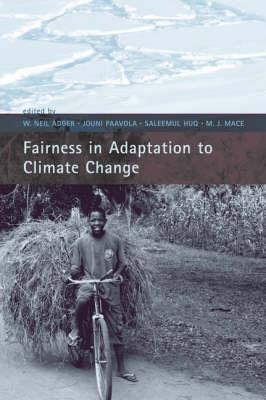
Full Product Details
Author: W. Neil Adger (University of East Anglia) ,
Jouni Paavola ,
Saleemul Huq ,
M. J. Mace
Publisher: MIT Press Ltd
Imprint: MIT Press
Dimensions:
Width: 15.20cm
, Height: 1.90cm
, Length: 22.90cm
Weight: 0.567kg
ISBN: 9780262012270
ISBN 10: 0262012278
Pages: 312
Publication Date: 28 April 2006
Recommended Age: From 18 years
Audience:
Professional and scholarly
,
Professional & Vocational
Format: Hardback
Publisher's Status: Out of Stock Indefinitely
Availability: In Print

Limited stock is available. It will be ordered for you and shipped pending supplier's limited stock.
Reviews
This book is a timely source of information and analysis that will be valuable in determining actions for meeting the threat of climate change post-2012. The contributors provide important insights into the critical issues of burden sharing and equity considerations, which must define the global approach in this area. The book will be particularly significant for negotiators involved in the UNFCCC process, as well as researchers dealing with a host of issues relating to the future of human society. --R.K. Pachauri, Director-General, The Energy and Resources Institute, New Delhi
Democracy's dilemma is how to leaven one-dimensional economic globalization with social and environmental imperatives. Paehlke makes an ambitious and compelling case, laced with his trademark optimism, for a democratic pincer movement from above and below, designed to recapture 'the earth' from 'the globe'. This is an essential contribution from one of our most original and imaginative environmental thinkers. --Andrew Dobson, Professor of Politics, Keele University, UK Political Nature is a significant contribution to the field. Not enough has been made elsewhere of the major traditions in political theory in the context of contemporary environmental politics, and this book goes a long way toward addressing that problem. --Andrew Dobson, Professor of Politics, Keele University, UK This book provides a valuable overview of spatial cognition and its possible roles in abstract thought--a notoriously difficult issue, but an increasingly important one. Although its subject matter is primarily psychological, the book includes contributions from anthropology, linguistics and neuroscience. Spatial Schemas in Abstract Thought should attract the interest of a wide community of researchers. --Alan Garnham, Professor, Laboratory of Experimental Psychology, University of Sussex, Brighton, UK If you thought that environmental philosophy had lost sight of environmental practice, think again. Anyone who has ever despaired at bringing activists and theorists into beneficial contact will find plenty of succor and sound advice in these pages. --Andrew Dobson, Professor of Politics, Keele University, UK A magnificent achievement which will be a key point of reference for years to come. --Andrew Dobson, Professor of Politics, Keele University, UK This is a brilliant book -- clear, direct, and scholarly as well as committed. The authors bring adaptation to the forefront of climate change debate. Who owes what to whom in this era of common yet differentiated responsibility? Fairness is critical to successful climate change policy, and this book shows us the way. --Andrew Dobson, Professor of Politics, Keele University, UK
Author Information
W. Neil Adger leads the research effort on adaptation at the Tyndall Centre for Climate Change Research at the University of East Anglia. Jouni Paavola is Senior Research Fellow at the Centre for Social and Economic Research on the Global Environment at the University of East Anglia. Saleemul Huq is Director of the Climate Change Programme at the International Institute for Environment and Development in London. M. J. Mace is a staff lawyer at the Foundation for International Environmental Law and Development's Climate Change and Energy Programme.