Overview
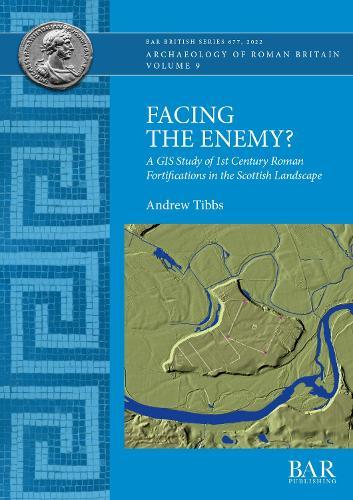
Facing the Enemy is a GIS-based examination of the relationship between Roman fortifications occupied during the Flavian period (AD 77-86/90), and their Scottish landscape setting. It undertakes spatial analysis of the positioning, orientation, intervisibility and interconnectivity of the early legionary fortresses, forts, fortlets, camps and towers. The study combines mapping data, remote sensing technologies, along with archaeological evidence in an extensive GIS database, and takes a systematic approach to analysing the landscapes surrounding the fortifications. The work demonstrates that Flavian fortifications were almost always located in positions which enabled the military to control movement through the landscape, with coastal sites frequently guarding access to river networks and fortifications further upstream. The study concludes that the military strategy in Flavian Scotland was not to block all movement through the landscape as such a strategy would have been impossible in such a varied setting, but rather to control the main corridors of movement, and by extension, exert control and authority over the indigenous population.
Full Product Details
Author: Andrew Tibbs
Publisher: BAR Publishing
Imprint: BAR Publishing
Weight: 0.698kg
ISBN: 9781407360157
ISBN 10: 1407360159
Pages: 175
Publication Date: 30 September 2022
Audience:
Professional and scholarly
,
Professional & Vocational
Format: Paperback
Publisher's Status: Active
Availability: Available To Order

We have confirmation that this item is in stock with the supplier. It will be ordered in for you and dispatched immediately.
Reviews
'This is a very significant contribution to the study of the Romans in Scotland and to the nature of Roman/native relations. Its findings are of relevance to Roman frontier studies across the world.' Dr Murray Cook, Rampart Scotland 'This is an important contribution to a growing corpus of studies that examine the relationship between Roman fortifications and the landscapes (and peoples) they occupied. Any student of Roman military occupation strategies should have this on their shelf.' Erik P. Graafstal, municipality of Utrecht
'This is a very significant contribution to the study of the Romans in Scotland and to the nature of Roman/native relations. Its findings are of relevance to Roman frontier studies across the world.' Dr Murray Cook, Rampart Scotland 'This is an important contribution to a growing corpus of studies that examine the relationship between Roman fortifications and the landscapes (and peoples) they occupied. Any student of Roman military occupation strategies should have this on their shelf.' Erik P. Graafstal, municipality of Utrecht
Author Information
Andrew Tibbs is a Teaching Fellow with the University of Edinburgh, and an Honorary Research Fellow in Archaeology at Durham University, where he gained his PhD in 2021. His research interests focus on the influence and impact of Roman military activity in Northern England and Scotland.