Overview
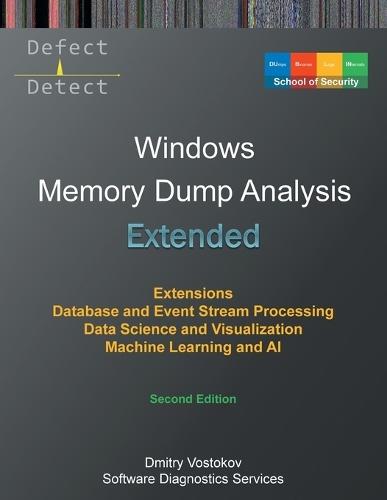
The book contains the full Software Diagnostics Services training transcript with 25 hands-on exercises. This training course extends pattern-oriented analysis introduced in Accelerated Windows Memory Dump Analysis, Accelerated .NET Core Memory Dump Analysis, and Advanced Windows Memory Dump Analysis with Data Structures courses with: Surveying the current landscape of WinDbg extensions with analysis pattern mappings Writing WinDbg extensions in C, C++, and Rust (new) Connecting WinDbg to NoSQL databases Connecting WinDbg to streaming and log processing platforms Querying and visualizing WinDbg output data Using Data Science, Machine Learning, and Gen AI for diagnostics and postmortem debugging (new) The new edition of the training updates existing exercises and includes new ones. Prerequisites: Working knowledge of WinDbg. Working knowledge of C, C++, or Rust is optional (required only for some exercises). Other concepts are explained when necessary. Audience: Software developers, software maintenance engineers, escalation engineers, quality assurance engineers, security and vulnerability researchers, malware and memory forensics analysts who want to build memory analysis pipelines.
Full Product Details
Author: Dmitry Vostokov ,
Software Diagnostics Services ,
Dublin School of Security
Publisher: Opentask
Imprint: Opentask
Edition: 2nd ed.
Dimensions:
Width: 21.60cm
, Height: 2.40cm
, Length: 27.90cm
Weight: 1.166kg
ISBN: 9781912636518
ISBN 10: 1912636514
Pages: 364
Publication Date: 04 May 2025
Audience:
General/trade
,
General
Format: Paperback
Publisher's Status: Active
Availability: Available To Order

We have confirmation that this item is in stock with the supplier. It will be ordered in for you and dispatched immediately.
Author Information
Dmitry Vostokov is an internationally recognized expert, speaker, educator, scientist, inventor, and author. He founded the pattern-oriented software diagnostics, forensics, and prognostics discipline (Systematic Software Diagnostics) and Software Diagnostics and Observability Institute. Vostokov has also authored over 50 books on software diagnostics, anomaly detection and analysis, software and memory forensics, root cause analysis and problem solving, memory dump analysis, debugging, software trace and log analysis, reverse engineering, and malware analysis. He has over 30 years of experience in software architecture, design, development, and maintenance in various industries, including leadership, technical, and people management roles. Dmitry founded OpenTask Iterative and Incremental Publishing and Software Diagnostics Technology and Services (former Memory Dump Analysis Services). In his spare time, he explores Software Narratology and Quantum Software Diagnostics. His interest areas are theoretical software diagnostics and its mathematical and computer science foundations, application of formal logic, semiotics, artificial intelligence, machine learning, and data mining to diagnostics and anomaly detection, software diagnostics engineering and diagnostics-driven development, diagnostics workflow and interaction. Recent interest areas also include functional programming, cloud native computing, monitoring, observability, visualization, security, automation, applications of category theory to software diagnostics, development and big data, and diagnostics of artificial intelligence.