Overview
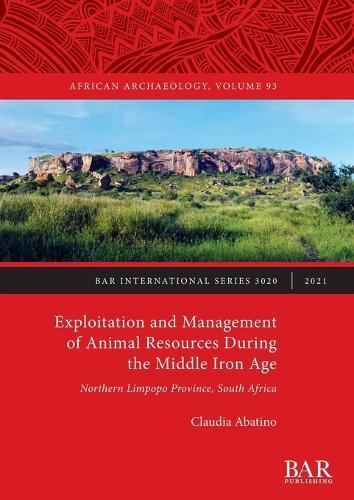
This research aims to reconstruct the dynamics of exploitation and management of animal resources during the Middle Iron Age in the northern part of the Limpopo region (South Africa). The book offers an interpretation of faunal remains from two sites: Mapungubwe, an important regional centre during the 13th century AD, and Mutamba, a small agro-pastoral settlement contemporary to the period of maximum hegemony of the capital and located at the southernmost limit of Mapungubwe influence. Some of the fauna from earlier excavations at Mapungubwe has been published previously, but this volume considers new material and re-examines earlier findings. In addition to the zooarchaeological analysis, ethnozooarchaeological research has been carried out in a Venda village. Furthermore, the published data concerning the Mapungubwe area of influence have been collected. The book includes a summary chapter in Italian.
Full Product Details
Author: Claudia Abatino
Publisher: BAR Publishing
Imprint: BAR Publishing
Weight: 0.750kg
ISBN: 9781407357263
ISBN 10: 1407357263
Pages: 188
Publication Date: 25 February 2021
Audience:
General/trade
,
General
Format: Paperback
Publisher's Status: Active
Availability: Available To Order

We have confirmation that this item is in stock with the supplier. It will be ordered in for you and dispatched immediately.
Reviews
'The author's painstaking presentation of research results, including excellent illustrations in the form of photographs, graphs, tables, and charts, enhances understanding and makes for a rich and valuable publication. This book is a must-read for southern African archaeologists, particularly university students and scholars using archaeozoology to study human-animal relationships during the Iron Age.' Plan Shenjere-Nyabezi, African Archaeological Review, Vol 38 (2021) 'This is a novel piece of research conducted on two key early second-millennium AD Iron Age sites in northern South Africa . Understanding how people used animals-both wild and domestic-and for what purposes is fundamental to understanding not only the economic basis of Iron Age societies in southern Africa, but also their social and political relations. The data presented here are a significant addition to that knowledge base with respect to the early development of state-level polities and intercontinental systems of trade in the far north of South Africa as represented by the two sites of Mapungubwe and Mutamba.' Professor Peter Mitchell, St Hugh's College, University of Oxford 'The publication of these new unpublished data certainly enriches the wealth of knowledge about the exploitation of animal resources in the Limpopo valley during the Iron Age. ... The chapter on ethnoarcheological research also represents a very interesting extension of the investigations aimed at a better understanding of the exploitation of animal resources using sources that are not strictly archaeological.' Professor Antonio Curci, University of Bologna
'This is a novel piece of research conducted on two key early second-millennium AD Iron Age sites in northern South Africa . Understanding how people used animals-both wild and domestic-and for what purposes is fundamental to understanding not only the economic basis of Iron Age societies in southern Africa, but also their social and political relations. The data presented here are a significant addition to that knowledge base with respect to the early development of state-level polities and intercontinental systems of trade in the far north of South Africa as represented by the two sites of Mapungubwe and Mutamba.' Professor Peter Mitchell, St Hugh's College, University of Oxford 'The publication of these new unpublished data certainly enriches the wealth of knowledge about the exploitation of animal resources in the Limpopo valley during the Iron Age. ... The chapter on ethnoarcheological research also represents a very interesting extension of the investigations aimed at a better understanding of the exploitation of animal resources using sources that are not strictly archaeological.' Professor Antonio Curci, University of Bologna
{\rtf1\ansi\ansicpg1252\deff0\deflang2057{\fonttbl{\f0\fswiss\fprq2\fcharset0 Calibri;}{\f1\fnil\fcharset0 Verdana;}} \viewkind4\uc1\pard\lang1033\f0\fs22\lquote The author\rquote s painstaking presentation of research results, including excellent illustrations in the form of photographs, graphs, tables, and charts, enhances understanding and makes for a rich and valuable publication. This book is a must-read for southern African archaeologists, particularly university students and scholars using archaeozoology to study human-animal relationships during the Iron Age.' Plan Shenjere-Nyabezi, African Archaeological Review, Vol 38 (2021)\par \pard\sa160\sl252\slmult1\lang2057\par \lquote This is a novel piece of research conducted on two key early second-millennium AD Iron Age sites in northern South Africa \'85 Understanding how people used animals-both wild and domestic-and for what purposes is fundamental to understanding not only the economic basis of Iron Age societies in southern Africa, but also their social and political relations. The data presented here are a significant addition to that knowledge base with respect to the early development of state-level polities and intercontinental systems of trade in the far north of South Africa as represented by the two sites of Mapungubwe and Mutamba.\rquote \i Professor Peter Mitchell, St Hugh\rquote s College, University of Oxford\i0\par \par \lquote The publication of these new unpublished data certainly enriches the wealth of knowledge about the exploitation of animal resources in the Limpopo valley during the Iron Age. ... The chapter on ethnoarcheological research also represents a very interesting extension of the investigations aimed at a better understanding of the exploitation of animal resources using sources that are not strictly archaeological.\rquote \i Professor Antonio Curci, University of Bologna\i0\f1\fs17\par }
Author Information
Claudia Abatino is a zooarchaeologist and is currently a Postdoctoral Researcher at the University of Siena, having earned a PhD in Cultural Heritage Sciences at the University of Salento. For this work, she was awarded an Aesop+ scholarship from the European Commission, providing her with the opportunity to conduct research at the University of Pretoria.