Reviews
""As a teacher of paraprofessionals earning education degrees, I often hear my students express that despite extensive experience in schools, they lack the confidence to try some of the teaching techniques we discuss in class. The fourth edition of Explaining Reading not only provides excellent content, but does so in a way that empowers educators to create authentic and explicit lessons that will foster students' motivation in their classrooms.""--Joy Myers, PhD, Executive Director, Grow Your Own Initiatives, James Madison University ""This book takes the 'secret' out of reading by showing how to teach comprehension skills and strategies through clear, step-by-step lessons. The 30 sample lessons model what teachers can say and do to guide students toward true understanding. Each lesson includes adaptations for different grade levels and subjects, making it practical and flexible. As an EL teacher, I value the focus on differentiation and supporting English learners.""--Monica Kula, MA, Bilingual Teacher, Pennoyer School District #79, Norridge, Illinois ""Duffy and Scales have created a vital resource for teachers who want to teach reading concepts explicitly while aligning their instructional practices to support comprehension. The book guides teachers in the kind of thinking that expert teachers do, using concrete classroom examples. The fourth edition has a heightened focus on student agency and motivation. This book is essential reading for preservice, beginning, and veteran teachers, as well as for professional development providers who want to promote adaptive, visionary, and effective reading teachers.""--Margaret Vaughn, PhD, College of Education, Washington State University
""Duffy and Scales have created a vital resource for teachers who want to teach reading concepts explicitly while aligning their instructional practices to support comprehension. The book guides teachers in the kind of thinking that expert teachers do, using concrete classroom examples. The fourth edition has a heightened focus on student agency and motivation. This book is essential reading for preservice, beginning, and veteran teachers, as well as for professional development providers who want to promote adaptive, visionary, and effective reading teachers.""--Margaret Vaughn, PhD, College of Education, Washington State University ""This book takes the 'secret' out of reading by showing how to teach comprehension skills and strategies through clear, step-by-step lessons. The 30 sample lessons model what teachers can say and do to guide students toward true understanding. Each lesson includes adaptations for different grade levels and subjects, making it practical and flexible. As an EL teacher, I value the focus on differentiation and supporting English learners.""--Monica Kula, MA, Bilingual Teacher, Pennoyer School District #79, Norridge, Illinois ""As a teacher of paraprofessionals earning education degrees, I often hear my students express that despite extensive experience in schools, they lack the confidence to try some of the teaching techniques we discuss in class. The fourth edition of Explaining Reading not only provides excellent content, but does so in a way that empowers educators to create authentic and explicit lessons that will foster students' motivation in their classrooms.""--Joy Myers, PhD, Executive Director, Grow Your Own Initiatives, James Madison University-
Author Information
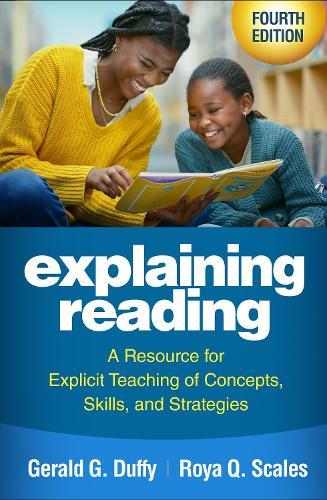
Gerald G. Duffy, EdD, is the former William E. Moran Distinguished Professor of Literacy and Reading at the University of North Carolina at Greensboro and Professor Emeritus at Michigan State University. Now retired and living in Bellingham, Washington, he was an elementary and middle school teacher, researcher, and teacher educator for over 50 years. His teaching and research focused on the explicit teaching of reading, on comprehension, and on the development of adaptive teachers. A past president of the Literacy Research Association and a member of the Reading Hall of Fame, Dr. Duffy has worked with teachers and children across the United States and internationally. He has written and edited several books on reading instruction and has published over 150 articles and research studies. Roya Q. Scales, PhD, is Professor of Literacy Education at Western Carolina University. An educator for more than 30 years (11 as a K–2 classroom teacher), she is noted for her research on thoughtfully adaptive teaching, enactment of teachers’ visions, literacy teacher education, and effective teaching of literacy. She is currently Editor of Reading and Writing Quarterly: Overcoming Learning Difficulties. Dr. Scales is the recipient of the 2022 Association of Literacy Educators and Researchers A. B. Herr Award for outstanding contributions to literacy education. With 50 peer-reviewed publications, she has coauthored several books on reading instruction and teachers’ professional development.