Overview
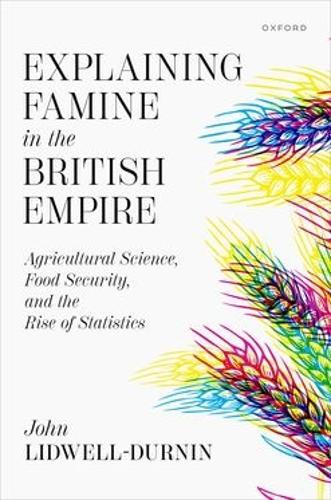
Famine is humanity's oldest fear. Famine memorials and stories are literally carved into the stones that lie on the beds of Europe's rivers. Our science fiction and fantasy literature often begin by evoking a world of hunger and scarcity. Famine shapes our past, it threatens our future, and we struggle to explain how it is tolerated and permitted to unfold in the present. In eighteenth-century Britain, rising food prices provoked a politics of hunger, manifested in food riots, fears of revolution, and political arguments over how to feed a growing population. In the 1790s, fear of famine provoked the state to experiment with something new: funding a voluntary board of experts to compile agricultural data and promote the use of scientific methods in food production. The problem of scarcity and the threat of famine were to be plainly and clearly represented in statistical data, transparent to both the state and the public. This book is about the famines and food shortages that struck India and Britain at the close of the eighteenth century, and it explores how these crises and episodes of scarcity gave rise to scientific efforts to explain and quantify 'famine.' Focusing on the time period between the Bengal famine of 1770 and the food shortages in Britain in 1800, it explores the development of the concepts of 'artificial scarcity' (and 'artificial famine'), and how statistical science and philosophy played a role in the naturalization of famine. During this time, Britain's first 'Board of Agriculture' was established, creating political opportunities for a rising class of agriculturalists interested in the promotion of their science as a means of confronting and solving the empire's food insecurity during a time of war and upheaval. Following the networks and collaboration between this Board of Agriculture and the East India Company, the book explores the careers and correspondence of agriculturalists, economists, Company officials, scientists, hack writers, and politicians. Explaining Famine in the British Empire shows how these debates over the anthropogenic and natural causes of scarcity and famine shaped the subsequent development of the field of food security and modern concerns over carrying capacity, environment, and population. This is an open access title available under the terms of a CC BY-NC-ND 4.0 International licence. It is free to read on the Oxford Academic platform and offered as a free PDF download from OUP and selected open access locations.
Full Product Details
Author: John Lidwell-Durnin (Lecturer in History, Lecturer in History, University of Exeter)
Publisher: Oxford University Press
Imprint: Oxford University Press
Dimensions:
Width: 16.50cm
, Height: 2.50cm
, Length: 24.00cm
Weight: 0.595kg
ISBN: 9780198982609
ISBN 10: 0198982607
Pages: 304
Publication Date: 12 February 2026
Audience:
College/higher education
,
Postgraduate, Research & Scholarly
Format: Hardback
Publisher's Status: Active
Availability: To order

Stock availability from the supplier is unknown. We will order it for you and ship this item to you once it is received by us.
Author Information
John Lidwell-Durnin is Lecturer in History at the University of Exeter. Previously, he taught at the University of Oxford as a Departmental Lecturer.