Overview
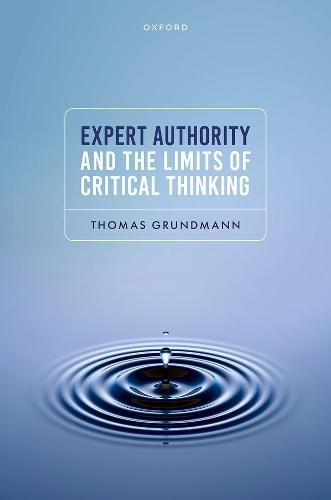
This is an open access title available under the terms of a CC BY-NC-ND 4.0 International licence. It is free to read on the Oxford Academic platform and offered as a free PDF download from OUP and selected open access locations.There is no doubt that experts play a prominent but controversial role in modern societies. While they constitute an invaluable source of knowledge and represent the gold standard of expertise, they may also exhibit arrogance, harbour blind spots, make mistakes, and contribute to larger institutions that are susceptible to serious abuse. In Expert Authority and the Limits of Critical Thinking, Thomas Grundmann develops a new theory of rationality that enables us to take the epistemic authority of experts seriously without exempting it from rational scrutiny by laypeople.This volume argues that expert testimony holds epistemic authority over laypeople in a way that may preempt their critical reasoning from being usable in belief formation. This Preemption View of epistemic authority, shaped by philosophers such as Hans-Georg Gadamer, Joseph Raz, Arnon Keren, and Linda Zagzebski, has yet to receive a thorough epistemological explanation, a compelling motivation, or a robust defence against challenges--all of which this book aims to provide. Preemptive reasons are explored through the framework of higher-order defeat, demonstrating how expert testimony generates these higher-order defeaters; further, the ten most common challenges to the Preemption View are addressed at length. The emerging account explains how laypeople's deference to experts is properly linked to their thinking for themselves and what remains of their epistemic autonomy.The volume also offers a short history of epistemic authority and applies its theoretical insights to real-world phenomena such as the role of experts in politics, expert communication, and conspiracy thinking, and explores what the interplay between expert authority and critical oversight by the public means for democracy and the Enlightenment ideal of thinking for oneself.
Full Product Details
Author: Thomas Grundmann (Professor of Philosophy, Professor of Philosophy, University of Cologne)
Publisher: Oxford University Press
Imprint: Oxford University Press
ISBN: 9780198971023
ISBN 10: 0198971028
Pages: 272
Publication Date: 16 April 2026
Audience:
Professional and scholarly
,
Professional & Vocational
Format: Hardback
Publisher's Status: Forthcoming
Availability: To order

Author Information
Thomas Grundmann is Professor of Philosophy at the University of Cologne, Germany. He has published numerous articles on epistemology, philosophical methodology, and analytic existential philosophy. His current research addresses issues from social epistemology such as epistemic authority and experts, the limits of epistemic autonomy, disagreement, and post-truth. He is co-editor of The Epistemology of Experts (2025), The Epistemology of Fake News (2021), and Experimental Philosophy and Its Critics (2012).