|
|
|||
|
||||
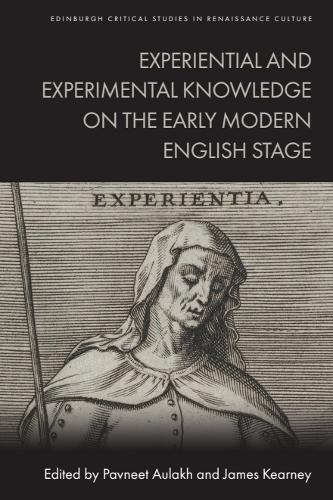
OverviewEarly modern dramatists entertained audiences by staging experiential and experimental knowledge, especially consequential forms of coming to or arriving at knowledge. The contributors to this collection explore the ways in which the culture's fascination with forms of knowledge creation scientific, experiential, religious shaped early modern drama. Experiential and Experimental Knowledge on the Early Modern English Stage addresses these issues from phenomenological, political and ethical perspectives and in terms of histories of science, cognitive and affective studies, and discourses of the body. Across the volume, the contributors articulate how the early modern stage served as a site where knowledge was not merely performed but produced and interrogated, imagined and transformed. Full Product DetailsAuthor: Pavneet Aulakh (Senior Lecturer in the Department of English, Vanderbilt University) , James Kearney (Professor of English, University of California - Santa Barbara)Publisher: Edinburgh University Press Imprint: Edinburgh University Press ISBN: 9781399520836ISBN 10: 1399520830 Pages: 272 Publication Date: 30 April 2026 Audience: College/higher education , Postgraduate, Research & Scholarly Format: Hardback Publisher's Status: Forthcoming Availability: Not yet available This item is yet to be released. You can pre-order this item and we will dispatch it to you upon its release. Language: English Table of ContentsList of Illustrations Acknowledgments Introduction: Experimenting with Experience Pavneet Aulakh, James Kearney and Adam Rzepka Part I. Experiential Knowledge 1. Experiencing Shakespeare’s Experiences Bruce Smith 2. Sad Experience: Jaques, Polonius, Gloucester Adam Rzepka Part II. Experimental Forms & Frames 3. Theatre as Portal: A Shakespearean Thought Experiment Wendy Beth Hyman 4. Fictional Hypothesis, Lived Experience, and Re-worlding in The Tempest Jane Degenhardt 5. Amazement in The Tempest Jenny Mann Part III. Embodied Knowledge 6. Knowing Instincts in Shakespeare’s Macbeth Katherine Walker 7. Laughing Matters: Violence, Witness, and Experiential Knowledge in The Massacre at Paris Katie Adkison Part IV. Experiential & Experimental Philosophy 8. Theatrical Experiments and Experiential Protestants: Shakespearean Iconoclasm in Love’s Labors Lost Jennifer Waldron 9. ‘Boys that play with watry Bubbles’: Innocence and Experience at the Infancy of Science Elizabeth Swann 10. ‘through the woods of experience’: Minding the Gaps in the Time of Experiment Pavneet Aulakh Afterword Julia Reinhard Lupton Notes Bibliography IndexReviewsThis collection of essays provides us with a series of fresh and illuminating entry points into the relationship between experience and experiment in the early modern world, and proves beyond any reasonable doubt that the theatre is one of the most illuminating entry points of all. Highly recommended. -- Rhodri Lewis, Princeton University Author InformationPavneet Aulakh is a Senior Lecturer in the Department of English at Vanderbilt University. Primarily positioned at the intersection of seventeenth-century imaginative literature and natural philosophy, he is currently working on his monograph Digesting Bacon in Seventeenth-Century England. James Kearney is Professor of English at the University of California, Santa Barbara. He is the author of Shakespearean Ethics in Extremity: Phenomenology, Theater, Experience (2025) and The Incarnate Text: Imagining the Book in Reformation England (2010), which won CCL’s Book of the Year Award. With Julia Reinhard Lupton and Lowell Gallagher, he co-edited Entertaining the Idea: Shakespeare, Performance, and Philosophy (2020). Tab Content 6Author Website:Countries AvailableAll regions |
||||