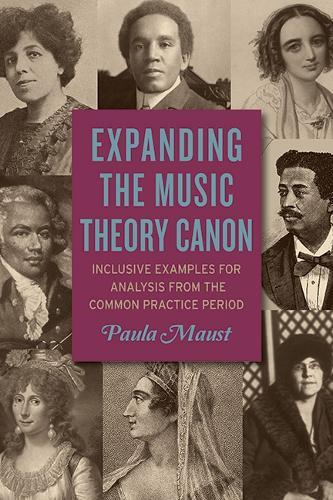
Full Product Details
Author: Paula Maust
Publisher: State University of New York Press
Imprint: State University of New York Press
Dimensions:
Width: 21.60cm
, Height: 2.50cm
, Length: 27.90cm
Weight: 0.771kg
ISBN: 9781438495811
ISBN 10: 1438495811
Pages: 360
Publication Date: 01 December 2023
Audience:
College/higher education
,
Tertiary & Higher Education
Format: Paperback
Publisher's Status: Active
Availability: In Print

This item will be ordered in for you from one of our suppliers. Upon receipt, we will promptly dispatch it out to you. For in store availability, please contact us.
Reviews
"""Paula Maust's Expanding the Music Theory Canon is an indispensable resource for music theory educators who wish to move beyond the narrow confines of twentieth-century academic music. Now that we music scholars have finally come to the consensus opinion that it was exclusionist to teach only a handful of so-called canonic composers who, in the United States, were of necessity both white and male, we all desperately need resources outlining the rich and varied compositional output of those who identified otherwise. Because sources have been hard to locate and procure, musicians wishing to expand the canon are often left with few good resources to work with. Maust's anthology goes a long way in solving this dilemma. With sections on and examples of the basic topics of common-practice tonality—such as scale types, various meters, melodic embellishments, harmonic syntax, formal structures, and post-tonal topics—Maust's anthology will be invaluable to all who wish to make the music classroom more inclusive of all students, and more welcoming for everyone."" — Philip Ewell, Professor of Music Theory at Hunter College, CUNY and author of On Music Theory, and Making Music More Welcoming for Everyone Praise for Paula Maust’s website, Expanding the Music Theory Canon: “Congratulations on completing this wonderful project. This is such a significant contribution to the field of music theory.” — Joseph Chi-Sing Siu, University of Maryland Baltimore County “She’s doing what most of us are talking about and not knowing how to do.” — David Forrest, Texas Tech University and President, Texas Society for Music Theory"
""This book is a welcome addition and valuable resource for teachers of music theory at every level who are looking to expand the music to which they expose their students and study. I therefore foresee this becoming an important resource in music theory—and by extension music history pedagogy."" — Early Music America ""Paula Maust's Expanding the Music Theory Canon is an indispensable resource for music theory educators who wish to move beyond the narrow confines of twentieth-century academic music. Now that we music scholars have finally come to the consensus opinion that it was exclusionist to teach only a handful of so-called canonic composers who, in the United States, were of necessity both white and male, we all desperately need resources outlining the rich and varied compositional output of those who identified otherwise. Because sources have been hard to locate and procure, musicians wishing to expand the canon are often left with few good resources to work with. Maust's anthology goes a long way in solving this dilemma. With sections on and examples of the basic topics of common-practice tonality—such as scale types, various meters, melodic embellishments, harmonic syntax, formal structures, and post-tonal topics—Maust's anthology will be invaluable to all who wish to make the music classroom more inclusive of all students, and more welcoming for everyone."" — Philip Ewell, Professor of Music Theory at Hunter College, CUNY and author of On Music Theory, and Making Music More Welcoming for Everyone Praise for Paula Maust's website, Expanding the Music Theory Canon: ""Congratulations on completing this wonderful project. This is such a significant contribution to the field of music theory."" — Joseph Chi-Sing Siu, University of Maryland Baltimore County ""She's doing what most of us are talking about and not knowing how to do."" — David Forrest, Texas Tech University and President, Texas Society for Music Theory
Author Information
Paula Maust is Assistant Professor of Music Theory at the Peabody Institute of the Johns Hopkins University.