Overview
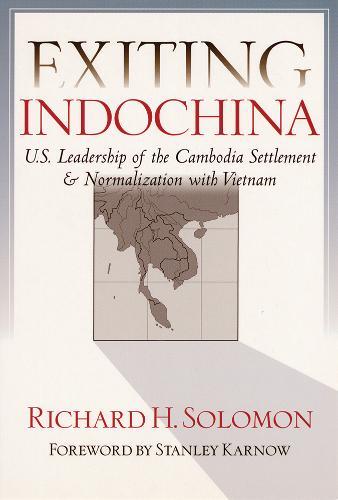
For most Americans, the exit from Indochina occurred in 1973, with the withdrawal of the U.S. military from South Vietnam. In fact, the final exit did not occur until two decades later, after the collapse of the Republic of Vietnam in 1975, the Cambodian revolution, and a decade of Vietnamese occupation of Cambodia. Only in the early 1990s were the major powers able to negotiate a settlement of the Cambodia conflict and withdraw from the region.This book recounts the diplomacy that brought an end to great power involvement in Indochina, including the negotiations for a UN peace process in Cambodia and construction of a road map for normalizing U.S.-Vietnam relations. In so doing, this volume also highlights the changing character of diplomacy at the beginning of the 1990s, when, at least temporarily, an era of military confrontation among the major world powers gave way to political management of international conflicts.
Full Product Details
Author: Richard Hugh Solomon ,
Stanley Karnow
Publisher: United States Institute of Peace Press
Imprint: United States Institute of Peace Press
Dimensions:
Width: 22.90cm
, Height: 1.00cm
, Length: 15.20cm
Weight: 0.270kg
ISBN: 9781929223015
ISBN 10: 1929223013
Pages: 104
Publication Date: 06 January 2000
Audience:
College/higher education
,
Professional and scholarly
,
Undergraduate
,
Postgraduate, Research & Scholarly
Format: Paperback
Publisher's Status: Out of Stock Indefinitely
Availability: Awaiting stock

Author Information
Richard H. Solomon was president of the United States Institute of Peace from 1993 to 2012 and oversaw its growth into a center of international conflict management analysis and applied programs. Prior to this assignment, Solomon was assistant secretary of state for East Asian and Pacific affairs from 1989 to 1992. He negotiated the Cambodia peace treaty, the first United Nations Permanent Five peacemaking agreement; had a leading role in the dialogue on nuclear issues between the United States and South and North Korea; helped establish the Asia-Pacific Economic Cooperation initiative; and led U.S. negotiations with Japan, Mongolia, and Vietnam on important bilateral matters. In 1992-93, Solomon served as U.S. ambassador to the Philippines. He coordinated the closure of the U.S. naval bases and developed a new framework for bilateral and regional security cooperation. Solomon previously served as director of policy planning at the Department of State and as a senior staff member of the National Security Council. In 1995, Solomon was awarded the State Department's Foreign Affairs Award for Public Service, and he has received awards for policy initiatives from the governments of Korea and Thailand. In 2005, he received the American Political Science Association's Hubert H. Humphrey career award for notable public service by a political scientist. Solomon began his career as professor of political science at the University of Michigan, and also served as head of the Political Science Department at the RAND Corporation. Solomon holds a Ph.D. in political science, with a specialization in Chinese politics, from the Massachusetts Institute of Technology.