Overview
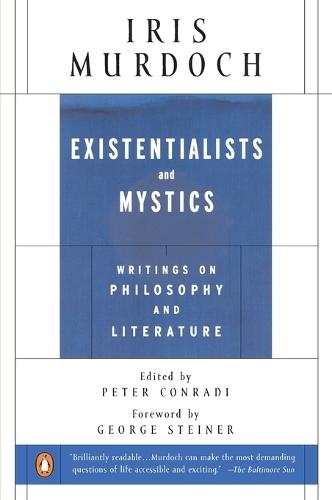
Best known as the author of 26 novels, Iris Murdoch was also an accomplished essayist and critic who taught philosophy for many years at Oxford University. This work gathers for the first time in one volume her most influential essays and shorter pieces. Included are her major critiques of existentialism written in the 1950s, her two Platonic dialogues on art and religion, incisive evaluations of the writings of T.S. Eliot, Jean-Paul Sartre, Albert Camus, Simone de Bauvoir, and Elias Canetti, as well as key texts on the continuing importance of the sublime, on the concept of love, and of the role great literature can play in curing the ills of philosophy. This volume confirms Iris Murdoch's major contributions to the literature and thought of the 20th century.
Full Product Details
Author: Iris Murdoch ,
Peter J. Conradi ,
George Steiner
Publisher: Penguin Books Ltd
Imprint: Penguin Books Ltd
Edition: New edition
Dimensions:
Width: 13.40cm
, Height: 3.00cm
, Length: 20.20cm
Weight: 0.465kg
ISBN: 9780140264920
ISBN 10: 0140264922
Pages: 576
Publication Date: 01 July 1999
Audience:
General/trade
,
General
Format: Paperback
Publisher's Status: Active
Availability: In Print

This item will be ordered in for you from one of our suppliers. Upon receipt, we will promptly dispatch it out to you. For in store availability, please contact us.
Reviews
Brilliantly readable . . . Murdoch can make the most demanding questions of life accessible and exciting. --The Baltimore Sun Existentialists and Mystics desribes the intellectual journey of a lifetime. This book is Murdoch's key. Readers will find much here to stimulate, entertain and edify. No one conveys the beauty and excitement of philosophy better than Murdoch. --Hilary Spurling, Daily Telegraph Murdoch, a wondrous writer and a careful student of the history of thought, is endowed a rare talent for philosophical writing--she offers, in accessible prose, insight into some of the great questoins that have preoccupied thinkers for centuries. --San Diego Union Tight, graceful writing, and a pleasure to read . . . [Murdoch's moral theory] has a real claim to our attention. --Elijah Millgram, The Boston Review A perceptive investigation into the symbiotic relationship of philosophy and literature. --The Guardian
Brilliantly readable . . . Murdoch can make the most demanding questions of life accessible and exciting. -The Baltimore Sun Existentialists and Mystics desribes the intellectual journey of a lifetime. This book is Murdoch's key. Readers will find much here to stimulate, entertain and edify. No one conveys the beauty and excitement of philosophy better than Murdoch. -Hilary Spurling, Daily Telegraph Murdoch, a wondrous writer and a careful student of the history of thought, is endowed a rare talent for philosophical writing-she offers, in accessible prose, insight into some of the great questoins that have preoccupied thinkers for centuries. -San Diego Union Tight, graceful writing, and a pleasure to read . . . [Murdoch's moral theory] has a real claim to our attention. -Elijah Millgram, The Boston Review A perceptive investigation into the symbiotic relationship of philosophy and literature. -The Guardian
Gathered here are essays by philosopher-novelist Murdoch, whose cool, clear thoughts on goodness and beauty offer sanctuary to all weary refugees from moral relativism. The selections, edited by Conradi (Humanities/Kingston Univ., England) and vibrantly introduced by George Steiner, span the years between 1950 and 1986, and include academic papers, radio talks, book reviews, lectures, a BBC interview, and one long essay, The Fire and the Sun: Why Plato Banished the Artists, issued as a book in 1977. Murdoch, a professional philosopher (Metaphysics as a Guide to Morals, 1993) and author of more than 25 novels, reflects here on the moral dimensions of literature and the contrasting ethical visions of Platonic, existential, and British analytic philosophy. The existentialists of the title represent a style of moral decision-making, best illustrated by Jean-Paul Sartre, that centers on self-conscious free will; decisions within a mystical consciousness, like Plato's, flow naturally out of moral ideas, like goodness and beauty, that have enduringly focused its attention. Murdoch appreciates Sartre for employing fiction so successfully in his philosophic demonstration of self-determination, but her sympathies lie finally with Platonists and mystics, whose attentive gaze on reality reveals transcendent value. Literature (which can embody philosophic ideas) and philosophy (which is more sensual and metaphorical, and so more literary, than it lets on) are both means of extending the same gaze. Murdoch has her blind spots. Behind her dismissive remarks on literary theory and fantasy lies the long tradition of critical reflection on philosophy and art inaugurated by the early German Romantics, Schlegel, Schelling, and Novalis - arguably the ancestors of deconstructive thought today - whose names never occur in these essays. Her case for the moral truthfulness of literature needs the challenge of this less overtly moralistic tradition in esthetics. Murdoch smooths the rocky path between ethics and art, but apart from the eternal Plato, many of the choices of representative philosophers in these aging essays - Same, Smart Hampshire, Gilbert Ryle, among others - now seem quaintly dated. (Kirkus Reviews)
Author Information
Iris Murdoch (1919–1999) was born in Dublin and brought up in London. She studied philosophy at Cambridge and was a philosophy fellow at St. Anne's College for 20 years. She published her first novel in 1954 and was instantly recognized as a major talent. She went on to publish more than 26 novels, as well as works of philosophy, plays, and poetry.