|
|
|||
|
||||
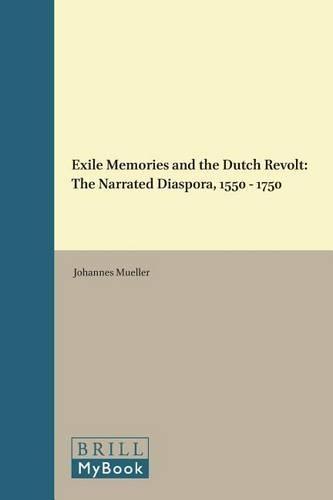
OverviewThe Dutch Revolt (ca. 1572-1648) led to the displacement of tens of thousands of people. In Exile Memories and the Dutch Revolt, Johannes Müller shows how migrants and their descendants in the Dutch Republic, England and Germany cultivated their Netherlandish heritage for more than 200 years. Memories of war and persecution shaped new religious and political identities that combined images of suffering and heroism and served as foundational narratives of newcomers. Exposing the underlying narrative structures of early modern exile memories, this volume shows how stories about the Dutch Revolt allowed migrants to participate in their host societies rather than producing a closed and exclusive diaspora. While narratives of religious persecution attracted non-migrants as well, exile networks were able to connect newcomers and established residents. Full Product DetailsAuthor: Johannes MuellerPublisher: Brill Imprint: Brill Volume: 199 Dimensions: Width: 15.50cm , Height: 2.00cm , Length: 23.50cm Weight: 0.533kg ISBN: 9789004311664ISBN 10: 9004311661 Pages: 264 Publication Date: 07 April 2016 Audience: Professional and scholarly , Professional & Vocational Format: Hardback Publisher's Status: Active Availability: Manufactured on demand We will order this item for you from a manufactured on demand supplier. Table of ContentsReviewsMuller's study is an important addition to our understanding of the cultures of exile produced by the religious upheavals of the early modern era. Memory culture among immigrant communities, he convincingly demonstrates, is essential to assessing the culture of religious identity more generally. The book is thoroughly researched and carefully argued, with an eye for nuance and subtlety. Students of early modern religious, cultural and social history will find this to be an illuminating work. Christine Kooi, Louisiana State University. In: Sixteenth Century Journal, Vol. 48, No. 2 (2017), pp. 503-505. Exile Memories is a well-written book with many appealing examples. What makes this study so useful is its scale: Muller follows various generations and reconstructs their position within society. [...] It is without doubt a book that should receive the attention of cultural and church historians, but also of people interested in (constructed-)identity and memory studies. Annemieke Romein, in: BMGN - Low Countries Historical Review, Vol. 132 (October 2017). Author InformationJohannes Müller, Ph.D. (2014), is lecturer of German literature and culture at Leiden University. He has published on early modern literature, migration and religion and is co-editor of the volume Memory before Modernity. Practices of Memory in Early Modern Europe (Brill, 2013). Tab Content 6Author Website:Countries AvailableAll regions |
||||