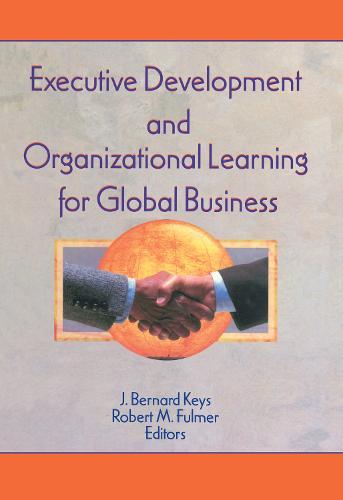
Executive Development and Organizational Learning for Global Business

Author:   Erdener Kaynak ,  Robert M Fulmer ,  J Bernard Keys ,  J. Bernard Keys
Publisher:   Taylor & Francis Inc
ISBN:  

9781560249832


Pages:   290
Publication Date:   16 April 1998
Format:   Hardback
Availability:   In Print   Availability explained
This item will be ordered in for you from one of our suppliers. Upon receipt, we will promptly dispatch it out to you. For in store availability, please contact us.

Our Price $189.00 Quantity:  
Add to Cart

Share |

Executive Development and Organizational Learning for Global Business


Overview

Full Product Details

Author:   Erdener Kaynak ,  Robert M Fulmer ,  J Bernard Keys ,  J. Bernard Keys
Publisher:   Taylor & Francis Inc
Imprint:   Routledge
Dimensions:   Width: 15.60cm , Height: 2.50cm , Length: 23.40cm
Weight:   0.700kg
ISBN:  

9781560249832


ISBN 10:   1560249838
Pages:   290
Publication Date:   16 April 1998
Audience:   General/trade ,  Professional and scholarly ,  General ,  Professional & Vocational
Format:   Hardback
Publisher's Status:   Active
Availability:   In Print   Availability explained
This item will be ordered in for you from one of our suppliers. Upon receipt, we will promptly dispatch it out to you. For in store availability, please contact us.

Table of Contents

Contents About the Editors Contributors Introduction: Seven Imperatives for Executive Education and Organizational Learning in the Global World Think and Act Globally Become an Equidistant Global Learning Organization Focus on the Global System, Not Its Parts Develop Global Leadership Skills Empower Teams to Create a Global Future Make Learning a Core Competence for Your global Organization Regularly Reinvent Yourself and the Global Organization PART I: GLOBALIZATION AND LEARNING Chapter 1. Anticipatory Learning for Global Organization The Organizational Learning Imperative All Learning Is Not Equal The Organizational Learning Matrix Forecasting versus Creating the Future From the Forecasted Future to the Invented Future Summary and Conclusion Chapter 2. Do Cultural Differences Make a Difference? Contextual Factors Affecting Cross-cultural Relationship Success In Search of Cultural Differences The Foreign Acquisitions Study Culture versus Context as an Explanatory Factor Contextual Factors as Key Determinants of Cross-Cultural Relationship Success The Negative Side of Cross-Cultural Interaction: Threat and Prejudice The Attribution of Organizational Problems to National Culture Conclusion Chapter 3. Managing Globally Competent People Transnationally Competent Managers The Globalization of Business: Strategy, Structure, and Managerial Skills Transnational Human Resource Systems Today's Firms: How Transnational? Illusions and Recommendations Chapter 4. Creating a High-Performance International Team Establishing the Context of the Growing Number of International Teams Creating and Managing an International Team Managing the Geographical Distances Managing Globally Competent People Creating a High Performance International Team (Sue Canney Davison) Establishing the Context of the Growing Number of International Teams Creating and Managing an international Team Managing the Geographical Distances Working Within the Team PART II: DEVELOPING THE GLOBAL EXECUTIVE Chapter 5. Selecting Training Methodology for International Managers A Model for Managerial Training for International Assignments A Theoretical Base for Training Methodology Management Development Methods Developing Cognitive Competencies Developing Behavioral Competencies with Experiential Methods Developing Performance Competencies Summary and Case Application of the Training Model Recommendations for future Research Chapter 6. Creating Scenarios and Cases for Global Anticipatory Learning Review of Anticipatory Learning Program Issues Scenario Planning Cases Conclusion Chapter 7. A Culture-General Assimilator: Preparation for Various Types of Sojourns Introduction Rationale for Materials Development The Culture-Assimilator Format Learning the Ropes The Themes Around Which the One Hundred Incidents Were Developed Uses for Culture-General Assimilator Conclusion Chapter 8. Action Learning: Executive Development of Choice for the 1990s What Is Action Learning? Traditional Approaches to Action Learning Unique Action Learning Adaptations Summary Chapter 9. Case Studies of International Management Development Needs Analysis for International Training Program Design and Development Training for Trainers Cultural Awareness International Negotiation Consulting in a Multicultural Environment Communication in a International Context Expatriate Preparation Managing Internationally An Application by ICM Management Training in Russia: Traps and Gaps PART III: DEVELOPING THE LEARNING ORGANIZATION Chapter 10. Systems Dynamics and Anticipatory Learning Examples of Microworlds

Reviews

Author Information

Kaynak, Erdener; Fulmer, Robert M; Keys, J Bernard

Tab Content 6

Author Website:  

Countries Available

All regions
Latest Reading Guide

NOV RG 20252


Shopping Cart
Your cart is empty
Shopping cart
Mailing List