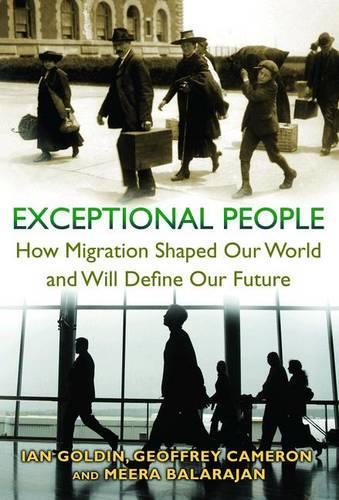
Full Product Details
Author: Ian Goldin ,
Geoffrey Cameron ,
Meera Balarajan
Publisher: Princeton University Press
Imprint: Princeton University Press
Dimensions:
Width: 15.20cm
, Height: 3.60cm
, Length: 23.50cm
Weight: 0.709kg
ISBN: 9780691145723
ISBN 10: 0691145725
Pages: 384
Publication Date: 24 April 2011
Audience:
College/higher education
,
College/higher education
,
Postgraduate, Research & Scholarly
,
Tertiary & Higher Education
Format: Hardback
Publisher's Status: Out of Print
Availability: In Print

Limited stock is available. It will be ordered for you and shipped pending supplier's limited stock.
Language: English
Reviews
In Exceptional People, the authors carry out an evenhanded assessment of the costs and benefits of international migration. They find that all involved--the countries that receive immigrants, those that send them, and immigrants most of all--prosper when movement across borders is allowed without hindrance. Anti-immigration campaigners who consult Exceptional People will encounter hard-to-refute arguments that favor free movement; advocates of open borders will find in the book the data and reasoning they need to fortify their case. -- Karunesh Tuli, ForeWord Reviews
In Exceptional People, Ian Goldin and Geoffrey Cameron, of the University of Oxford, carry out an evenhanded assessment of the costs and benefits of international migration. They find that all involved--the countries that receive immigrants, those that send them, and immigrants most of all--prosper when movement across borders is allowed without hindrance. Anti-immigration campaigners who consult Exceptional People will encounter hard-to-refute arguments that favor free movement; advocates of open borders will find in the book the data and reasoning they need to fortify their case. -- Karunesh Tuli, ForeWord Reviews
Goldin's conclusion is that western governments should simply accept the inevitable and open their borders, in line with economic demand--albeit within the framework of some pan-national treaty and institution. After all, as he points out, it is odd that there is no global body to oversee the movement of people, as there is with finance and trade. If that liberalization occurred, he thinks it would deliver an 'economic boost as high as $39,000bn over 25 years'. More surprisingly, he also argues that a 'tipping point' will be reached soon, which could shift the political debate. As world population levels stabilize in the next 50 years, a global labor shortage could prompt fierce competition for migrants. -- Gillian Tett, Financial Times In Exceptional People, the authors carry out an evenhanded assessment of the costs and benefits of international migration. They find that all involved--the countries that receive immigrants, those that send them, and immigrants most of all--prosper when movement across borders is allowed without hindrance. Anti-immigration campaigners who consult Exceptional People will encounter hard-to-refute arguments that favor free movement; advocates of open borders will find in the book the data and reasoning they need to fortify their case. -- Karunesh Tuli, ForeWord Reviews This is a book of bold ambitions ably fulfilled. Mr. Goldin and his co-authors offer a history of migration, from man's earliest wanderings in Africa to the present day... After filling in the historical background, the authors give a rigorous but readable guide to the costs and benefits of modern migration. -- The Economist
Goldin's conclusion is that western governments should simply accept the inevitable and open their borders, in line with economic demand--albeit within the framework of some pan-national treaty and institution. After all, as he points out, it is odd that there is no global body to oversee the movement of people, as there is with finance and trade. If that liberalization occurred, he thinks it would deliver an 'economic boost as high as $39,000bn over 25 years'. More surprisingly, he also argues that a 'tipping point' will be reached soon, which could shift the political debate. As world population levels stabilize in the next 50 years, a global labor shortage could prompt fierce competition for migrants. -- Gillian Tett, Financial Times In Exceptional People, the authors carry out an evenhanded assessment of the costs and benefits of international migration. They find that all involved--the countries that receive immigrants, those that send them, and immigrants most of all--prosper when movement across borders is allowed without hindrance. Anti-immigration campaigners who consult Exceptional People will encounter hard-to-refute arguments that favor free movement; advocates of open borders will find in the book the data and reasoning they need to fortify their case. -- Karunesh Tuli, ForeWord Reviews This is a book of bold ambitions ably fulfilled. Mr. Goldin and his co-authors offer a history of migration, from man's earliest wanderings in Africa to the present day... After filling in the historical background, the authors give a rigorous but readable guide to the costs and benefits of modern migration. -- The Economist Exceptional People is an absorbing study albeit academic. It strongly advocates the need to establish a global migration agenda and clearly shows that the advantages of migration far outweigh the disadvantages: Migration Shaped Our World and Will Define Our Future. -- Arab News Exceptional People is an excellent book. It would make a great addition to readings lists for graduate and advanced undergraduate courses dealing extensively with migration. Its wide scope will provide plenty of ideas for new academic projects, and its conclusions invite reflection and further discussion. -- Chris Minns, EH.net
Author Information
Ian Goldin is director of the Oxford Martin School, University of Oxford, and professorial fellow at Balliol College, Oxford. He has served as vice president of the World Bank and advisor to President Nelson Mandela, and chief executive of the Development Bank of Southern Africa. His many books include ""Globalization for Development"". Geoffrey Cameron is a research associate at the Oxford Martin School, University of Oxford. He is currently principal researcher with the Baha'i Community of Canada. Meera Balarajan holds a PhD from the University of Cambridge and works for a research organization in the United Kingdom. She has also worked for the United Nations, a UK government department, and a grassroots NGO in India.