Overview
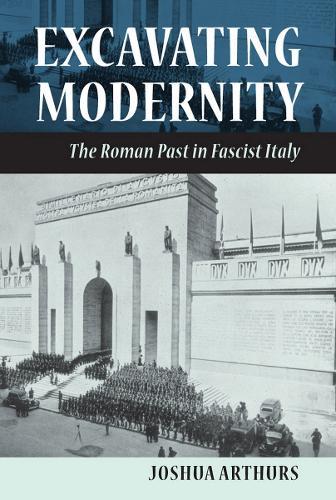
The cultural and material legacies of the Roman Republic and Empire in evidence throughout Rome have made it the ""Eternal City."" Too often, however, this patrimony has caused Rome to be seen as static and antique, insulated from the transformations of the modern world. In Excavating Modernity, Joshua Arthurs dramatically revises this perception, arguing that as both place and idea, Rome was strongly shaped by a radical vision of modernity imposed by Mussolini's regime between the two world wars. Italian Fascism's appropriation of the Roman past-the idea of Rome, or romanita- encapsulated the Fascist virtues of discipline, hierarchy, and order; the Fascist ""new man"" was modeled on the Roman legionary, the epitome of the virile citizen-soldier. This vision of modernity also transcended Italy's borders, with the Roman Empire providing a foundation for Fascism's own vision of Mediterranean domination and a European New Order. At the same time, romanita also served as a vocabulary of anxiety about modernity. Fears of population decline, racial degeneration and revolution were mapped onto the barbarian invasions and the fall of Rome. Offering a critical assessment of romanita and its effects, Arthurs explores the ways in which academics, officials, and ideologues approached Rome not as a site of distant glories but as a blueprint for contemporary life, a source of dynamic values to shape the present and future.
Full Product Details
Author: Joshua Arthurs
Publisher: Cornell University Press
Imprint: Cornell University Press
Dimensions:
Width: 15.50cm
, Height: 2.10cm
, Length: 23.50cm
Weight: 0.907kg
ISBN: 9780801449987
ISBN 10: 0801449987
Pages: 232
Publication Date: 15 August 2012
Audience:
General/trade
,
General
Format: Hardback
Publisher's Status: Active
Availability: Manufactured on demand

We will order this item for you from a manufactured on demand supplier.
Language: English
Reviews
Arthurs does an excellent job in showing the debates and struggles between contrasting visions of Romanita' in the 1938-1945 period... In the end, Arthurs's book is an enormous contribution to our understanding of the fascist cultural project. -Paul Baxa, American Historical Review (Dec 2013) Is there anything left to say about Fascist Italy's connections to the country's Roman past? Surprisingly enough, there is, and Joshua Arthurs's new book illustrates how non-party institutions configured the image of that past institutionally, outside of the party and regime propaganda machines... Arthurs's narrative is crisp, lucid and rich with little-known and often unknown information. The particular accomplishment here is the detailed and thoughtful examination of seldom-studied institututions and the individuals who comprised them that were not explicitly fascist, but whose studies, exhibits, journals, and conferences cohered with the Regime. -Diane Yvonne Ghirardo, Canadian Journal of History (Autumn 2013) That Italian fascism would adopt Rome as a fundamental part of its ideology, though it seems obvious now, was not a given at the start of the movement. As Joshua Arthurs notes, Rome was associated with the decadent liberal state and with the Catholic Church. Fascism, in contrast, meant modernity and dynamism... Arthurs has given us an excellent, concise summary of what Rome meant to fascism. It is a valuable guide to scholars and to general readers. -Alexander De Grand,The Historian(Spring 2014) Excavating Modernity is an original and nuanced study of the Italian Fascist regime's engagement with and exploitation of the immense heritage of ancient Rome. -Ruth Ben-Ghiat, New York University, author of Fascist Modernities: Italy, 1922-1945 In Excavating Modernity, Joshua Arthurs makes a valuable contribution to our understanding of Italian Fascist ideology and the centrality of the myth of Rome: romanita. He challenges the notion that romanita meant only bombast and nostalgia by dwelling on Rome's past greatness. Instead he shows that it also provided a model for modernity. Mussolini gathered classicists, archeologists, and historians in the Istituto di Studi Romani to present to the Italian people a road map to Italy's future unity and strength in a program of national regeneration. Arthurs's well-researched book is a welcome addition to the growing historical literature on Mussolini's use of Rome to mobilize Italians for his new Fascist Empire. -Borden W. Painter Jr., Trinity College, author of Mussolini's Rome: Rebuilding the Eternal City Romanita has been a ubiquitous conceptual anchor in the analysis of the Fascist regime's fascination with Rome's histories and myths. While its relevance to Fascist ideology, discourse, and propaganda has been widely acknowledged, the concept itself has often been too easily juxtaposed to Fascism's 'modernist' streak. Joshua Arthurs's fascinating and multilayered exploration offers a much-needed redress: the appropriation of the Roman past as history, aesthetics, physical space, and a set of values by the Fascist regime points to a decidedly revolutionary project that was underpinned by a unique transformational dynamic. Arthurs's idea of a Fascist excavation of romanita presents its investment in the ancient Roman past as a genuine, wholesale, and active attempt to redeem and mold it, both in physical terms within the urban space and as a timeless symbolic capital to be reclaimed in order to be (re)produced. In this respect, this book establishes Fascist romanita as different from previous iterations of the myth of Rome in modern Western and Italian political cultures. -Aristotle Kallis, Lancaster University, author of Genocide and Fascism: The Eliminationist Drive in Fascist Europe
<p> Romanit has been a ubiquitous conceptual anchor in the analysis of the Fascist regime's fascination with Rome's histories and myths. While its relevance to Fascist ideology, discourse, and propaganda has been widely acknowledged, the concept itself has often been too easily juxtaposed to Fascism's 'modernist' streak. Joshua Arthurs's fascinating and multilayered exploration offers a much-needed redress: the appropriation of the Roman past as history, aesthetics, physical space, and a set of values by the Fascist regime points to a decidedly revolutionary project that was underpinned by a unique transformational dynamic. Arthurs's idea of a Fascist excavation of romanit presents its investment in the ancient Roman past as a genuine, wholesale, and active attempt to redeem and mold it, both in physical terms within the urban space and as a timeless symbolic capital to be reclaimed in order to be (re)produced. In this respect, this book establishes Fascist romanit as different from previous iterations of the myth of Rome in modern Western and Italian political cultures. -Aristotle Kallis, Lancaster University, author of Genocide and Fascism: The Eliminationist Drive in Fascist Europe
<p> Romanita has been a ubiquitous conceptual anchor in the analysis of the Fascist regime's fascination with Rome's histories and myths. While its relevance to Fascist ideology, discourse, and propaganda has been widely acknowledged, the concept itself has often been too easily juxtaposed to Fascism's 'modernist' streak. Joshua Arthurs's fascinating and multilayered exploration offers a much-needed redress: the appropriation of the Roman past as history, aesthetics, physical space, and a set of values by the Fascist regime points to a decidedly revolutionary project that was underpinned by a unique transformational dynamic. Arthurs's idea of a Fascist excavation of romanita presents its investment in the ancient Roman past as a genuine, wholesale, and active attempt to redeem and mold it, both in physical terms within the urban space and as a timeless symbolic capital to be reclaimed in order to be (re)produced. In this respect, this book establishes Fascist romanita as different from previous iterations of the myth of Rome in modern Western and Italian political cultures. -Aristotle Kallis, Lancaster University, author of Genocide and Fascism: The Eliminationist Drive in Fascist Europe
Author Information
Joshua Arthurs is Assistant Professor of History at West Virginia University.