Overview
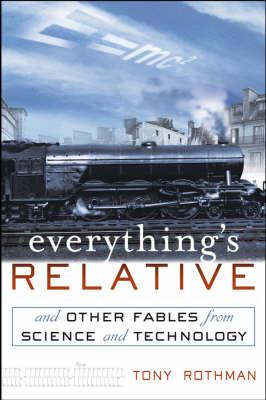
The surprising truth behind many of the most cherished ""facts"" in science history Morse invented the telegraph, Bell the telephone, Edison the light bulb, and Marconi the radio ...right? Well ...the truth is slightly more complicated. The history of science and technology is riddled with apocrypha, inaccuracies, and falsehoods, and physicist Tony Rothman has taken it upon himself to throw a monkey wrench into the works. Combining a storyteller's gifts with a scientist's focus and hardheaded devotion to the facts-such as they may be-Rothman breaks down many of the most famous ""just-so"" stories of physics, astronomy, chemistry, biology, and technology to give credit where credit is truly due. From Einstein's possible misunderstanding of his own theories to actress Hedy Lemarr's role in the invention of the radio-controlled torpedo, he dredges his way through the legends of science history in relating the fascinating stories behind some of the most important, and often unsung, breakthroughs in science. Tony Rothman, PhD (Bryn Mawr, PA), is a Research Associate at Bryn Mawr College. He is the author of seven other critically acclaimed science books and a frequent contributor to leading science publications, including Scientific American and Discover.
Full Product Details
Author: Tony Rothman
Publisher: Turner Publishing Company
Imprint: John Wiley & Sons Inc
Dimensions:
Width: 16.10cm
, Height: 2.50cm
, Length: 23.20cm
Weight: 0.536kg
ISBN: 9780471202578
ISBN 10: 0471202576
Pages: 272
Publication Date: 01 September 2003
Audience:
College/higher education
,
General/trade
,
Professional and scholarly
,
Tertiary & Higher Education
,
General
Format: Hardback
Publisher's Status: Active
Availability: Awaiting stock 
The supplier is currently out of stock of this item. It will be ordered for you and placed on backorder. Once it does come back in stock, we will ship it out for you.
Table of Contents
Preface. Lapses, Sources, and Acknowledgments. I. THE DOMAIN OF PHYSICS AND ASTRONOMY. 1. The Mafia Invents the Barometer. 2. The Riddle of the Sphinx: Thomas Young's Experiment. 3. Joseph Henry and the (Near) Discovery of (Nearly) Everything. 4. Neptune: The Greatest Triumph in the History of Astronomy, or the Greatest Fluke? 5. Invisible Light: The Discovery of Radioactivity. 6. Light, Ether, Corpuscles, and Charge: The Electron. 7. Einstein's Miraculous Year (and a Few Others). 8. What Did the Eclipse Expedition Really Show? And Other Tales of General Relativity. 9. Two Quantum Tales: Bohr and Hydrogen, Dirac and the Positron. 10. A Third Quantum Tale: Southpaw Electrons and Discounted Luncheons. II. THE DOMAIN OF TECHNOLOGY. 11. What Hath God Wrought? Shadows of Forgotten Ancestors, Samuel Morse, and the Telegraph. 12. Fiat Lux: Edison, the Incandescent Bulb, and a Few Other Matters. 13. Magna Est Veritas et Praevalet : The Telephone. 14. A Babble of Incoherence: The Wireless Telegraph, a.k.a. Radio. 15. Mind-Destroying Rays: Television. 16. Plausibility: The Invention of Secret Electronic Communication. III. THE DOMAIN OF CHEMISTRY AND BIOLOGY. 17. The Evolution of Evolution: Erasmus, Charles, Gregor, and Ronald. 18. Dreams with Open Eyes: Kekule, Benzene, and Loschmidt. 19. Chance, Good and Bad: Penicillin. IV. THE DOMAIN OF MATHEMATICS: CLOSED FOR RENOVATION. References and Notes. Index.
Reviews
. .. its real strength is the way it rehabilitates some of the great unknowns in scientific history... ( Focus , May 2004) <p> The writing is witty, scientifically sound, and unburdened with extensive footnotes and literature references. ( The Alchemist , 26 March 2004) <p> . ..informative and well researched, this is a surprisingly new look at some very old stories. ( Good Book Guide , April 2004) <p> It's hard to think of a more wonderful science writer than Tony Rothman. ( San Francisco Examiner ) <p> Tony Rothman is...a physicist who writes well and lucidly. His Hallmark is a rare attention to detail combined with abhorrence of any hint of condescension and an emphasis on the lighter side of physics. (Joseph Silk, Science magazine) <p> . ..enthralling... ( New Scientist , 17 January 2004)
From Renaissance Italy to modern day London, Tony Rothman takes us on a behind the scenes tour of the real history of science. Heroes are exposed as frauds, visionaries appear blind and the understudies of the plot become its stars. Morse, for example, didn't invent the telegraph. Alexander Graham Bell didn't produce the first telephone. Neptune was discovered only by accident. Kekule never dreamed up the origins of organic chemistry while asleep in the back of a Clapham omnibus. Even some of Einstein's thoughts were less original than he would have you believe. Darwin too comes under close scrutiny. His guilty secret? His grandfather Erasmus who at first he tried to ignore and then later eulogised, had some surprisingly vivid thoughts on the subject of evolution. This book is informative, well researched and good to read. In each episode legends are destroyed as a new mythology arises. Scientists appear not as academics but as professionals driven by kudos, fame, money and greed. The biologist may find it top-heavy with stories from physics and technology. And there are still some unsung heroes who don't get a mention. Tony Rothman has, however, produced a surprisingly new look at some very old stories. (Kirkus UK)
“… its real strength is the way it rehabilitates some of the great unknowns in scientific history…” ( Focus , May 2004) <p> “The writing is witty, scientifically sound, and unburdened with extensive footnotes and literature references.” ( The Alchemist , 26 March 2004) <p> “…informative and well researched, this is a surprisingly new look at some very old stories.” ( Good Book Guide , April 2004) <p> It's hard to think of a more wonderful science writer than Tony Rothman. ( San Francisco Examiner ) <p> Tony Rothman is...a physicist who writes well and lucidly. His Hallmark is a rare attention to detail combined with abhorrence of any hint of condescension and an emphasis on the lighter side of physics. (Joseph Silk, Science magazine) <p> . ..enthralling... ( New Scientist , 17 January 2004)
Author Information
TONY ROTHMAN is a physicist and writer. He is the author of seven other critically acclaimed science books and a frequent contributor to leading science publications, including Scientific American and Discover.
Tab Content 6
Author Website:
Countries Available
All regions
|