Overview
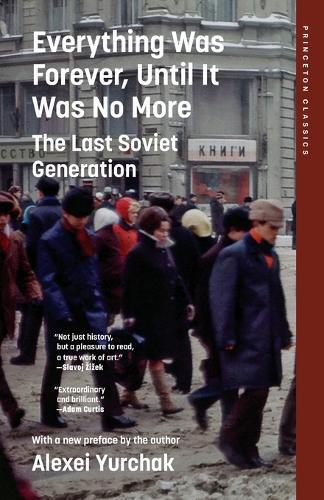
""[An] extraordinary book.""-Brian Eno ""One of the best books about the U.S.S.R. in its late stage.""-Alexei Navalny, from Patriot: A Memoir ""Not just history, but a pleasure to read, a true work of art.""-Slavoj iek ""Extraordinary and brilliant.""-Adam Curtis, director of HyperNormalisation A fascinating exploration of ""hypernormalization"" in a political system that seemed powerful and eternal-even when it was on the verge of collapse Soviet socialism was based on paradoxes that were revealed by the peculiar experience of its collapse. To the people who lived in that system the collapse seemed both completely unexpected and completely unsurprising. At the moment of collapse it suddenly became obvious that Soviet life had always seemed simultaneously eternal and stagnating, vigorous and ailing, bleak and full of promise. Although these characteristics may appear mutually exclusive, in fact they were mutually constitutive. This book explores the paradoxes of Soviet life during the period of ""late socialism"" (1960s-1980s) through the eyes of the last Soviet generation. Focusing on the major transformation of the 1950s at the level of discourse, ideology, language, and ritual, Alexei Yurchak traces the emergence of multiple unanticipated meanings, communities, relations, ideals, and pursuits that this transformation subsequently enabled. His historical, anthropological, and linguistic analysis draws on rich ethnographic material from Late Socialism and the post-Soviet period. The model of Soviet socialism that emerges provides an alternative to binary accounts that describe that system as a dichotomy of official culture and unofficial culture, the state and the people, public self and private self, truth and lie-and ignore the crucial fact that, for many Soviet citizens, the fundamental values, ideals, and realities of socialism were genuinely important, although they routinely transgressed and reinterpreted the norms and rules of the socialist state.
Full Product Details
Author: Alexei Yurchak ,
Alexei Yurchak
Publisher: Princeton University Press
Imprint: Princeton University Press
ISBN: 9780691284484
ISBN 10: 0691284482
Pages: 496
Publication Date: 10 March 2026
Audience:
College/higher education
,
Professional and scholarly
,
General/trade
,
Postgraduate, Research & Scholarly
,
Professional & Vocational
Format: Paperback
Publisher's Status: Active
Availability: Not yet available, will be POD

This item is yet to be released. You can pre-order this item and we will dispatch it to you upon it's release. This is a print on demand item which is still yet to be released.
Reviews
""If there is a prize for best title of the year, this book surely deserves it. Alexei Yurchak . . . has written an interesting and provocative book about the way young Soviet Russians talked in the Brezhnev period and what they meant by what they said.""---Sheila Fitzpatrick, London Review of Books ""Everything Was Forever, Until It Was No More is an important book. . . . Everything Was Forever provides fresh paradigms that pack a hefty explanatory punch both with regard to its immediate subject matter and beyond. Its publication means that discussions of Soviet life, culture, and literature that rely on the old, rigid binarisms are going to seem instantly dated. . . . [T]his study is a must-read.""---Harriet Murav, Current Anthropology ""Amidst these prolix transformations in Russian language and civilization, Yurchak's contribution has come in the form of a deep listening.""---Bruce Grant, Slavic Review ""The strength of Yurchak's study is in its methodological-analytical grasp of the seemingly contradictory nature of everyday existence. . . . Yurchak provides an elegant methodological tool to explore the complex, intersecting and often paradoxical nature of social change.""---Luahona Ganguly, International Journal of Communication
""A brilliant anthropological reconstruction of the mental and cultural furniture of late Communism.""---Robert Grogin, Historian ""If there is a prize for best title of the year, this book surely deserves it. Alexei Yurchak . . . has written an interesting and provocative book about the way young Soviet Russians talked in the Brezhnev period and what they meant by what they said.""---Sheila Fitzpatrick, London Review of Books ""Everything Was Forever, Until It Was No More is an important book. . . . [It] provides fresh paradigms that pack a hefty explanatory punch both with regard to its immediate subject matter and beyond. Its publication means that discussions of Soviet life, culture, and literature that rely on the old, rigid binarisms are going to seem instantly dated. . . . This study is a must-read.""---Harriet Murav, Current Anthropology ""Amidst these prolix transformations in Russian language and civilization, Yurchak's contribution has come in the form of a deep listening.""---Bruce Grant, Slavic Review ""The strength of Yurchak's study is in its methodological-analytical grasp of the seemingly contradictory nature of everyday existence. . . . Yurchak provides an elegant methodological tool to explore the complex, intersecting and often paradoxical nature of social change.""---Luahona Ganguly, International Journal of Communication
""Everything Was Forever, Until It Was No More is an important book. . . . [It] provides fresh paradigms that pack a hefty explanatory punch both with regard to its immediate subject matter and beyond. Its publication means that discussions of Soviet life, culture, and literature that rely on the old, rigid binarisms are going to seem instantly dated. . . . This study is a must-read.""---Harriet Murav, Current Anthropology ""A brilliant anthropological reconstruction of the mental and cultural furniture of late Communism.""---Robert Grogin, Historian ""Amidst these prolix transformations in Russian language and civilization, Yurchak's contribution has come in the form of a deep listening.""---Bruce Grant, Slavic Review ""If there is a prize for best title of the year, this book surely deserves it. Alexei Yurchak . . . has written an interesting and provocative book about the way young Soviet Russians talked in the Brezhnev period and what they meant by what they said.""---Sheila Fitzpatrick, London Review of Books ""The strength of Yurchak's study is in its methodological-analytical grasp of the seemingly contradictory nature of everyday existence. . . . Yurchak provides an elegant methodological tool to explore the complex, intersecting and often paradoxical nature of social change.""---Luahona Ganguly, International Journal of Communication
Author Information
Alexei Yurchak is professor of anthropology at the University of California, Berkeley.