Overview
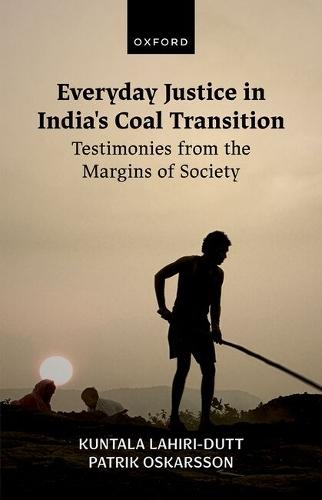
Everyday Justice in India's Coal Transition reimagines the concept of justice by exploring what a 'just transition' away from coal could look like in the Indian context. It defines 'everyday justice' more broadly to include informal economies and labour and the realities of human lives that have been fundamentally altered by coal mining. In doing so, it acknowledges the rights of local communities to make choices about their own future, have attachments to their own place and other local people, and finally, participate in political decisions and hold property. It builds a compelling case for everyday justice in India's coal transition through three kinds of evidence: testimonies collected from the same individuals over more than two decades, beginning in the late 1990s, to present a temporal view of their altered livelihoods and worldviews; a detailed examination of coal production and transport by various agents and unconventional labour arrangements therein; and the degradation of the landscape and decay of peasantry in older coal mining regions situated near the Jharkhand region in eastern India. Through decades of research, observation, interaction, and conversation with people, Lahiri-Dutt and Oskarsson provide vital insights for those aiming to understand grassroots perspectives and the need for multiple approaches to justice.
Full Product Details
Author: Kuntala Lahiri-Dutt (Emeritus Professor, Emeritus Professor, Resources, Environment and Development Program, Crawford School of Public Policy, Australian National University) ,
Patrik Oskarsson (Associate Professor, Associate Professor, Department of Urban and Rural Development, Swedish University of Agricultural Sciences)
Publisher: Oxford University Press
Imprint: Oxford University Press
ISBN: 9780198993490
ISBN 10: 0198993498
Pages: 208
Publication Date: 30 April 2026
Audience:
Professional and scholarly
,
Professional & Vocational
Format: Hardback
Publisher's Status: Forthcoming
Availability: To order

Reviews
This book is about more than giving voice to those who would ordinarily be unheard in the coal transition. A fieldwork-based study over decades, the book chooses to be clinical in parts, but at the same time cannot help being poignant in many places. It will be a definitive work for those interested in narratives beyond those formally recorded or as per norms of formal compensation, instead focusing on the most marginalized and vulnerable. As Lahiri-Dutt and Oskarsson point out, development cannot be separated from justice, for which we need to think of 'everyday justice' instead of conventional models of justice. * Dr. Rahul Tongia, Senior Fellow, Centre for Social and Economic Progress (CSEP) * Everyday Justice in India's Coal Transition presents a remarkable longitudinal ethnographic study of the impacts of India's coal boom. The book is centred on the coalfields of Jharkhand in India's east. Tracking affected communities over three decades, the book evidences the logic of India's coal curse and foregrounds displaced Indigenous peoples and exploited workers. Most important, the book explores what this means for Indian democracy -- for the future of affected peoples and for Indigenous Adivasi mobilization. As the authors suggest, India 'has a tremendous opportunity to reconcile past injustices in coal regions while envisioning a new, coal-free future through decentralized governance, community participation, and bottom-up development'. * James Goodman, Professor, University of Technology Sydney *
Author Information
Emeritus Professor Kuntala Lahiri-Dutt, AO, is at the Resources, Environment and Development (RE&D) Program at the Crawford School of Public Policy, Australian National University. Her research and publications have contributed to the social and ecological aspects of resources as they relate to people's livelihoods in South and Southeast Asian countries, in particular, to both large industrial and informal or artisanal small-scale mines and quarries, rivers and water, and the feminization of agriculture in rural communities. Both international and grassroots-level development organizations have used her work. The World Bank's Just Transition Centre published her monograph Just Transition for All: A Feminist Approach for the Coal Sector, and the United Nations Environment Program's Extractive Industries Governance Group sought her contributions to their report on Mineral Resource Governance in the 21st Century. Patrik Oskarsson is an established researcher focusing on resource politics, especially over India's extractive industries, land use, and environmental consultations. His primary theoretical focus is the political ecology of resource conflicts using bottom-up approaches. He has also worked and taught in a wide range of countries, and his research and teaching engage with resource-related and ecological challenges in developing countries, as well as social science methods.