Overview
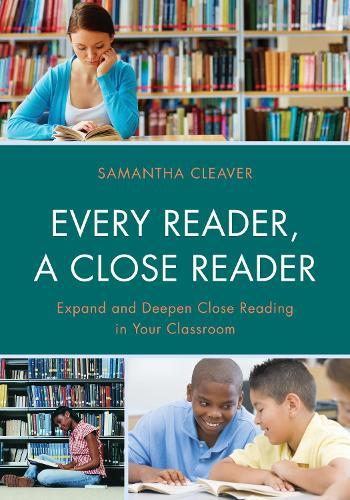
Close reading, the purposeful, focused reading and rereading of text, is more than an education buzzword. Every Reader, a Close Reader defines and unpacks the components of close reading and explores how to apply it within the context of the Common Core State Standards so that every student will be able to implement close reading strategies in class and independently. Drawing expertise and ideas from research, as well as teachers from across the country, Every Reader, a Close Reader serves as both an instructional guide and professional development tool for classroom teachers and instructional leaders to use when starting or strengthening close reading at the classroom level. In addition, this book includes chapters that focus on developing the close reading skills of students who are struggling readers, English language learners, or gifted learners.
Full Product Details
Author: Samantha Cleaver
Publisher: Bloomsbury Publishing Plc
Imprint: Rowman & Littlefield
Dimensions:
Width: 17.80cm
, Height: 2.30cm
, Length: 25.40cm
Weight: 0.771kg
ISBN: 9781475814736
ISBN 10: 1475814739
Pages: 252
Publication Date: 17 July 2015
Audience:
Professional and scholarly
,
Professional & Vocational
Format: Hardback
Publisher's Status: Active
Availability: In Print

This item will be ordered in for you from one of our suppliers. Upon receipt, we will promptly dispatch it out to you. For in store availability, please contact us.
Reviews
This book is a must-read for instructional coaches. Cleaver provides useful information and guidance for planning for close reading. As our school implements close reading as a practice, I know Every Reader a Close Reader will be my go-to guide for the next few years. -- Elena Trotta, ELA Instructional Coach, Arthur T. Talmadge Elementary School, Springfield, MA This book serves as a wonderful resource for both general and special educators in the field. Comprehensive and up-to-date, professionals will find it highly useful, as the material presented is well written and reader-friendly. By using the Common Core State Standards (CCSS) as a frame of reference, as well as personal experiences and teacher examples, the author provides a very strong foundation of the importance of close reading in the classroom. -- George Giuliani, JD, Psy.D, Executive Director of the American Academy of Special Education Professionals In an educational landscape where close reading and text-dependent questions are buzzwords, this book brings the act of close reading alive in a way that can be immediately put to use in the classroom. Every Reader a Close Reader gives teachers and instructional leaders the foundational knowledge needed to understand why adopting the approach of close reading is important for all readers, while making it clear that there is not one way to implement the approach and giving concrete examples of how it will change depending on classroom context. Every Reader a Close Reader clears the misconceptions about close reading, bringing the ah-ha moments for instructional coaches and teachers. -- Lo Nigrosh, director of school support, The Achievement Network, former ELL teacher Many articles and books have addressed the Common Core Standards. Even though most materials provide a sound understanding of the standards and potential ways to embed them, there hasn't been a how to like Samantha Cleaver's book for close reading. Through her research, she invites you into classrooms to discover other teacher's lessons and materials that have been utilized effectively in helping students meet the standards and develop their skills as readers. This is a vital read for all educators in all disciplines that looking for ways to implement the standards and help student grow as readers. -- Craig Wisniewski, instructional coach, Martin Kellogg Middle School, Hartford, CT This book provides a flexible and functional approach to close reading that is clear and helpful. This text is a valuable turn in ongoing pedagogical conversations, and will help teachers to understand the theory behind and the potential power of close reading, wisely modeled and mentored. Most importantly, it will help teachers in immediately applicable ways to assist their students to more engaged and agentive reading. A unique gift of this book is its emphasis on helping teachers reflect on their own reading and teaching, helping the reader to learn from classroom innovation and student response how to teach in more assistive and wide-awake ways. -- Jeffrey D. Wilhelm, Distinguished Professor of English Education at Boise State University; Director of the Boise State Writing Project
This book is a must-read for instructional coaches. Cleaver provides useful information and guidance for planning for close reading. As our school implements close reading as a practice, I know Every Reader a Close Reader will be my go-to guide for the next few years. -- Elena Trotta, ELA Instructional Coach, Arthur T. Talmadge Elementary School, Springfield, MA This book serves as a wonderful resource for both general and special educators in the field. Comprehensive and up-to-date, professionals will find it highly useful, as the material presented is well written and reader-friendly. By using the Common Core State Standards (CCSS) as a frame of reference, as well as personal experiences and teacher examples, the author provides a very strong foundation of the importance of close reading in the classroom. -- George Giuliani, JD, Psy.D, Executive Director of the American Academy of Special Education Professionals In an educational landscape where “close reading” and “text-dependent questions” are buzzwords, this book brings the act of close reading alive in a way that can be immediately put to use in the classroom. Every Reader a Close Reader gives teachers and instructional leaders the foundational knowledge needed to understand why adopting the approach of close reading is important for all readers, while making it clear that there is not one way to implement the approach and giving concrete examples of how it will change depending on classroom context. Every Reader a Close Reader clears the misconceptions about close reading, bringing the ""ah-ha"" moments for instructional coaches and teachers. -- Lo Nigrosh, director of school support, The Achievement Network, former ELL teacher Many articles and books have addressed the Common Core Standards. Even though most materials provide a sound understanding of the standards and potential ways to embed them, there hasn't been a ""how to"" like Samantha Cleaver's book for close reading. Through her research, she invites you into classrooms to discover other teacher's lessons and materials that have been utilized effectively in helping students meet the standards and develop their skills as readers. This is a vital read for all educators in all disciplines that looking for ways to implement the standards and help student grow as readers. -- Craig Wisniewski, instructional coach, Martin Kellogg Middle School, Hartford, CT This book provides a flexible and functional approach to close reading that is clear and helpful. This text is a valuable turn in ongoing pedagogical conversations, and will help teachers to understand the theory behind and the potential power of close reading, wisely modeled and mentored. Most importantly, it will help teachers in immediately applicable ways to assist their students to more engaged and agentive reading. A unique gift of this book is its emphasis on helping teachers reflect on their own reading and teaching, helping the reader to learn from classroom innovation and student response how to teach in more assistive and wide-awake ways. -- Jeffrey D. Wilhelm, Distinguished Professor of English Education at Boise State University; Author of “Reading Unbound: Why Kids Need to Read What They Want, and Why We Should Let Them”
Author Information
Samantha Cleaver has worked in education for more than a decade as a special education teacher and instructional coach. As a coach, Cleaver has worked with middle grade teachers and school leaders to focus and strengthen reading instruction.