|
Overview
Full Product Details
Author: Mike Duignan
Publisher: Taylor & Francis Ltd
Imprint: Routledge
Weight: 0.560kg
ISBN: 9781032786254
ISBN 10: 1032786256
Pages: 282
Publication Date: 15 December 2025
Audience:
College/higher education
,
Professional and scholarly
,
Tertiary & Higher Education
,
Professional & Vocational
Format: Paperback
Publisher's Status: Active
Availability: Not yet available 
This item is yet to be released. You can pre-order this item and we will dispatch it to you upon its release.
Table of Contents
Foreword Acknowledgements Introduction Section 1 – Soft Power and Propaganda Chapter 1: The 1936 Berlin Olympics: Propaganda, Spectacle, and the Politics of Sport. Gjoko Muratovski, Deakin University, USA. Chapter 2: How (Should?) the Olympics (Intentionally) Transform Society? Tim Elcombe, Wilfrid Laurier University, Canada. Chapter 3: All the Olympics are a stage, and all the athletes merely players: the Olympics as theatre. Timothy Olds, University of South Australia, Australia. Section 2 – Sports Washing and Rights Chapter 4: The Olympic industry: a threat to human rights, a threat to democracy. Helen Jefferson Lenskyj, University of Toronto, Canada. Chapter 5: The World Cup put the spotlight on Qatar, but also brought attention to its human rights record and politics. David Mednicoff, University of Massachusetts-Amherst, USA. Chapter 6: The Paralympic Games: an event having impact on the world stage but one not without its critics. Simon Darcy, University of Technology Sydney, Australia. David Legg, Mount Royal University, Canada. Chapter 7: Sportswashing - Manging state relations and reputations through associations with sport. Michael Skey, Loughborough University, UK. Section 3 – Diplomacy and Peace Chapter 8: Playbook for Peace? How World Events Disconnected Putin and Set a Precedence for Isolating Autocratic Regimes. Mike Duignan, University of Paris 1 (Pantheon-Sorbonne), France. Chapter 8b: Russia’s misfired sport diplomacy? Or our misunderstanding of the 2014 (Winter Olympics) and 2018 (FIFA World Cup) sports mega-events? Jonathan Grix, Manchester Metropolitan University, UK. Chapter 9: CONIFA events: organizing international football tournaments for unrecognized nations on divided lands. Joel Rookwood, University College Dublin, Ireland. Chapter 10: Ancient Ideals, Modern Problems: Pierre de Coubertin and the Olympic Games. Peter J. Miller, University of Winnipeg, USA. Chapter 11: Wimbledon 2022 and the Politics of Exclusion: Sport, Sanctions, and Governance in a Geopolitical Crisis Leon Davis, Teeside University, UK. Mike Duignan, University of Paris 1 (Pantheon-Sorbonne), France. Chapter 12: The Politics of Film Festivals: The Case of Dinard’s Festival of British Cinema. Neil Archer, Keele University, UK. Chapter 13: Global Games: a radical proposal for a sustainable future. Adam Talbot, University of the West of Scotland, UK. Stephen J. Mills, University of the West of Scotland, UK. Section 4 – Activism and Events as Platforms for Protest Chapter 14: The Politics of Sydney’s Gay and Lesbian Mardi Gras Leigh Boucher, Macquarie University, Australia. Michelle Arrow, Macquarie University, Australia. Chapter 15: Athlete activism and the Olympic movement: resistance, defiance, and restraint. Michelle O’Shea, Western Sydney University, Australia. Chris Yorke, University of Technology Sydney, Australia. Hazel Maxwell, University of Technology Sydney, Australia. Chapter 16: FIFA’s World Cup: A mirage of unity Daryl Adair, University of Technology Sydney, Australia. Chapter 17: Boycotting the Olympic Games: Effective Policy Tool or Futile Gesture? Ryan Gauthier, Thompson Rivers University, Canada. Chapter 18: The Olympics are democratically illegitimate: a call for democracy in sport. Jean-Paul Gagnon, Canberra University, Australia. Thomas D. Bunting, Shawnee State University, Ferdinand Sanchez II, Canberra University, Australia. Chapter 19: Black Lives Matter Protests Changed the US Landscape and Who Is Represented in Public Spaces. Shannon Smith, St. John’s University, USA. Section 5 – Power, Corruption, and Elitism Chapter 20: The 2022 FIFA World Cup and its potential anti-corruption legacy. Christina Philippou, University of Portsmouth, UK. Chapter 21: Ancient Athletic Contests and Greek Culture. Joel Christensen, Brandeis University, USA. Chapter 22: China and Sport Mega Events: An Ongoing Project. Alan Bairner, Loughborough University, UK. Chapter 22b: Fan parks at football mega-events: prioritizing security and improving the fan experience. Joel Rookwood, University College Dublin, UK. Section 6 – Nationalism and Historical Perspectives Chapter 23: Curating a Contemporary Dance Festival in Africa: Socio-Political Insights and Provocations from South Africa. Liliane Loots, University of KwaZulu-Natal, South Africa. Chapter 24: How ‘The Dragon of Shandon’ celebrates people, place, and culture on Halloween. Tony Matthews, Griffith University, Australia. Deanna Grant-Smith, Queensland University of Technology, Australia. Chapter 25: The New Olympics: How Tokyo Helped Reshape the Games. Sam Duncan, Homesglen Institute, Australia. Chapter 26: The Australian Open: An event that has grown alongside a nation. Hunter Fujak, Deakin University, Australia. Scott Field, Deakin University, Australia. Chapter 27: Goodbye Commonwealth Games Tom Heenan, Monash University, Australia. Conclusion and recommendations Index
Reviews
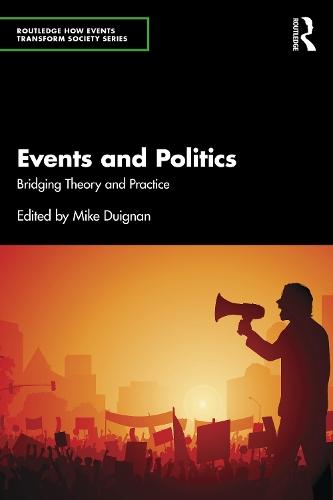
""This state-of-the-art collection brings together key researchers in events and politics. Discussing highly relevant topics, such as soft power, international relations, activism, corruption, and governance, this offering will be an important resource for graduate students and researchers alike."" Prof. Milena M. Parent, Telfer School of Management and School of Human Kinetics, University of Ottawa; Director, Executive Masters in Sport Organisation Management, English program ""This is an important and timely collection that brings together a diverse range of perspectives on the connections between events and politics. Understanding the politics of events will only become more vital in our turbulent times. Because it includes a mixture of historical and contemporary cases, this book will be valued by researchers and students who want to get a sense of the bigger picture issues in events research."" Dr James Kennell, Head of Surrey Hospitality and Tourism Management, University of Surrey, UK ""This edited collection makes a timely contribution to the field, bringing together a range of leading researchers to how events are implicated in geopolitical processes. I particularly liked the book’s coverage, including chapters on soft power, sport event diplomacy, sport washing, activism, and political power. This book will be an important reference point for researchers and students looking to understand more about how events are political and politicised, providing a platform for some actors to promote their political agendas, while also allowing others to contest it. The geographical coverage of the chapters also means that the book will be of interest to scholars across the world."" Prof. David McGillivray, Professor of Event and Digital Cultures, Centre of Culture, Sport and Events, University of the West of Scotland, UK “This timely and thought-provoking collection critically examines the political dimensions, on and off the field of play, of major events, including the increasingly important soft power benefits that hosting successful events can bring to the host nation or city. As we seek to harness the collective experience and unifying power of events, the multi-faceted political dimensions at play can enhance or work against that aim for unity and cohesion. Spanning sport, arts and culture, this collection will be of interest to those both looking at the history of events past, and considering the place that events could play in future.” Ruth Hollis OBE, Chief Executive, Spirit of 2012
""This state-of-the-art collection brings together key researchers in events and politics. Discussing highly relevant topics, such as soft power, international relations, activism, corruption, and governance, this offering will be an important resource for graduate students and researchers alike."" Prof. Milena M. Parent, Telfer School of Management and School of Human Kinetics, University of Ottawa; Director, Executive Masters in Sport Organisation Management, English program. ""This is an important and timely collection that brings together a diverse range of perspectives on the connections between events and politics. Understanding the politics of events will only become more vital in our turbulent times. Because it includes a mixture of historical and contemporary cases, this book will be valued by researchers and students who want to get a sense of the bigger picture issues in events research."" Dr James Kennell, Head of Surrey Hospitality and Tourism Management, University of Surrey, UK. ""This edited collection makes a timely contribution to the field, bringing together a range of leading researchers to how events are implicated in geopolitical processes. I particularly liked the book’s coverage, including chapters on soft power, sport event diplomacy, sport washing, activism, and political power. This book will be an important reference point for researchers and students looking to understand more about how events are political and politicised, providing a platform for some actors to promote their political agendas, while also allowing others to contest it. The geographical coverage of the chapters also means that the book will be of interest to scholars across the world."" Prof David McGillivray, Professor of Event and Digital Cultures, Centre of Culture, Sport and Events, University of the West of Scotland, UK. “This timely and thought-provoking collection critically examines the political dimensions, on and off the field of play, of major events, including the increasingly important soft power benefits that hosting successful events can bring to the host nation or city. As we seek to harness the collective experience and unifying power of events, the multi-faceted political dimensions at play can enhance or work against that aim for unity and cohesion. Spanning sport, arts and culture, this collection will be of interest to those both looking at the history of events past, and considering the place that events could play in future.” Ruth Hollis OBE, Chief Executive, Spirit of 2012.
Author Information
Mike Duignan is a Professeur at the Sorbonne, University of Paris 1 (Pantheon-Sorbonne) and Editor-in-Chief of Event Management Journal. Formerly, he was an Associate Professor and Department Chair of the Department of Events at the School of Hospitality and Tourism Management at the University of Surrey, where he was also the Director of the Observatory for Human Rights and Major Events. For the past 15 years, Mike has been researching, analysing, commentating, writing, publishing, and teaching on the economics and social impacts of staging major events.
Tab Content 6
Author Website:
Countries Available
All regions
|