Overview
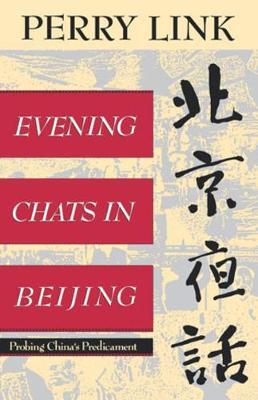
Chinese intellectuals have a traditional duty, for which there is no equivalent in the West: to worry, to """"take responsibility for all under heaven,” to argue the question """"What can we do with China?"""" In this “utterly absorbing gem of a book” (Library Journal), Perry Link conveys the worries besetting China’s most prominent writers, journalists, scientists, professors, and dissident officials. Link creates “an invaluable opening onto China’s best and brightest hearts and minds” (Kirkus Reviews), allowing the Chinese themselves to tell us why Beijing took to the streets in Spring 1989.
Full Product Details
Author: E. Perry Link
Publisher: WW Norton & Co
Imprint: WW Norton & Co
Edition: New edition
Dimensions:
Width: 14.00cm
, Height: 2.50cm
, Length: 21.10cm
Weight: 0.430kg
ISBN: 9780393310658
ISBN 10: 0393310655
Pages: 336
Publication Date: 17 September 1993
Audience:
College/higher education
,
Professional and scholarly
,
General/trade
,
Undergraduate
,
Postgraduate, Research & Scholarly
Format: Paperback
Publisher's Status: Active
Availability: Out of stock

The supplier is temporarily out of stock of this item. It will be ordered for you on backorder and shipped when it becomes available.
Reviews
Beautifully conceived and reported collection of musings by Chinese intellectuals, expertly stitched together by Link (Chinese Literature/Princeton). These conversations catch Chinese academics, scientists, writers, and dissidents at their most candid and despairing about the ebb and tide of democracy and authoritarianism in mid- and late-80's China. Two themes emerge clearly: that modern China's intellectuals, adamantly upholding their traditional role as the national conscience, are suffering deeply under Deng; and that a fierce pride prevents them from giving up their positions as dissidents. Link knows of this dilemma firsthand, having accompanied dissident physicist Fang Lizhi the night that he was turned away from Chinese leaders' farewell banquet for George Bush in 1989. Here, the dissidents' discussions portray China's social world as rife with political corruption, graft, nepotism, and guandao, or official profiteering; young intellectuals point to the students' rallying slogan at Tiananmen Square - Sell the Benzes to pay the national debt - as evidence of how far Party morality has sunk. The work-unit system, China's vast bureaucratic web headed by Party officials at every level, is described as a suffocating political octopus that fosters favoritism over efficiency. University professors lament underfunding for education and their own horrific living conditions, while historians wonder whatever became of China's long-ago commitment to liberty, equality, fraternity. Perhaps most unsettling is the portrait of China's disaffected youth, a political lost generation apparently subsumed by cynicism and ennui resulting from the failure of the student movement on what Chinese now call Six Four - June 4th, 1989. For his part, Link is both compassionate toward and critical of China's intellectual elite, concluding that more than brain power is needed to alleviate China's pain or restore its morale. An invaluable opening onto China's best and brightest hearts and minds. (Kirkus Reviews)