Awards
- Commended for 2017 Prix du Livre Europeen, Esprit d'Europe 2017
- Winner of Winner of the Leipzig Book Fair Prize.
Overview
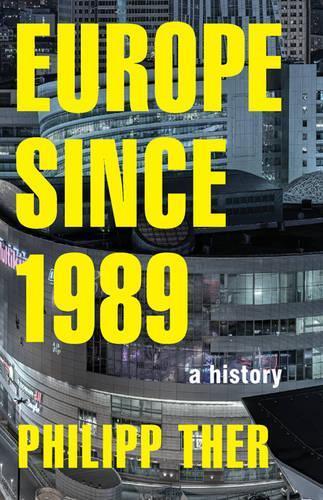
The year 1989 brought the fall of the Berlin Wall and the collapse of communism in Eastern Europe. It was also the year that the economic theories of Reagan, Thatcher, and the Chicago School achieved global dominance. And it was these neoliberal ideas that largely determined the course of the political, economic, and social changes that transformed Europe--both east and west--over the next quarter century. This award-winning book provides the first comprehensive history of post-1989 Europe. Philipp Ther--a firsthand witness to many of the transformations, from Czechoslovakia during the Velvet Revolution to postcommunist Poland and Ukraine--offers a sweeping narrative filled with vivid details and memorable stories. He describes how liberalization, deregulation, and privatization had catastrophic effects on former Soviet Bloc countries. He refutes the idea that this economic ""shock therapy"" was the basis of later growth, arguing that human capital and the ""transformation from below"" determined economic success or failure.Most important, he shows how the capitalist West's effort to reshape Eastern Europe in its own likeness ended up reshaping Western Europe as well, in part by accelerating the pace and scope of neoliberal reforms in the West, particularly in reunified Germany. Finally, bringing the story up to the present, Ther compares events in Eastern and Southern Europe leading up to and following the 2008-9 global financial crisis. A compelling and often-surprising account of how the new order of the New Europe was wrought from the chaotic aftermath of the Cold War, this is essential reading for understanding Europe today.
Full Product Details
Author: Philipp Ther ,
Charlotte Hughes-Kreutzmüller
Publisher: Princeton University Press
Imprint: Princeton University Press
Dimensions:
Width: 14.00cm
, Height: 3.80cm
, Length: 21.60cm
Weight: 0.652kg
ISBN: 9780691167374
ISBN 10: 0691167370
Pages: 440
Publication Date: 20 September 2016
Audience:
General/trade
,
College/higher education
,
Professional and scholarly
,
General
,
Tertiary & Higher Education
Format: Hardback
Publisher's Status: Active
Availability: Manufactured on demand

We will order this item for you from a manufactured on demand supplier.
Language: English
Reviews
Eye-opening. --Frankfurter Allegemeine Zeitung Groundbreaking ... and beautifully written. --Die Zeit Bound to become the standard work for Europe's transformation since 1989. --Frank Bosch, H-Net
His central thesis demands serious consideration. He argues that a 'neoliberal train,' put on track in Margaret Thatcher's Britain and Ronald Reagan's United States, began 'to cross Europe in 1989.' He says he uses neoliberalism 'as a neutral, analytical term,' and rightly distinguishes between its intellectual history and the specific social and political circumstances of its implementation. --Timothy Garton Ash, New York Review of Books Eye-opening. --Frankfurter Allegemeine Zeitung Groundbreaking ... and beautifully written. --Die Zeit Bound to become the standard work for Europe's transformation since 1989. --Frank Bosch, H-Net Recommended, not just the usual and interesting to see 'the West' treated as the periphery. Makes you wonder if eastern Europe ever had a chance. --Tyler Cowen, Marginal Revolution A very sobering read. --Yuval Levin, National Review [Europe since 1989] ... is well-documented. It can be recommended to general readers and students of postcommunist history in Europe. --Choice
[Europe since 1989] . . . is well-documented. It can be recommended to general readers and students of postcommunist history in Europe. --Choice A very sobering read. --Yuval Levin, National Review Recommended, not just the usual and interesting to see `the West' treated as the periphery. Makes you wonder if eastern Europe ever had a chance. --Tyler Cowen, Marginal Revolution Bound to become the standard work for Europe's transformation since 1989. --Frank Bosch, H-Net Groundbreaking . . . and beautifully written. --Die Zeit Eye-opening. --Frankfurter Allegemeine Zeitung His central thesis demands serious consideration. He argues that a `neoliberal train,' put on track in Margaret Thatcher's Britain and Ronald Reagan's United States, began `to cross Europe in 1989.' He says he uses neoliberalism `as a neutral, analytical term,' and rightly distinguishes between its intellectual history and the specific social and political circumstances of its implementation. --Timothy Garton Ash, New York Review of Books
Author Information
Philipp Ther is professor of Central European history and director of the Institute of European History at the University of Vienna.