Overview
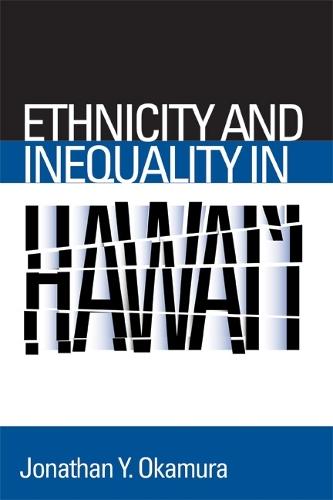
Challenging the dominant view of Hawai'i as a ""melting pot paradise""--a place of ethnic tolerance and equality--Jonathan Okamura examines how ethnic inequality is structured and maintained in island society. He finds that ethnicity, not race or class, signifies difference for Hawai'i's people and therefore structures their social relations. In Hawai'i, residents attribute greater social significance to the presumed cultural differences between ethnicities than to more obvious physical differences, such as skin colour. According to Okamura, ethnicity regulates disparities in access to resources, rewards, and privileges among ethnic groups, as he demonstrates in his analysis of socioeconomic and educational inequalities in the state. He shows that socially and economically dominant ethnic groups--Chinese Americans, Japanese Americans, and whites--have stigmatized and subjugated the islands' other ethnic groups--especially Native Hawaiians, Filipino Americans, and Samoans. He demonstrates how ethnic stereotypes have been deployed against ethnic minorities and how these groups have contested their subordinate political and economic status by articulating new identities for themselves.
Full Product Details
Author: Jonathan Y. Okamura
Publisher: Temple University Press,U.S.
Imprint: Temple University Press,U.S.
Dimensions:
Width: 15.20cm
, Height: 2.00cm
, Length: 22.90cm
Weight: 0.386kg
ISBN: 9781592137558
ISBN 10: 1592137555
Pages: 256
Publication Date: 15 April 2008
Audience:
Professional and scholarly
,
Professional & Vocational
Format: Hardback
Publisher's Status: Active
Availability: Out of stock

The supplier is temporarily out of stock of this item. It will be ordered for you on backorder and shipped when it becomes available.
Reviews
In a carefully documented study, Okamura demonstrates persistent ethnic inequality characterized by stereotypes in the press, criminal justice unfairness, and differential access to scarce goods and resources... [R]ecommended for its insight into how racial/ethnic conflicts in the continental US may evolve, as well as for its less sunny view of Hawai'i. - April 2009 issue of Choice [T]his book is a fascinating and provocative read. One is left with the overall sense that Hawaii has at least the potential to truly achieve the ideal of a society based on ethnic harmony and unfettered opportunity for all. Asian Affairs, Summer 2009 Ethnicity and Inequality in Hawai'i comes to us at a time when it is most sorely needed... Although written before the election of Obama, Okamura's work provides a long awaited response to [the] Hawai'i multicultural model. In the book, he challenges the reader to question how and why the life chances and opportunities for Native Hawaiian, Samoan, and Filipino American youth differ substantially from their Chinese American, Japanese American, and White counterparts. Okamura demonstrates convincingly that 'ethnic inequality, rather than equality of opportunity, is becoming further entrenched in Hawai'i.' Okamura's new work gives us a much needed reality check on life in 'paradise,' while also providing a valuable contribution to the comparative study of race and ethnicity... Okamura opens up new lines of inquiry that examine how power and privilege operate between and within interethnic and intraracial group formations, and continue to resonate at the institutional level. - Amerasia, vol. 37, no. 3, 2011
In a carefully documented study, Okamura demonstrates persistent ethnic inequality characterized by stereotypes in the press, criminal justice unfairness, and differential access to scarce goods and resources... [R]ecommended for its insight into how racial/ethnic conflicts in the continental US may evolve, as well as for its less sunny view of Hawai'i. - April 2009 issue of Choice
What is most compelling about Ethnicity and Inequality in Hawai'i is the detail and historiography. Okamura's knowledge of local issues and ethnic identity in Hawai'i is impressive. This book will make a wonderful contribution to conversations about race and ethnicity in American studies, ethnic studies, and perhaps sociology too. -Dana Takagi, Department of Sociology, University of California, Santa Cruz