Overview
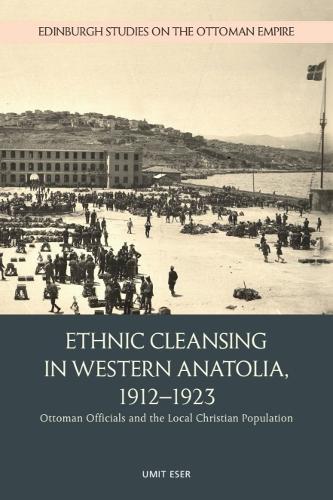
The Greek landing in Smyrna in May 1919 is widely seen as the catalyst of the Turkish national struggle but even during the chaos of between 1919-1923, the diverse peoples of Asia Minor coexisted and created astonishing but fragile infra-national solutions. In sharp contrast to popular history, this book tells the often-overlooked story of cooperation and resistance in a province renowned for its rich and prosperous ethnic and religious diversity in the face of a larger geopolitical struggle. As such, this research demonstrates that even the most contested national conflicts can display a remarkable degree of capacity for coexistence at the local level, a capacity that is all too easily forgotten amid global conflicts today.
Full Product Details
Author: Umit Eser (Assistant Professor, Necmettin Erbakan University)
Publisher: Edinburgh University Press
Imprint: Edinburgh University Press
ISBN: 9781399533256
ISBN 10: 1399533258
Pages: 312
Publication Date: 28 February 2026
Audience:
College/higher education
,
Postgraduate, Research & Scholarly
Format: Paperback
Publisher's Status: Active
Availability: Not yet available

This item is yet to be released. You can pre-order this item and we will dispatch it to you upon its release.
Reviews
Soundly based on exhaustive original research, Umit Eser's nuanced study of the state-sponsored violence that altered the ethnic makeup of the borderlands of Europe and Asia is essential reading for anyone interested in the upheavals that heralded the end of the Ottoman Empire and the creation of the modern Turkish state.--George Vassiadis, Hellenic Institute, Royal Holloway, University of London Ümit Eser's fine study traces the careers of the officials in Western Anatolia during the turbulent years following the Great War. Although later characterised by Turkish nationalist historians as 'traitors, ' Ümit's study reveals the ways they protected various local ethnic groups from persecution and other more mundane forms of discontinuity.--Benjamin C. Fortna, University of Arizona Ethnic Cleansing in Western Anatolia weaves a rich story that expands our understanding of the most consequential period in the making of modern Turkey. It constitutes the most complete account of arguably the most critical site in what is so often referred to as the Turkish War of Independence. Drawing on a critical array of sources, most notably from Greece, Umit Eser's work challenges many of the most common perceptions of this period. Ethnic Cleansing undoubtedly will be recognised as an essential work in the field of Ottoman studies.--Ryan Gingeras, Naval Postgraduate School
Author Information
Umit Eser is Assistant Professor of History at Necmettin Erbakan University and former Visiting Researcher at Centre d’études turques, ottomanes, balkaniques et centrasiatiques (CETOBaC). He completed his PhD at SOAS University of London in 2016. His publications have appeared in Diyâr: Zeitschrift für Osmanistik, Türkei- und Nahostforschung, Journal of Modern Greek Studies and British Journal of Middle Eastern Studies.