Overview
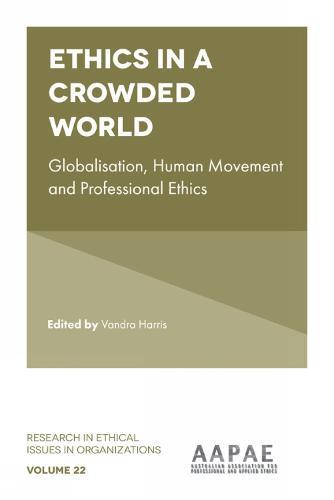
The twenty-first century has thus far been characterised by a persistent amplification of diverse and interconnected global flows, as well as various attempts to control, harness and channel these flows for individual and collective benefits. Whether we resist, appropriate, or simply observe those forces, for most of us they have meant significant change and adaptation. Conceiving crowdedness broadly, the work in this volume engages with increased exposure to the lives and realities of both proximate and distant others, facilitated by the perpetual motion of globalisation. The chapters approach crowdedness from a range of perspectives. These include a consideration of the expectations of migrating health professionals and the responsibilities of host governments, and humanitarian professionals' perspectives on whether their sector can genuinely localise. Two chapters consider research ethics in development and humanitarian practice respectively, and the final two propose a role for virtue ethics in addressing identity politics and employee motivation. Together these papers demonstrate the broad impacts of globalisation, turning to ethics to inform response and engagement now and in the unpredictable future.
Full Product Details
Author: Vandra Harris (RMIT University, Australia)
Publisher: Emerald Publishing Limited
Imprint: Emerald Publishing Limited
Volume: 22
Dimensions:
Width: 15.20cm
, Height: 1.30cm
, Length: 22.90cm
Weight: 0.317kg
ISBN: 9781838670092
ISBN 10: 1838670092
Pages: 128
Publication Date: 24 October 2019
Audience:
Professional and scholarly
,
Professional & Vocational
Format: Hardback
Publisher's Status: Active
Availability: In Print

This item will be ordered in for you from one of our suppliers. Upon receipt, we will promptly dispatch it out to you. For in store availability, please contact us.
Reviews
Seven papers, most from an applied ethics conference in Melbourne during September 2018, respond to the persistent amplification of global flows-and attempts to control those flows-that have characterized the 21st century so far. They cover the ethical significance of migrating health professionals' legitimate expectations: Canadian and Australian pathways to nowhere, humanitarian localization: can we put values into practice, a culture of ethical inquiry in the international development sector, the ethics of research in humanitarian action, identity politics and virtue ethics, and a virtue ethics perspective on motivation. -- Copyright 2019 * Portland, OR *
Author Information
Vandra Harris teaches ethics, humanitarianism and international development in RMIT's postgraduate International Development program and researches intersections between diverse actors in development and humanitarian settings, particularly police and militaries.