Overview
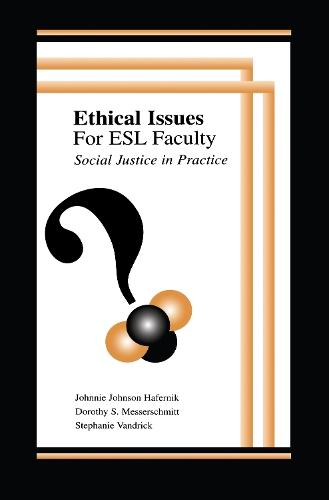
This title explicitly addresses ethical dilemmas and issues that ESL post-secondary faculty commonly encounter and examines them in the framework of social justice concerns. Ethics is defined broadly, to include responsibilities and obligations to students inside and outside the classroom, as well as to colleagues, educational institutions, the TESL profession and society as a whole. Scenarios in each chapter provide realistic and compelling situations for reflection and discussion. The authors then set out the issues raised, relate them to the classroom environment and offer opportunities to examine them in a variety of contexts and to consider possible solutions to the dilemmas. Issues include testing, plagiarism, technology, social and political issues affecting students and the classroom, gift-giving, curriculum decisions, disruptive students, institutional constraints, academic freedom, gender, class and power.
Full Product Details
Author: Johnnie Johnson Hafernik ,
Dorothy S. Messerschmitt ,
Stephanie Vandrick
Publisher: Taylor & Francis Inc
Imprint: Routledge
Weight: 0.500kg
ISBN: 9780805840278
ISBN 10: 0805840273
Pages: 182
Publication Date: 01 June 2002
Audience:
College/higher education
,
Professional and scholarly
,
Postgraduate, Research & Scholarly
,
Professional & Vocational
Format: Hardback
Publisher's Status: Active
Availability: In Print

This item will be ordered in for you from one of our suppliers. Upon receipt, we will promptly dispatch it out to you. For in store availability, please contact us.
Reviews
I find this book to be a good resource for school administrators to penetrate the best possible answers in Q&A manuals, or perhaps, to furnish ideas for workshop topics....The pedagogical content of the book is excellent and practically applicable to ESL teachers, in particular novice teachers, as well as some K-12 and EFL teachers. I certainly find this little book handy for future endeavors, especially in the ESL environment where diversity and multicultural surroundings are norm. Where many ESL teachers may concentrate entirely on the language teaching, this book encourages them to be more alert and think of the possibility of the occurrence of these setbacks. -TESL-EJ ...readers with classroom experience will attest to the authenticity of the cases, and both novice and experienced teachers would benefit from discussing them, as the authors suggest. Such a joint reflection would suggest practical strategies for handling such situations and help teachers become aware of and perhaps question the values that shape their behavior. Thus, the book would be a valuable contribution to faculty development and graduate programs in ESL. -SSLA
"""I find this book to be a good resource for school administrators to penetrate the best possible answers in Q&A manuals, or perhaps, to furnish ideas for workshop topics....The pedagogical content of the book is excellent and practically applicable to ESL teachers, in particular novice teachers, as well as some K-12 and EFL teachers. I certainly find this little book handy for future endeavors, especially in the ESL environment where diversity and multicultural surroundings are norm. Where many ESL teachers may concentrate entirely on the language teaching, this book encourages them to be more alert and think of the possibility of the occurrence of these setbacks."" —TESL-EJ ""...readers with classroom experience will attest to the authenticity of the cases, and both novice and experienced teachers would benefit from discussing them, as the authors suggest. Such a joint reflection would suggest practical strategies for handling such situations and help teachers become aware of and perhaps question the values that shape their behavior. Thus, the book would be a valuable contribution to faculty development and graduate programs in ESL."" —SSLA"
Author Information
Johnnie Johnson Hafernik (Author) , Dorothy S Messerschmitt (Author) , Stephanie Vandrick (Author