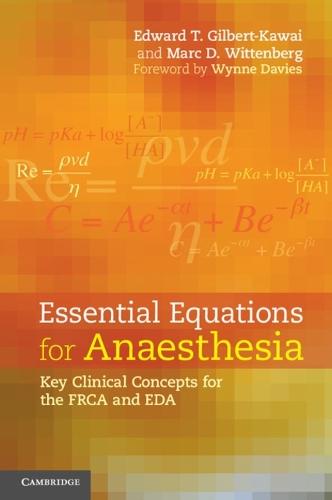
Essential Equations for Anaesthesia: Key Clinical Concepts for the FRCA and EDA

Author:   Edward T. Gilbert-Kawai (University College London) ,  Marc D. Wittenberg (University College London)
Publisher:   Cambridge University Press
ISBN:  

9781107636606


Pages:   218
Publication Date:   08 May 2014
Format:   Paperback
Availability:   Manufactured on demand   Availability explained
We will order this item for you from a manufactured on demand supplier.

Our Price $121.61 Quantity:  
Add to Cart

Share |

Essential Equations for Anaesthesia: Key Clinical Concepts for the FRCA and EDA


Overview

Full Product Details

Author:   Edward T. Gilbert-Kawai (University College London) ,  Marc D. Wittenberg (University College London)
Publisher:   Cambridge University Press
Imprint:   Cambridge University Press
Dimensions:   Width: 15.60cm , Height: 1.20cm , Length: 23.50cm
Weight:   0.330kg
ISBN:  

9781107636606


ISBN 10:   1107636604
Pages:   218
Publication Date:   08 May 2014
Audience:   College/higher education ,  Professional and scholarly ,  Tertiary & Higher Education ,  Professional & Vocational
Format:   Paperback
Publisher's Status:   Active
Availability:   Manufactured on demand   Availability explained
We will order this item for you from a manufactured on demand supplier.

Table of Contents

Preface; Foreword; Part I. Physics: Section 1A. Gases: 1. Boyle's law; 2. Charles' law; 3. Gay–Lussac's law; 4. Avogadro's law; 5. Universal gas equation; 6. Dalton's law of partial pressures; 7. Henry's law; 8. Graham's law of diffusion; Section 1B. Pressure and Flow: 1. Pressure and force; 2. Hagen–Poiseuille equation and laminar flow; 3. Reynold's number and turbulent flow; 4. Laplace's law and tension; 5. Bernoulli equation and Venturi effect; Section 1C. Electricity: 1. Ohm's law: voltage, current and resistance; 2. Capacitance; 3. Inductance; 4. Work and power; 5. Transformers; 6. Electrical charge; Section 1D. Other: 1. Doppler equation and Doppler effect; 2. Beer–Lambert law; 3. Humidity; 4. Natural frequency; 5. Wave equation and ultrasound; Part II. Pharmacology: Section 2A. Pharmacokinetics: 1. Bioavailability; 2. Volume of distribution; 3. Clearance; 4. Hepatic clearance; 5. Concentration and elimination; 6. Plasma concentration and compartment models; 7. Loading dose and maintenance dose; 8. Exponential function and rate constant; 9. Half life and context-sensitive half life; 10. Time constant; 11. Rates of reaction; 12. Michaelis–Menten equation; Section 2B. Pharmacodynamics: 1. Drug-receptor dissociation constant and affinity; 2. Therapeutic index; Part III. Physiology: Section 3A. Cardiovascular: 1. Cardiac output and cardiac index; 2. Stroke volume; 3. Ventricular stroke work and index; 4. Ejection fraction and fractional area change; 5. Coronary perfusion pressure and coronary blood flow; 6. Bazett's formula – QT interval corrected; 7. The Fick principle – cardiac output measurement; 8. The Fick equation – oxygen uptake measurement; 9. Mean arterial pressure; 10. Venous return; 11. Total blood volume; 12. Systemic vascular resistance; 13. Uterine blood flow; 14. Stewart-Hamilton equation; 15. Oxygen delivery; 16. Oxygen extraction ratio; 17. Oxygen content; 18. The dilution principle – measurement of fluid compartment volume; Section 3B. Respiratory: 1. Diffusing capacity; 2. Compliance; 3. Bohr equation; 4. Alveolar ventilation equation; 5. Alveolar gas equation; 6. Helium dilution technique; 7. Spirometry: forced expiration; 8. Lung volumes and capacities; 9. Respiratory quotient (and respiratory exchange ratio); 10. Shunt equation; 11. Pulmonary vascular resistance; Section 3C. Renal: 1. Renal filtration fraction; 2. Renal clearance and Cockcroft–Gault formula; 3. Starling's equation – rate of filtration; 4. Fick's law of diffusion; Section 3D. Cellular, Biochemical and Acid-base: 1. Osmolality, osmolarity and the osmolar gap; 2. Morse equation and osmotic pressure; 3. Anion gap; 4. Goldman equation; 5. Gibbs–Donnan effect; 6. Nernst equation; 7. pH; 8. pKa; 9. Acid-base compensation simplified; 10. Henderson–Hasselbalch equation; Section 3E. Neurological: 1. Cerebral perfusion pressure and intracranial pressure; 2. Intraocular pressure; Part IV. Statistics: 1. Binary classification tests and 2x2 tables; 2. Negative predictive value; 3. Positive predictive value; 4. Specificity; 5. Sensitivity; 6. Relative risk; 7. Relative risk reduction; 8. Absolute risk reduction; 9. Accuracy of test; 10. Chi-squared test; 11. Likelihood ratio; 12. Standard error of mean; 13. Standard deviation and variance; 14. Power; 15. Odds ratio; Appendix: 1. The international system of units; 2. Units of measurement; Index.

Reviews

'... a worthwhile and enjoyable read, easy to browse through and a good means of revision ...' P. J. Venn, British Journal of Anaesthesia ... a worthwhile and enjoyable read, easy to browse through and a good means of revision ... P. J. Venn, British Journal of Anaesthesia


'... a worthwhile and enjoyable read, easy to browse through and a good means of revision ...' P. J. Venn, British Journal of Anaesthesia


Author Information

Dr Edward Gilbert-Kawai is an Anaesthetic Registrar and the Senior Research Fellow at the Centre of Altitude, Space and Extreme Environment Medicine, University College London, London, UK. Dr Marc Wittenberg is a Senior Anaesthetic Registrar and Clinical Fellow at NHS England and the BMJ, UK.

Tab Content 6

Author Website:  

Countries Available

All regions
Latest Reading Guide

NOV RG 20252


Shopping Cart
Your cart is empty
Shopping cart
Mailing List