Overview
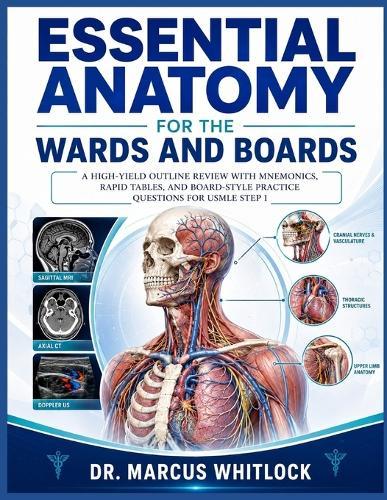
Master Anatomy Without Drowning in Detail Anatomy can feel impossible when every nerve, vessel, muscle, tract, space, and embryological remnant seems equally testable. One chapter gives you names. Another gives you diagrams. A question stem gives you a patient with weakness, numbness, trauma, pain, imaging findings, or a congenital defect-and suddenly memorized facts are not enough. This is not a thin cram sheet. It is a complete high-yield anatomy textbook designed for first- and second-year medical coursework, board review, ward preparation, and clinical reasoning. It teaches anatomy by region, links structures to real clinical patterns, and reinforces recall with mnemonics, rapid tables, worked vignettes, and board-style practice questions. Turn Anatomy From a Memory Burden Into a Clinical Map Instead of studying isolated facts, you learn how anatomy behaves in real cases: - A humeral shaft fracture becomes a radial nerve question - Shoulder dislocation becomes an axillary nerve pattern - Painless rectal bleeding in a child becomes a vitelline duct remnant - Contralateral pain loss becomes a spinal cord tract problem - ST elevation patterns become coronary artery anatomy Medical students are often told to ""know anatomy,"" but few resources show how to use anatomy under pressure. This textbook closes that gap. Built for the Way Medical Students Actually Study Inside, you get a regional anatomy system that covers the major areas tested and used in clinical training: - Back and spinal cord - Upper limb and brachial plexus - Lower limb, gait, and nerve injuries - Thorax, lungs, mediastinum, heart, and cardiac embryology - Abdomen, GI blood supply, hernias, and gut embryology - Pelvis, perineum, pelvic autonomics, and reproductive anatomy - Head and neck, cranial nerves, foramina, and pharyngeal arches - Neuroanatomy, brainstem syndromes, stroke territories, and cranial nerve nuclei - Cross-sectional and radiologic anatomy Each section is written to help you move from structure to function, from function to clinical presentation, and from clinical presentation to the best answer. Why This Textbook Works Anatomy becomes easier when the pattern is clear. This resource uses: - High-yield explanations that focus on what matters most - Mnemonics that connect directly to clinical use - Rapid-reference tables for fast review - Worked clinical vignettes that show the full reasoning path - Board-style practice questions to test recall and application - Teaching rationales that explain why answers are right or wrong - Study schedules for structured review No vague summaries. No endless low-yield detail. No answer key that leaves you guessing. For Students Who Want More Than Memorization Use this textbook if you are preparing for anatomy coursework, reviewing for integrated exams, strengthening Step-style reasoning, or trying to connect lecture material to clinical medicine. It is especially useful if you struggle with: - Brachial plexus and lumbosacral plexus questions - Brainstem and spinal cord localization - Embryology correlations - Coronary artery and vascular supply patterns - Turning long clinical stems into clear anatomical answers Stop Relearning Anatomy From Scratch The real cost of waiting is not just lost study time. It is repeated confusion. It is rereading the same structures without knowing how they appear in questions. It is missing clinical clues that should have pointed straight to the answer.
Full Product Details
Author: Dr Marcus Whitlock
Publisher: Independently Published
Imprint: Independently Published
Dimensions:
Width: 21.60cm
, Height: 1.80cm
, Length: 27.90cm
Weight: 0.807kg
ISBN: 9798195894276
Pages: 348
Publication Date: 06 May 2026
Audience:
General/trade
,
General
Format: Paperback
Publisher's Status: Active
Availability: Available To Order

We have confirmation that this item is in stock with the supplier. It will be ordered in for you and dispatched immediately.