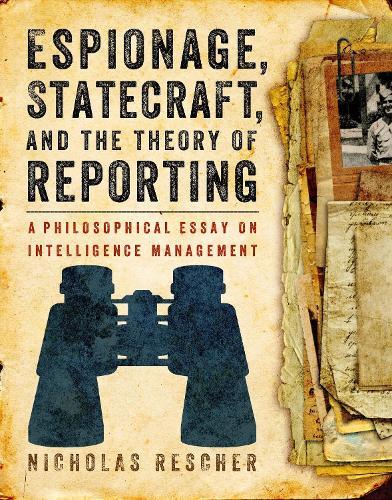
Full Product Details
Author: Nicholas Rescher
Publisher: University of Pittsburgh Press
Imprint: University of Pittsburgh Press
ISBN: 9780822944737
ISBN 10: 0822944731
Pages: 168
Publication Date: 12 December 2017
Audience:
Professional and scholarly
,
Professional & Vocational
Format: Paperback
Publisher's Status: Active
Availability: In Print

This item will be ordered in for you from one of our suppliers. Upon receipt, we will promptly dispatch it out to you. For in store availability, please contact us.
Reviews
In this book, Nicholas Rescher, one of the preeminent figures in twentieth-century philosophy, turns his attention to intelligence analysis in espionage and statecraft. The result is a characteristically clear and clear-headed discussion that will appeal to both amateur and professional philosophers alike. --Joseph Shieber, author of Testimony: A Philosophical Introduction
In this book, Nicholas Rescher, one of the preeminent figures in twentieth-century philosophy, turns his attention to intelligence analysis in espionage and statecraft. The result is a characteristically clear and clear-headed discussion that will appeal to both amateur and professional philosophers alike. --Joseph Shieber, author of Testimony: A Philosophical Introduction Nicholas Rescher offers a lucid and illuminating general introduction to the theory of reporting. I highly recommend this book for its distinctive and organized philosophical clarification of some central features about the nature of reporting. --Paul K. Moser, Loyola University Chicago In this book, Nicholas Rescher, one of the preeminent figures in twentieth-century philosophy, turns his attention to intelligence analysis in espionage and statecraft. The result is a characteristically clear and clear-headed discussion that will appeal to both amateur and professional philosophers alike. Joseph Shieber, author of Testimony: A Philosophical Introduction Nicholas Rescher offers a lucid and illuminating general introduction to the theory of reporting. I highly recommend this book for its distinctive and organized philosophical clarification of some central features about the nature of reporting. Paul K. Moser, Loyola University Chicago
In this book, Nicholas Rescher, one of the preeminent figures in twentieth-century philosophy, turns his attention to intelligence analysis in espionage and statecraft. The result is a characteristically clear and clear-headed discussion that will appeal to both amateur and professional philosophers alike. --Joseph Shieber, author of Testimony: A Philosophical Introduction Nicholas Rescher offers a lucid and illuminating general introduction to the theory of reporting. I highly recommend this book for its distinctive and organized philosophical clarification of some central features about the nature of reporting. --Paul K. Moser, Loyola University Chicago In this book, Nicholas Rescher, one of the preeminent figures in twentieth-century philosophy, turns his attention to intelligence analysis in espionage and statecraft. The result is a characteristically clear and clear-headed discussion that will appeal to both amateur and professional philosophers alike. Joseph Shieber, author of Testimony: A Philosophical Introduction Nicholas Rescher offers a lucid and illuminating general introduction to the theory of reporting. I highly recommend this book for its distinctive and organized philosophical clarification of some central features about the nature of reporting. Paul K. Moser, Loyola University Chicago
Author Information
Nicholas Rescher is Distinguished University Professor of Philosophy at the University of Pittsburgh and co-chairman of the Center for Philosophy of Science. A member of the American Academy of Arts and Sciences, he has served as president of the E