Overview
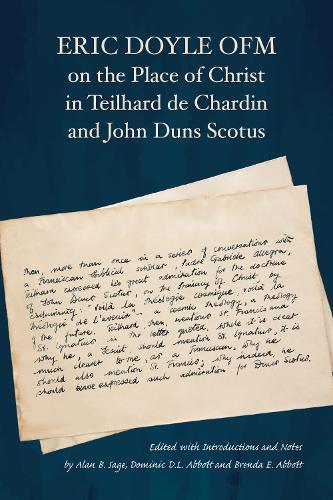
This volume presents an edited version of the many talks, dated 1967 to c. 1972, that Eric Doyle OFM delivered on Teilhard de Chardin, together with some of his published articles on John Duns Scotus. Here, the seeming incongruity between the Franciscan and Jesuit thinkers comes together in Doyle’s thought and writing, providing an insight into his unique understanding of their respective Christologies, despite the six centuries which separate them. Doyle was one of the first British Catholic theologians to introduce the thinking of the French priest and scientist, Pierre Teilhard de Chardin SJ, to an English speaking audience. His interest in Teilhard stemmed from his emphasis on the evolutionary, dynamic character of modern life and also the cosmic aspect of salvation. Doyle’s unique insight of the 1960s was the similarity he saw in both Teilhard and Scotus on the place of Christ in the universe. Whilst Scotus’ Weltanschauung was that of a static universe and that of Teilhard a dynamic evolving universe, they both saw Christ as the central point of creation. Christ would have become incarnate even without the Fall. Much of Doyle’s writing is considered to be ahead of its time and his Franciscan vision has an urgent and contemporary relevance both for the Church and the wider world; the lectures presented here are no exception, making them not only apposite but also seminal, even prescient.
Full Product Details
Author: Eric Doyle OFM
Publisher: The Franciscan Publishing Company
Imprint: The Franciscan Publishing Company
ISBN: 9781915198310
ISBN 10: 1915198313
Pages: 260
Publication Date: 08 April 2026
Audience:
College/higher education
,
Postgraduate, Research & Scholarly
Format: Paperback
Publisher's Status: Active
Availability: In Print 
This item will be ordered in for you from one of our suppliers. Upon receipt, we will promptly dispatch it out to you. For in store availability, please contact us.
Table of Contents
Contents Foreword ix Preface xiii Acknowledgements xvii Section One An Introduction to the Life and Thought of Eric Doyle OFM on the Christology of John Duns Scotus and Teilhard de Chardin 21 An Introduction to Pierre Teilhard de Chardin 49 Reading Suggestions for an Introduction to Teilhard 59 Section Two Notes to Eric Doyle’s Introductory Talk 63 Introductory Talk 65 Notes to Talk One and Talk Two 69 Talk 1: Introducing Teilhard de Chardin 73 Talk 2:Teilhard Speaks to the Scientific World We Live in 83 Notes to Talk Three 89 Talk 3: Teilhard’s Vision 93 Notes to Talk Four 105 Talk 4: Teilhard the Theologian 109 Notes to Talk Five 119 Talk 5: The Phenomenon of Man 123 Notes to Talk Six: Teilhard’s Christology 137 Notes to 6.1 In the Total Christ 148 Talk 6: 6.1 In the Total Christ 149 Notes to 6.2 Teilhard’s Christology 153 Talk 6.2 Teilhard’s Christology 155 Notes to 6.3 God, Creation and Cosmogenesis 161 Talk 6.3 God, Creation and Cosmogenesis 163 Notes to 6.4 The Cosmic Christ as seen by Teilhard 175 Talk 6.4 The Cosmic Christ as seen by Teilhard 177 Notes to 6.5 Christ, the Cosmos and the Problem of Evil 183 Talk 6.5 Christ, the Cosmos and the Problem of Evil 187 Notes to Talk Seven: The Eucharist and the Church 193 Talk 7: The Eucharist and the Church in Teilhard 195 Section Three An Introduction to John Duns Scotus (c.1266-1308): Franciscan Theologian and Philosopher 209 John Duns Scotus and the Place of Christ I 215 John Duns Scotus and the Place of Christ II 233 John Duns Scotus and the Place of Christ III 249 Doyle’s Published Works on Bl. John Duns Scotus 260 Doyle’s Published Works on Teilhard de Chardin 261
Reviews
Pierre Teilhard de Chardin’s contributions to our understanding of Christian faith and its relationship to science are as important now as ever. After the Jesuit geologist’s death in 1955, however, his posthumously published works, though widely read, were often misunderstood, as is still the case. Happily, the present book introduces readers to one of Teilhard’s most reliable and insightful early interpreters, the Franciscan priest Eric Doyle. Cleverly arranged by theologian Brenda Abbott, the book offers four distinct levels of theological content, placing Teilhard’s understanding of the person and work of Christ in a tradition of Christology too often overlooked. At one level, the book succinctly summarizes the theology of the 13th century Franciscan theologian Duns Scotus, featuring his famous proposal that God would have become incarnate in Christ even if there had been no original sin. Second, keeping its eye on Scotus, the book keeps recalling how Teilhard similarly took the person of Christ to be the goal of creation rather than simply expiation for a prehistoric human fault. Third, this synthesis introduces readers to the neglected work of Eric Doyle and his insightful theological comparison of Teilhard’s thoughts about Christ with the creative vision of Duns Scotus. At a fourth level the volume exhibits the scholarship of its editor who has produced here a richly layered work of historical theology. I am happy to endorse it. John F. Haught, Georgetown University, Emeritus, author of The Cosmic Vision of Teilhard de Chardin Few Teilhardians would expect to encounter a study of the Jesuit scientist by a Franciscan priest. So for them this collection of talks by Fr Eric Doyle ofm will come as a revelation: for example, he discusses in depth Teilhard’s theology, Christology, the Eucharist, the problem of evil, and above all his concept of the Cosmic Christ, as expounded in Paul’s letters to the Colossians and Ephesians. Even more unexpected would be the chapters on Duns Scotus, whom most people know only as the mediaeval theologian who inspired the poet Gerard Manley Hopkins with his concept of haecceitas or ‘thisness’. But Doyle examines the links between Scotus and Teilhard; for instance, the Franciscan’s belief that the Absolute Primacy of Christ means that He is the crown of both the natural and the supernatural worlds, which accords well with Teilhard’s belief that Christ is the origin of the cosmos and the driving force within evolution and its ultimate goal, the Omega Point. This superbly edited book is a valuable and unusual addition to Teilhard studies. Paul R. Bentley, Editor, British Teilhard Network In this remarkable book Franciscan priest Eric Doyle is concerned with a theologian/ philosopher and a scientist/mystic, both of whom were not accepted by most of the academic scholars in their respective subjects in their own day. John Duns Scotus OFM (1266–1308) met with opposition to his theological vision, so much so that his thought was virtually hidden from the academic world till the twentieth century. Six centuries later Pierre Teilhard de Chardin SJ (1881–1955) was forbidden by the Vatican authorities to publish any of his theological/spiritual work. His writings on these subjects were published only after his death. It was the destiny of Doyle to introduce these two thinkers to the English-speaking world in the twentieth century. Unfortunately, Doyle died at the tender age of forty-six but his legacy is being forwarded today by The Franciscan Publishing Company. Doyle was one of the first to see the connection between the fourteenth century Duns Scotus and the twentieth century Teilhard de Chardin, particularly in their writings on the central place of Christ in the universe. This is usually referred to as the Absolute Primacy of Christ. Doyle shows how the theologian and the scientist, from their totally different world views, came to the same conclusion: Christ is the centre of the universe. The Thomistic view, which had been taught for centuries in seminaries and found its way into catechisms worldwide, is that Christ was born in order to redeem fallen humanity. The question can then be asked: if Adam had not sinned, would Christ have been born? Yes, say Scotus and Teilhard, because Christ is the purpose of the universe; it was created with him, for him and in him. Thomistic theology is based on Paul’s teaching in his letter to the Romans. Both Scotus and Teilhard interpret the more developed Christology of Paul which is to be found in the first chapters of Colossians and Ephesians. They do so in a similar way and conclude that creation is inconceivable without Christ and that he is the universe’s crowning point and completion. As the editors summarise, ‘God intends Christ before all else and with, in and through him, the whole of creation.’ This is spelled out by Teilhard in his essay ‘The Christic’ which he wrote two months before his death. We find the same teaching in the first chapter of John’s gospel: ‘The Word was with God in the beginning. Through him all things came to be, not one thing had its being but through him’ (Jn 1: 3–4). Doyle is not concerned with theological debates in the past but with the concerns of today. Thus, the teaching of Scotus and Teilhard has implications for contemporary issues such as the motive for the incarnation, the meaning of human life, ecumenical dialogue, cosmology and ecology. Teilhard has been positively referred to by Popes John Paul II, Benedict XVI and Francis. In the first major papal statement in almost four decades, Pope John Paul specifically focused on the substantive and constructive relationship between theology and science. In it the Pope calls for theologians to take science with extreme seriousness, and to integrate the results into their own theological programmes. He stressed the relationship between the natural sciences and religious belief. In an address to the Pontifical Academy of Science, he said, ‘Science can purify religion from error and superstition. Religion can purify science from idolatry and false absolutes. Each can draw the other into a wider world, a world in which both can flourish.’ It is important to note that the three editors contribute immensely to the subject of the book. The essay in chapter one and the introductory notes to Doyle’s fourteen lectures could form a book on its own. The copious, and sometimes lengthy, footnotes add very much to the book, often clarifying the author’s views and also situating his presentations in their historical setting. I sat through Eric Doyle’s lectures for four years. His enthusiasm for his subject carries into this book. This is a book worth reading and its contents need to be disseminated far and wide. Dr Anselm Laurence Prior OFM
Author Information
Eric Doyle OFM (1938–1984) was a Friar of the Province of the Immaculate Conception in Great Britain. A gifted scholar, theologian, orator and writer, his prime concern was always to bring the Franciscan message to the wider world. St Francis and the Song of Brotherhood and Sisterhood was the outcome of a lifetime lived imbued with the Franciscan spirit. In this book he examines not only humanity’s attitude towards creation, but also some of the specifically human questions which surface perennially: the possibility of world peace, the mystery of suffering, the presence of evil, the superiority of value and meaning over use and convenience, and the need for humility and gratitude. Born in Bolton on 13 July 1938, the son of a mill-worker, Martin William Doyle was educated at St Joseph’s R.C. primary school and then, having obtained an academic scholarship, at Thornleigh Salesian College. He entered the Order of Friars Minor at the age of 16, having been inspired to do so by a book on the life of St Francis.[1] He made his solemn profession the day after his twenty-first birthday and was ordained to the priesthood on 16 July 1961, which required a dispensation in view of his young age. This was followed by studies in Rome, 1962-64, where Doyle trained as an ecclesiastical historian and where he received his doctorate summa cum laude.[2] Inspired by the Second Vatican Council, Doyle was at the forefront of the renewal process and was tireless in his efforts to put the teaching of the Council into practice. The breadth of Doyle’s learning was immense and his vision wide, so that he brought astute and far-sighted observations to bear on many areas of theology including Christology, Ecclesiology, Franciscan Spirituality, Ecumenism, Ecology, Eschatology and Religious Life. He was a founding father of the Franciscan Study Centre in Canterbury, where he introduced Franciscan Studies, and a pioneer of the newly established ‘group-style’ of community living there. He lectured at home and abroad, gave many retreats (principally to priests and religious), took part in ARCIC I debates, and made over 500 programs for Anglia TV’s The Big Question and BBC Radio 4’s Prayer for the Day. He was a participant at the Second Scotistic Congress in Oxford/Edinburgh, at the first International ‘Terra Mater’ Seminar in Gubbio, an International Bonaventurian Congress in Rome, as well as numerous conferences on the work of Teilhard de Chardin, of which Association he was also vice-president. In addition, his enormous capacity for work enabled him to publish over 100 articles and two books during the course of his career.[3] Recognized as an international scholar and lecturer, this theological multi-tasker’s focus was always on the present moment, ‘doing theology’, because standing as he did in the Franciscan intellectual tradition, theology of necessity always included a practical dimension, and for Doyle, also demanded contemporary relevance.[4] Much of his work was ahead of its time, prophetic even. Doyle was a humble and self-effacing man who did not seek his own aggrandizement; his was always a life of service. Extremely likeable and memorable, his irrepressible character, gentle humor and great kindness won him many friends and admirers, including some amongst the hierarchy of both the Catholic Church and Anglican Communion. A gifted speaker, he became the first Roman Catholic to address a huge congregation in Canterbury Cathedral since the Reformation.[5] After Doyle’s sudden death at the early age of 46, Conrad Harkins OFM commented: Friends of St Francis throughout the English-speaking world, to whom perhaps he was most familiar, know that in Eric’s transitus has departed one of the most vibrant Franciscans of this century.[6] He was buried at the Friary in Chilworth on 31 August 1984 where the church was full to overflowing, and where over 100 priests concelebrated his Requiem Mass. [1] This is information which Doyle himself shared with me, though he did not mention the book. There were only a handful of biographies of St Francis in print at that time and it is quite possible that the only access to books which Doyle could have read would have been in the school library. Given Doyle’s temperament and the availability of books my own view is that the book may well have been G.K. Chesterton’s St Francis of Assisi, of which I know he was very fond. In his ‘Select Bibliography on the Life and Message of St Francis,’ p.75, Doyle writes: ‘G.K. Chesterton’s book St Francis of Assisi reveals beyond doubt the heart of the Saint and what can only be called the utter genius of his holiness. Above all, Chesterton understood, as few have done, I think, St Francis’ love of particulars, of individual people, of animals, birds, stones. He writes with discernment and wisdom: “I have said that St Francis deliberately did not see the wood for the trees. It is even more true that St Francis deliberately did not see the mob for the men”.’ It is, I believe, a book which would have appealed greatly to Doyle as a young boy. [2] The full title of Doyle’s thesis was William Woodford OFM (c.1330-c.1400): His Life and Works together with a Study and Edition of his Responsiones contra Wiclevum et Lullardos which was published in Franciscan Studies 43 (1986), pp.17-187. This volume of Franciscan Studieswas dedicated to Doyle, in memory of his contribution to Franciscan scholarship. The editor wrote: ‘As a mark of gratitude and esteem, Fr Eric’s confreres and colleagues at the Franciscan Institute dedicate this issue to his memory.’ p.6. [3] St Francis and the Song of Brotherhood (George Allen & Unwin, London, 1980). Re-printed: The Catholic Book Club, London, 1980 & 1981; Seabury Press, New York, 1981; Harper, San Francisco, 1984; Franciscan Institute Publications, New York, 1997 as St. Francis and the Song of Brotherhood and Sisterhood. The Disciple and the Master: St Bonaventure’s Sermons on St Francis of Assisi (Franciscan Herald Press, Chicago, 1983). [4] See S. Mulholland: “And this is the final point on the cruciform that is the shape of his theological quest: the impact that Francis of Assisi had on him personally as a Franciscan doing theology. I say ‘doing’ theology because the Franciscan theological and intellectual tradition he had inherited, the tradition of Alexander of Hales, Bonaventure, Roger Bacon, Duns Scotus, was that theology was ‘practical’ and its purpose to lead us to union with God in this life.” ‘The Character of Eric Doyle’s Theological Endeavour: Trinity, Christology, Ecclesiology, Franciscanology’ in A. Cirino and J. Raischl, eds., A Pilgrimage Through the Franciscan Intellectual Tradition (Franciscan International Study Centre, Canterbury, 2008), p.371. [5] The Universe, ‘Thanks for 750 Years’ (20 Sept. 1974) reported: ‘Historian Fr Eric Doyle, O.F.M., due to give a festival lecture in the Chapter House, found himself transferred to the cathedral – and the pulpit – because of the large crowds who turned up to hear him.’ [6] C. Harkins OFM, ‘A Singer and his Song: Father Eric Doyle OFM, 1938-1984’ in The Cord 34.11 (Dec. 1984), p.321.
Tab Content 6
Author Website:
Countries Available
All regions
|