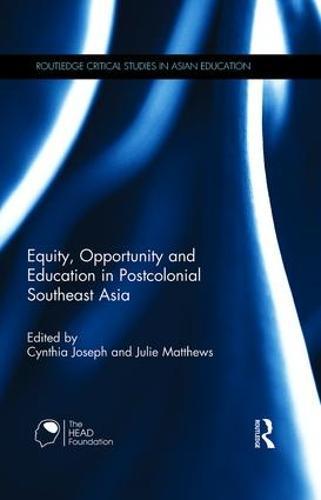
Full Product Details
Author: Cynthia Joseph (Monash University, Australia) ,
Julie Matthews
Publisher: Taylor & Francis Ltd
Imprint: Routledge
Dimensions:
Width: 15.60cm
, Height: 2.30cm
, Length: 23.40cm
Weight: 0.580kg
ISBN: 9780415834216
ISBN 10: 041583421
Pages: 228
Publication Date: 24 March 2014
Audience:
College/higher education
,
Professional and scholarly
,
Tertiary & Higher Education
,
Professional & Vocational
Format: Hardback
Publisher's Status: Active
Availability: In Print

This item will be ordered in for you from one of our suppliers. Upon receipt, we will promptly dispatch it out to you. For in store availability, please contact us.
Reviews
Cynthia Joseph and Julie Matthews have assembled an accessible and informative set of chapters on post-colonial education in Southeast Asia. There is a liveliness and theoretical sharpness about the book which lifts it above other collections of country chapters, and it is great to see the region receiving the attention it deserves. Education in Southeast Asian countries is very dynamic, shaped as it is between multiple influences: modernising states, indigenous traditions, colonial legacies (expertly dissected here), the global economy, rising China, aid and business from Korea and Japan, emerging India. Cultural issues have been brought to the front of the analysis here, allowing the commonalities and differences across Southeast Asia to be effectively explored. The editors provide an authoritative summary and there are succinct, engaging reflections on each of the principal systems. - Simon Marginson, Professor of International Higher Education, Institute of Education in London, and Joint Editor-in-Chief of Higher Education The political and economic reintegration of Southeast Asia led by ASEAN and other regional organization is spurring some interesting scholarly work looking into historical and contemporary transnational linkages across the region. This book, which charts the educational history of the region over centuries, is an excellent addition to that growing body of work. The two opening chapters by the editors provide very interesting historical overviews of the varied forms of traditional educational systems, colonialism and postcolonialism across the region. These provide the context for the chapters that follow, which each tackle a particular issue in one country. ... a very good introduction to the volume, especially for readers new to the educational history of the region. - Christopher Ziguras, RMIT University, Melbourne, Australia
Cynthia Joseph and Julie Matthews have assembled an accessible and informative set of chapters on post-colonial education in Southeast Asia. There is a liveliness and theoretical sharpness about the book which lifts it above other collections of country chapters, and it is great to see the region receiving the attention it deserves. Education in Southeast Asian countries is very dynamic, shaped as it is between multiple influences: modernising states, indigenous traditions, colonial legacies (expertly dissected here), the global economy, rising China, aid and business from Korea and Japan, emerging India. Cultural issues have been brought to the front of the analysis here, allowing the commonalities and differences across Southeast Asia to be effectively explored. The editors provide an authoritative summary and there are succinct, engaging reflections on each of the principal systems. - Simon Marginson, Professor of International Higher Education, Institute of Education in London, and Joint Editor-in-Chief of Higher Education
Cynthia Joseph and Julie Matthews have assembled an accessible and informative set of chapters on post-colonialã education in Southeast Asia. There is a liveliness and theoretical sharpness about the book which lifts it above other collections of country chapters, and it isã great to see the region receiving the attention it deserves. Education in Southeast Asian countries is very dynamic, shaped as it is between multiple influences:ã ã modernising states,ã indigenous traditions, colonial legacies (expertly dissected here), the global economy,ã rising China, aid and businessã from Korea and Japan, emerging India. Cultural issues have been brought to the front of the analysis here, allowing the commonalities and differences across Southeast Asia to beã effectivelyã explored. The editors provide anã authoritativeã summary and there are succinct, engaging reflections on each of the principal systems. - Simon Marginson, Professor of International Higher Education, Institute ofã Education in London, and Joint Editor-in-Chief of Higherã Educationã ã ã The political and economic reintegration of Southeast Asia led by ASEAN and other regional organization is spurring some interesting scholarly work looking into historical and contemporary transnational linkages across the region. This book, which charts the educational history of the region over centuries, is an excellent addition to that growing body of work. The two opening chapters by the editors provide very interesting historical overviews of the varied forms of traditional educational systems, colonialism and postcolonialism across the region. These provide the context for the chapters that follow, which each tackle a particular issue in one country. ... a very good introduction to the volume, especially for readers new to the educational history of the region. - Christopher Ziguras, RMIT University, Melbourne, Australia
Cynthia Joseph and Julie Matthews have assembled an accessible and informative set of chapters on post-colonial education in Southeast Asia. There is a liveliness and theoretical sharpness about the book which lifts it above other collections of country chapters, and it is great to see the region receiving the attention it deserves. Education in Southeast Asian countries is very dynamic, shaped as it is between multiple influences: modernising states, indigenous traditions, colonial legacies (expertly dissected here), the global economy, rising China, aid and business from Korea and Japan, emerging India. Cultural issues have been brought to the front of the analysis here, allowing the commonalities and differences across Southeast Asia to be effectively explored. The editors provide an authoritative summary and there are succinct, engaging reflections on each of the principal systems. - Simon Marginson, Professor of International Higher Education, Institute of Education in London, and Joint Editor-in-Chief of Higher Education ""The political and economic reintegration of Southeast Asia led by ASEAN and other regional organization is spurring some interesting scholarly work looking into historical and contemporary transnational linkages across the region. This book, which charts the educational history of the region over centuries, is an excellent addition to that growing body of work. The two opening chapters by the editors provide very interesting historical overviews of the varied forms of traditional educational systems, colonialism and postcolonialism across the region. These provide the context for the chapters that follow, which each tackle a particular issue in one country. ... a very good introduction to the volume, especially for readers new to the educational history of the region."" - Christopher Ziguras, RMIT University, Melbourne, Australia
Author Information
Cynthia Joseph is a Senior Lecturer at the Faculty of Education, Monash University, Australia. Julie Matthews is an Associate Professor at the School of Education in The University of Adelaide, Australia.