|
|
|||
|
||||
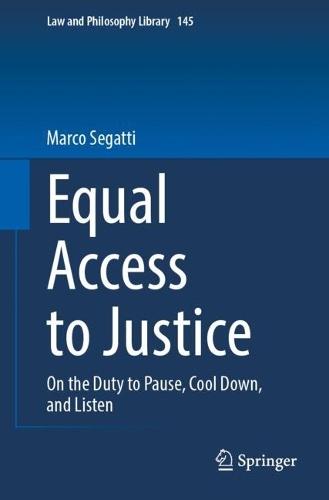
OverviewIt is wrong when someone cannot exercise their rights in a court of law because they have no money to pay for a good lawyer, because they are too scared of the possible consequences, or because they simply don’t know that the law protects them. But does that mean governments have an obligation to intervene? And if so, how?This book provides the first systematic philosophical theory of equal access to justice. It begins by identifying the content of claims to equal access to justice. Then, it reviews traditional political and legal arguments on the right of access to justice, which it argues are both illuminating and insufficient. The best comparative way to approach equal access to justice, the book argues, is to think through the requirements of a moral, pre-political, duty to – at times and provisionally – pause, cool down and listen: in other words, we ought to demand that governments step in and protect access rights, because we have a moral and pre-political interest in cultivating our ability to comply with this duty. It is the recognition of this duty which best explains both law’s potential for promoting, as well as its potential for endangering, equal justice. In closing, the book tests this novel theory of equal access to justice against contemporary trends and reforms in procedural law. Full Product DetailsAuthor: Marco SegattiPublisher: Springer International Publishing AG Imprint: Springer International Publishing AG Volume: 145 ISBN: 9783031529412ISBN 10: 3031529413 Pages: 191 Publication Date: 01 March 2025 Audience: Professional and scholarly , Professional & Vocational Format: Paperback Publisher's Status: Active Availability: Manufactured on demand We will order this item for you from a manufactured on demand supplier. Table of Contents1 Introduction.- Part I. Domain: conceptual, empirical and historical explorations of access to justice.- 2 Is there a (Human) Right of Access to Justice?.- 3 Equal access to justice: Three interpretations.- 4 Duties of assistance and the criminal/civil distinction.- 5 Unmet legal needs: identification and rich descriptions.- Part II Normative foundations.- 6 The need for a theoretical base: four arguments.- 7 Why capabilities? On the duty to, at times and provisionally, pause, cool down, and listen.- 8 The instrumentalities of access to justice in defending democratic cooperation.- Part III. Practical applications. Testing the political principles of equal access to justice.- 9 Free legal counsel and access to justice.- 10 Is group litigation legitimate?.- 11 Still Against Settlement?.- 12 Conclusion.ReviewsAuthor InformationMarco Segatti is a postdoc researcher at the University of Genoa. He previously worked at the University of Girona, where he taught courses in legal theory, political philosophy and dispute resolution. He graduated in law from the University of Pavia, and has completed graduate work at Harvard Law School (LLM), University of Bologna (Phd) and The University of Chicago Law School (JSD). Marco has published in English, Italian and Spanish both in peer-reviewed journals as well as chapters in edited volumes. Tab Content 6Author Website:Countries AvailableAll regions |
||||