Overview
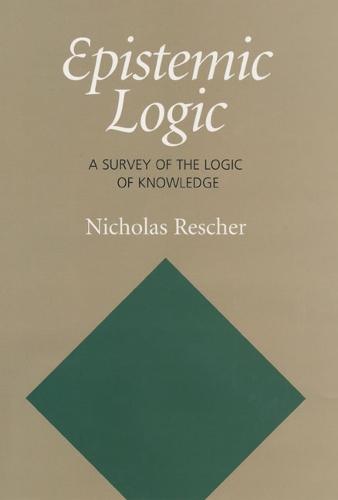
Epistemic logic is the branch of philosophical thought that seeks to formalize the discourse about knowledge. Its object is to articulate and clarify the general principles of reasoning about claims to and attributions of knowledge. This comprehensive survey of the topic offers the first systematic account of the subject as it has developed in the journal literature over recent decades. Rescher gives an overview of the discipline by setting out the general principles for reasoning about such matters as propositional knowledge and interrogative knowledge. Aimed at graduate students and specialists, Epistemic Logic elucidates both Rescher's pragmatic view of knowledge and the field in general.
Full Product Details
Author: Nicholas Rescher
Publisher: University of Pittsburgh Press
Imprint: University of Pittsburgh Press
Dimensions:
Width: 14.00cm
, Height: 1.30cm
, Length: 21.60cm
Weight: 0.177kg
ISBN: 9780822961307
ISBN 10: 082296130
Pages: 152
Publication Date: 15 February 2005
Audience:
College/higher education
,
Professional and scholarly
,
Undergraduate
,
Postgraduate, Research & Scholarly
Format: Paperback
Publisher's Status: Active
Availability: In Print

This item will be ordered in for you from one of our suppliers. Upon receipt, we will promptly dispatch it out to you. For in store availability, please contact us.
Reviews
Epistemic Logic is the shining star of Rescher s provocative trilogy on realism, knowledge, and our cognitive imitations. EL is a unique and crucial addition to the literature in formal epistemology because it locates the debate over the knowability principle within an overall system of the logic of knowledge. Mind
'Epistemic Logic' is the shining star of Rescher's provocative trilogy on realism, knowledge, and our cognitive imitations. EL is a unique and crucial addition to the literature in formal epistemology because it locates the debate over the knowability principle within an overall system of the logic of knowledge. --Mind
-'Epistemic Logic' is the shining star of Rescher's provocative trilogy on realism, knowledge, and our cognitive imitations. EL is a unique and crucial addition to the literature in formal epistemology because it locates the debate over the knowability principle within an overall system of the logic of knowledge.---Mind
Author Information
Nicholas Rescher was Distinguished University Professor of Philosophy at the University of Pittsburgh and co-chairman of the Center for Philosophy of Science. A member of the American Academy of Arts and Sciences, he served as president of the Eastern Division of the American Philosophical Association, the Leibniz Society of North America, the Charles S. Peirce Society, the American Catholic Philosophical Association, and the Metaphysical Society of America. Rescher was the author or editor of more than one hundred books, including Ignorance (On the Wider Implications of Deficient Knowledge), Philosophical Inquiries: An Introduction to Problems of Philosophy, and A Journey through Philosophy in 101 Anecdotes.