Overview
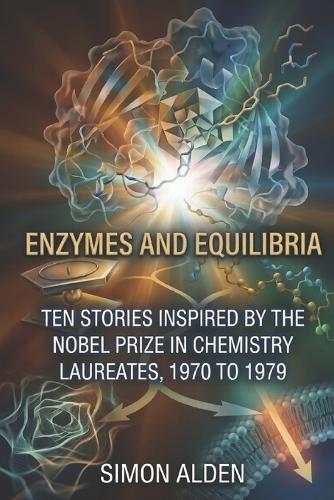
Enzymes and Equilibria is the eighth volume in a series of thirteen short story collections, each covering a decade of Nobel Prize winners in Chemistry. Between 1970 and 1979, chemistry became the science of the precise, the transient, and the structured. Scientists mapped the exact three-dimensional folding of proteins, captured the fleeting signatures of highly reactive free radicals, and discovered how life uses chemical gradients to power its cellular infrastructure. They proved that enzymes make strict geometric choices, expanded the rules of bonding with metallic sandwich compounds, and found order arising from chaos in systems pushed far from equilibrium. The laboratory shifted from simply making molecules to understanding the intricate, dynamic rules that govern their shape, their speed, and their assembly. Every story is built around one prize and one discovery, placing the science inside a human situation that brings it to life without simplifying it. A regulator uncovers a food manufacturer using nucleotide sugar intermediates to fraudulently rebuild carbohydrates and evade testing. A forensic chemist identifies the cause of mysterious warehouse fires by measuring the spectroscopic signatures of transient free radicals. An environmental sabotage case hinges on mapping the specific micro-chemistry of an engineered enzyme active site. An industrial explosion investigation becomes a bitter legal battle over an ""impossible"" organometallic sandwich compound. An art conservator traces the silent degradation of priceless paintings to the changing architecture of macromolecular polymer chains over time. A brewery falls victim to corporate sabotage when an introduced substrate flips the stereochemical preference of a vital enzyme. A hazardous materials team must rethink emergency containment when a chemical behaves according to the delocalised cluster logic of boranes. An engineer realises that a city heating network is being manipulated into a state of dissipative oscillation to force its privatisation. A saboteur targets an algae power system not by breaking equipment, but by introducing a molecule that silently dissipates its life-giving proton gradient. Finally, a forensic lab links a string of counterfeit perfumes to a single rogue chemist through the precise, modular geometry of a synthetic double bond. Every discovery is accurate. Every story is new. Together they make the 1970s not a chapter in a textbook but a living world, full of people for whom these ideas arrived not as settled knowledge but as sudden, disorienting, and irreversible light.
Full Product Details
Author: Simon Alden
Publisher: Independently Published
Imprint: Independently Published
Volume: 8
Dimensions:
Width: 15.20cm
, Height: 1.00cm
, Length: 22.90cm
Weight: 0.254kg
ISBN: 9798195478988
Pages: 184
Publication Date: 20 May 2026
Audience:
General/trade
,
General
Format: Paperback
Publisher's Status: Active
Availability: Available To Order

We have confirmation that this item is in stock with the supplier. It will be ordered in for you and dispatched immediately.