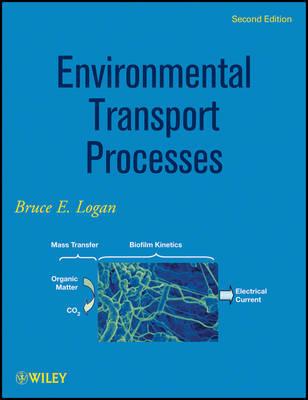
Environmental Transport Processes

Author:   Bruce E. Logan (Pennsylvania State University, PA)
Publisher:   John Wiley & Sons Inc
Edition:   2nd edition
ISBN:  

9780470619599


Pages:   496
Publication Date:   27 March 2012
Format:   Hardback
Availability:   Out of stock   Availability explained
The supplier is temporarily out of stock of this item. It will be ordered for you on backorder and shipped when it becomes available.

Our Price $236.95 Quantity:  
Add to Cart

Share |

Environmental Transport Processes


Overview

A unique approach to the challenges of complex environmental systems Environmental Transport Processes, Second Edition provides much-needed guidance on mass transfer principles in environmental engineering. It focuses on working with uncontrolled conditions involving biological and physical systems, offering examples from diverse fields, including mass transport, kinetics, wastewater treatment, and unit processes. This new edition is fully revised and updated, incorporating modern approaches and practice problems at the end of chapters, making the Second Edition more concise, accessible, and easy to use. The book discusses the fundamentals of transport processes occurring in natural environments, with special emphasis on working at the biological–physical interface. It considers transport and kinetics in terms of systems that involve microorganisms, along with in-depth coverage of particles, size spectra, and calculations for particles that can be considered either spheres or fractals. The book's treatment of particles as fractals is especially unique and the Second Edition includes a new section on exoelectrogenic biofilms. It also addresses dispersion in natural and engineered systems unlike any other book on the subject. Readers will learn to tackle with confidence complex environmental systems and make transport calculations in heterogeneous environments with mixtures of chemicals.

Full Product Details

Author:   Bruce E. Logan (Pennsylvania State University, PA)
Publisher:   John Wiley & Sons Inc
Imprint:   John Wiley & Sons Inc
Edition:   2nd edition
Dimensions:   Width: 19.80cm , Height: 2.80cm , Length: 24.10cm
Weight:   1.016kg
ISBN:  

9780470619599


ISBN 10:   0470619597
Pages:   496
Publication Date:   27 March 2012
Audience:   College/higher education ,  Postgraduate, Research & Scholarly
Format:   Hardback
Publisher's Status:   Active
Availability:   Out of stock   Availability explained
The supplier is temporarily out of stock of this item. It will be ordered for you on backorder and shipped when it becomes available.

Table of Contents

Preface xi 1. Introduction 1 1.1 Background 1 1.2 Notation for chemical transport 2 1.3 Simplifications for environmental systems 5 1.4 Review of Mass Balances 11 2. Equilibrium Calculations 18 2.1 Introduction 18 2.2 Thermodynamic state functions 20 2.3 Chemical potentials 21 2.4 Gibbs free energy and equilibrium constants 23 2.5 Distribution of chemical based on fugacites 25 3. Diffusive Transport 43 3.1 Introduction 43 3.2 Diffusion 43 3.3 Calculation of molecular diffusion coefficients 45 3.4 Effective diffusion coefficients in porous media 53 3.5 Experimental determination of diffusivities and molecular size spectra 59 4. The Constitutive Transport Equation 79 4.1 Introduction 79 4.2 Derivation of the general transport equation 80 4.3 Special forms of the general transport equation 81 4.4 Similarity of mass, momentum, and heat dispersion laws 84 4.5 Transport relative to moving coordinate systems 86 4.6 Simplified forms of the constitutive transport equation 89 4.7 The constitutive transport equation in cylindrical and spherical coordinates 91 5. Concentration Profiles and Chemical Fluxes 95 5.1 Introduction 95 5.2 The three theories of mass transport 95 5.3 Mass transport in radical and cylindrical coordinates using shell balances 112 6. Mass Transport Correlations: From Theory to Empiricism 120 6.1 Definition of a mass transport coefficient 120 6.2 The three theories 121 6.3 Multiple resistances during interphase mass transport 125 6.4 Correlations for mass transport coefficients 132 6.5 Transport to spheres 135 7. Kinetics and Mass Transfer 140 7.1 Introduction 140 7.2 Fluid shear and turbulence 141 7.3 Mass transport in steady sheared fluids 145 7.4 Mass transport in turbulent sheared fluids 148 7.5 Shear rates in mixed reactors 149 7.6 Chemical transport in bubbled reactors 158 8. Suspended Unattached and Aggregated Microorganisms 167 8.1 Introduction 167 8.2 Chemical transport to cells at rest 167 8.3 Effect of fluid motion on microorganisms 170 8.4 Transport to microbial aggregates 175 8.5 Effectiveness factors for mass transport 184 8.6 Relative uptake factors for mass transport 187 8.7 Differences between the MEC and MFC systems 145 9. Biofilms 194 9.1 Introduction 194 9.2 Transport in the fluid layer above a biofilm 194 9.3 Biofilm kinetics 198 9.4 Modeling completely mixed biofilm reactors: rotation biological contactors 210 9.5 Modeling plug flow biofilm reactors: packed beds 213 9.6 Modeling wetted wall biofilm reactors: trickling filters 215 9.7 Electrogenic biofilms 225 10. Disperson 232 10.1 Introduction 232 10.2 Averaging properties to derive dispersion coefficients in turbulent fluids 235 10.3 Dispersion in nonboundeded turbulent sheared fluids 239 10.4 Longitundinal dispersion coefficients for defined systems 244 10.5 Dispersion in porous media 253 11. Rivers, Lakes and Oceans 264 11.1 Introduction 264 11.2 Chemical transport in rivers 265 11.3 Mixing in lakes 273 11.4 Mixing in estuaries 277 11.5 Mixing in the ocean 279 11.6 Operation and assessment of MFCs 181 12. Chemical Transport in Porous Media 292 12.1 Introduction 292 12.2 Porous media hydraulics 292 12.3 Contaminant transport of conservative tracers 295 12.4 Transport with reaction 298 12.5 Transport with chemical adsorption 299 12.6 Formation of gangolia of non-aqueous phase-liquids 306 12.7 Mass transport calculations of chemical fluxes from NAPL 12.8 ganglia 315 13. Particles and Fractals 331 13.1 Introduction 331 13.2 Particle size spectra 332 13.3 Solid particles and fractal aggregate geometries 336 13.4 Measuring particle size distributions 351 13.5 Calculating fractal dimentions from particle size distributions 353 14. Coagluation in Natural and Engineered Systems 362 14.1 Introduction 362 14.2 The general coagulation equations: integral and summation forms 363 14.3 Factors affecting the stability of aquasols 364 14.4 Coagulation kinetics: collision kernels form spheres 374 14.5 Fractal coagulation models 388 14.6 Coagulation in the ocean 397 15. Particle Transport in Porous Media 408 15.1 Introduction 408 15.2 A macroscopic particle transport equation 409 15.3 Clean bed filtration theory 411 15.4 Discrete particle size distributions prepared by filtration 426 15.5 The dimensionless collision number 432 15.6 Pressure drops in clean bed filters 434 15.7 Particle accumulation in filters 435 15.8 Particle transport in aquifers 437 Appendices 445 1. Notation 445 2. Transport equations 452 3. Chemical properties 453 4. Solutions of differential equations 458 5. References 465 Index 474 

Reviews

It also would be useful for people that work with these issues. Environmental Transport Processes can be recommended both to undergraduate and graduate students seeking to gain a good comprehension of environmental transport processes. (Environ Earth Science, 19 October 2012)


It also would be useful for people that work with these issues. Environmental Transport Processes can be recommended both to undergraduate and graduate students seeking to gain a good comprehension of environmental transport processes. ( Environ Earth Science , 19 October 2012)


<p> It also would be useful for people that work with theseissues. Environmental Transport Processes can be recommendedboth to undergraduate and graduate students seeking to gain a goodcomprehension of environmental transport processes. (Environ Earth Science, 19October 2012) <p>


Author Information

Bruce E. Logan is the Stan and Flora Kappe Professor of Environmental Engineering, Department of Civil and Environmental Engineering at Penn State. He is Director of the Engineering Energy & Environmental Institute and the Hydrogen Energy (H2E) Center. Dr. Logan has won several awards for his research and articles and has authored Microbial Fuel Cells, also from Wiley.

Tab Content 6

Author Website:  

Countries Available

All regions
Latest Reading Guide

MRGC26


Shopping Cart
Your cart is empty
Shopping cart
Mailing List