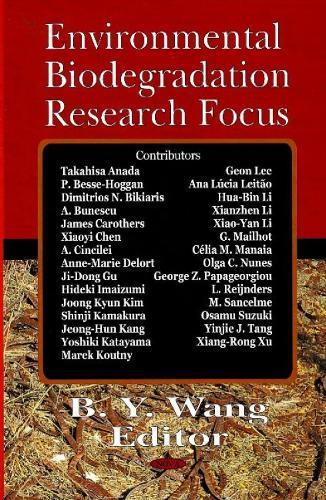
Environmental Biodegradation Research Focus

Author:   B Y Wang
Publisher:   Nova Science Publishers Inc
ISBN:  

9781600219047


Pages:   320
Publication Date:   01 January 2008
Format:   Hardback
Availability:   Out of stock   Availability explained
The supplier is temporarily out of stock of this item. It will be ordered for you on backorder and shipped when it becomes available.

Our Price $340.56 Quantity:  
Add to Cart

Share |

Environmental Biodegradation Research Focus


Overview

This new book is devoted to leading-edge research on environmental biodegradation which is the destruction of organic compounds by microorganisms. Microorganisms, particularly bacteria, are responsible for the decomposition of both natural and synthetic organic compounds in nature. Mineralisation results in complete conversion of a compound to its inorganic mineral constituents (for example, carbon dioxide from carbon, sulphate or sulphide from organic sulphur, nitrate or ammonium from organic nitrogen, phosphate from organophosphates, or chloride from organochlorine). Since carbon comprises the greatest mass of organic compounds, mineralisation can be considered in terms of CO2 evolution. Radioactive carbon-14 (14C) isotopes enable scientists to distinguish between mineralisation arising from contaminants and soil organic matter. However, mineralisation of any compound is never 100% because some of it (10-40% of the total amount degraded) is incorporated into the cell mass or products that become part of the amorphous soil organic matter, commonly referred to as humus. Thus, biodegradation comprises mineralisation and conversion to innocuous products, namely biomass and humus. Primary biodegradation is more limited in scope and refers to the disappearance of the compound as a result of its biotransformation to another product. Compounds that are readily biodegradable are generally utilised as growth substrates by single microorganisms. Many of the components of petroleum products (and frequent ground-water contaminants), such as benzene, toluene, ethylbenzene, and xylene, are utilised by many genera of bacteria as sole carbon sources for growth and energy.

Full Product Details

Author:   B Y Wang
Publisher:   Nova Science Publishers Inc
Imprint:   Nova Science Publishers Inc
Weight:   0.868kg
ISBN:  

9781600219047


ISBN 10:   1600219047
Pages:   320
Publication Date:   01 January 2008
Audience:   Professional and scholarly ,  Professional & Vocational
Format:   Hardback
Publisher's Status:   Active
Availability:   Out of stock   Availability explained
The supplier is temporarily out of stock of this item. It will be ordered for you on backorder and shipped when it becomes available.

Table of Contents

Biodegradation of Polysaccharide Sourced from Virulence Factor or Plant and Pathogenic Cell Wall Constituent and its Application in Management of Phytopathogenic Disease; Biodegradation or Metabolism of Bisphenol A in the Environment; From Planting to Harvest: Environmental Dissipation of the Herbicide Molinate and Proposal of a Clean-Up Methodology; Natural Attenuation of High Concentrations of Organic Pollutants by Biodegradation in Soils; Microbial Polyaromatic Hydrocarbon (PAH) Biodegradation in Submerged Sediment Environments; Microbial Degradation of 2-Benzothialzole Derivatives: A Review; Biodegradable Aliphatic Polyesters Derived from 1,3-Propanediol: Current Status and Promises; Aerobic Biodegradation of Fish-Meal Wastewater from Lab Scale to Large Scale; Methods in Study of Biodegradation of Water Insoluble Polymer Materials; Biodegradable Synthetic Octacalcium Phosphate Bone Substitute; Biodegradation of Phenol and Resorcinol by a Halotolerant Penicillium; Kinetics and Metabolic Pathway of Melatonin Biodegradation by a Bacterium Isolated from the Mangrove Sediment.; Index.

Reviews

Author Information

Tab Content 6

Author Website:  

Countries Available

All regions
Latest Reading Guide

NOV RG 20252


Shopping Cart
Your cart is empty
Shopping cart
Mailing List