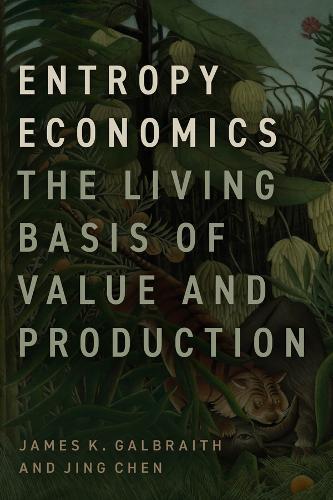
Full Product Details
Author: James K. Galbraith ,
Jing Chen
Publisher: The University of Chicago Press
Imprint: University of Chicago Press
Dimensions:
Width: 14.00cm
, Height: 2.50cm
, Length: 21.60cm
Weight: 0.367kg
ISBN: 9780226827193
ISBN 10: 0226827194
Pages: 248
Publication Date: 16 January 2025
Audience:
Professional and scholarly
,
Professional & Vocational
Format: Hardback
Publisher's Status: Active
Availability: Available To Order

We have confirmation that this item is in stock with the supplier. It will be ordered in for you and dispatched immediately.
Reviews
""Neoclassical economics has failed, and the call for a paradigm shift seems to pop up everywhere. But to truly move to a new approach to economics, an alternative theoretical foundation needs to be built from the bottom up in full knowledge of what came before. Few are willing, let alone equipped, to take on this task. Galbraith and Chen have done a masterful job by laying out an economics without equilibrium that starts from life processes and physical laws.""--Isabella M. Weber author of ""How China Escaped Shock Therapy"" ""Entropy Economics is an eloquent call for the abandonment of the equilibrium fetish that characterizes mainstream economics and an exposition of a nonequilibrium economics, grounded in the laws of thermodynamics, with an objective measure of value based on entropy and scarcity. Galbraith and Chen will be part of the foundation for the new economics that we desperately need.""--Steve Keen author of ""The New Economics: A Manifesto"" ""Old theories die hard, especially in economics. Galbraith and Chen offer an elevated understanding of value and production for a world that is anything but steady. Entropy Economics is an essential, critical work for twenty-first-century economics.""--Clara E. Mattei author of ""The Capital Order""
""Entropy Economics makes the case for an economic model that embraces entropy, aligning economic theory with life processes and physical laws—something that has real implications for how we understand markets, power, and regulation."" * Institute for New Economic Thinking * ""Galbraith and Chen [present] an economic theory that is consistent with life processes and physical laws, focusing on how a biophysical approach can guide us to simple mathematical expressions that describe value and production and are highly consistent with reality."" * Journal of Economic Literature * ""For most readers, the book will be a step into the unfamiliar...Nonetheless, readers should persevere. They will be enriched by this provocative perspective."" * Finance and Development Magazine * “Old theories die hard, especially in economics. Galbraith and Chen offer an elevated understanding of value and production for a world that is anything but steady. Entropy Economics is an essential, critical work for twenty-first-century economics.” -- Clara E. Mattei | author of ""The Capital Order"" “Neoclassical economics has failed, and the call for a paradigm shift seems to pop up everywhere. But to truly move to a new approach to economics, an alternative theoretical foundation needs to be built from the bottom up in full knowledge of what came before. Few are willing, let alone equipped, to take on this task. Galbraith and Chen have done a masterful job by laying out an economics without equilibrium that starts from life processes and physical laws.” -- Isabella M. Weber | author of ""How China Escaped Shock Therapy"" “Entropy Economics is an eloquent call for the abandonment of the equilibrium fetish that characterizes mainstream economics and an exposition of a nonequilibrium economics, grounded in the laws of thermodynamics, with an objective measure of value based on entropy and scarcity. Galbraith and Chen will be part of the foundation for the new economics that we desperately need.” -- Steve Keen | author of ""The New Economics: A Manifesto""
""Entropy Economics makes the case for an economic model that embraces entropy, aligning economic theory with life processes and physical laws—something that has real implications for how we understand markets, power, and regulation."" * Institute for New Economic Thinking * ""Galbraith and Chen [present] an economic theory that is consistent with life processes and physical laws, focusing on how a biophysical approach can guide us to simple mathematical expressions that describe value and production and are highly consistent with reality."" * Journal of Economic Literature * “Old theories die hard, especially in economics. Galbraith and Chen offer an elevated understanding of value and production for a world that is anything but steady. Entropy Economics is an essential, critical work for twenty-first-century economics.” -- Clara E. Mattei | author of ""The Capital Order"" “Neoclassical economics has failed, and the call for a paradigm shift seems to pop up everywhere. But to truly move to a new approach to economics, an alternative theoretical foundation needs to be built from the bottom up in full knowledge of what came before. Few are willing, let alone equipped, to take on this task. Galbraith and Chen have done a masterful job by laying out an economics without equilibrium that starts from life processes and physical laws.” -- Isabella M. Weber | author of ""How China Escaped Shock Therapy"" “Entropy Economics is an eloquent call for the abandonment of the equilibrium fetish that characterizes mainstream economics and an exposition of a nonequilibrium economics, grounded in the laws of thermodynamics, with an objective measure of value based on entropy and scarcity. Galbraith and Chen will be part of the foundation for the new economics that we desperately need.” -- Steve Keen | author of ""The New Economics: A Manifesto""
Author Information
James K. Galbraith is professor at the University of Texas at Austin. Jing Chen is assistant professor at the University of Northern British Columbia.