|
|
|||
|
||||
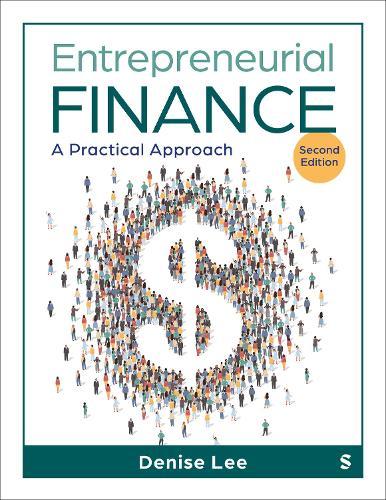
OverviewFormerly published by Chicago Business Press, now published by Sage Entrepreneurial Finance offers a comprehensive overview of the key concepts related to entrepreneurial finance, with a focus on practical applications in real-world settings. Full Product DetailsAuthor: Denise M, LeePublisher: Sage Publications Inc Ebooks Imprint: SAGE Publications Inc Edition: 2nd Revised edition Weight: 1.110kg ISBN: 9781071966204ISBN 10: 1071966200 Pages: 480 Publication Date: 14 May 2026 Audience: College/higher education , Tertiary & Higher Education Format: Paperback Publisher's Status: Forthcoming Availability: Not yet available This item is yet to be released. You can pre-order this item and we will dispatch it to you upon its release. Table of ContentsPreface Acknowledgments About the Author Chapter 1: Proper Preparation and the Nascent Entrepreneur 1.1 Entrepreneurship and Entrepreneurial Finance 1.2 Feasibility Analysis and the Business Plan 1.3 Personal Financial Preparation 1.4 Separation of the Entrepreneur from the Business 1.5 The Top 10 Legal and Financial Mistakes Entrepreneurs Make Summary Review and Discussion Questions Exercises Key Terms Chapter 2: Sources of Funding 2.1 Common Sources of Funding Available to a Typical U.S. Start-up Venture 2.2 Angel and Venture Capital Investment, CDFIs, and Grants 2.3 Crowdfunding 2.4 Debt 2.5 Regulatory Considerations Summary Review and Discussion Questions Exercises Key Terms Chapter 3: Legal Forms of Business, Taxation, and Business Owner Compensation 3.1 Legal Forms of Business Organization 3.2 The Franchise and the Nonprofit 3.3 Types of Business Owner Compensation 3.4 The Taxes that Most Significantly Affect U.S. Businesses and their Owners 3.5 The Tax Consequences of Business Ownership and Business Owner Compensation 3.6 Legal Form of Business and Business Owner Compensation—Making the Decision Summary Review and Discussion Questions Exercises Key Terms Chapter 4: Financial Statements of For-Profit Businesses 4.1 The Basic Financial Statements of a For-Profit Business 4.2 Accounting Information Systems 4.3 The Income Statement 4.4 The Balance Sheet 4.5 The Statement of Cash Flows 4.6 Financial Statements—a Few Words of Caution Summary Review and Discussion Questions Exercises Key Terms Chapter 5: Traditional Financial Statement Analysis and Breakeven Analysis 5.1 Financial Statement Analysis 5.2 Vertical and Horizontal Analysis of an Income Statement 5.3 Vertical and Horizontal Analysis of a Balance Sheet 5.4 Ratio Analysis 5.5 Vertical, Horizontal, and Ratio Analysis—Resources and Best Practices 5.6 Breakeven Analysis Summary Review and Discussion Questions Exercises Key Terms Chapter 6: Pro Forma Financial Statements–Part I 6.1 Pro Forma Financial Statements 6.2 Industry Research and the Schedule of Start-up Costs 6.3 The Pro Forma Pre-Revenue Balance Sheet and the Pro Forma Start-up Phase Expense Statement, Including Reconciliations of Cash and Equity 6.4 Market Research and the First Pro Forma Income Statement Summary Review and Discussion Questions Exercises Key Terms Chapter 7: Pro Forma Financial Statements–Part II 7.1 The First Pro Forma Post-Revenue Balance Sheet 7.2 Year 2 and Subsequent Year Pro Forma Income Statements 7.3 Sharing Pro Forma Financial Statements with Potential Investors and Lenders 7.4 Postponing the Creation of Pro Forma Balance Sheets (for Year 2 and Subsequent Years) and Pro Forma Statements of Cash Flows 7.5 Breakeven Analysis—Feasibility of a Proposed New Business 7.6 Words of Caution Regarding Pro Forma Financial Statements Summary Review and Discussion Questions Exercises Appendix 7-A: Example Pro Forma Financial Statements for a Service-Based Business, Including the Treatment of Accounts Receivable, Debt, and New Equity Investment Appendix 7-B: Example Pro Forma Financial Statements for a C Corporation Smartphone Application Business, Including the Treatment of Debt, Initial Net Losses, New Equity Investment, and Dividends Chapter 8: Pro Forma Balance Sheets for Year 2 and Subsequent Years and Pro Forma Statements of Cash Flows 8.1 The Percentage of Sales Method 8.2 Creating a Pro Forma Balance Sheet Using the Percentage of Sales Method 8.3 The Statement of Cash Flows 8.4 Creating a Pro Forma Statement of Cash Flows from a Pro Forma Reconciliation of Cash 8.5 Making Adjustments to Plans Based on a New Venture’s Completed Pro Forma Financial Statements Summary Review and Discussion Questions Exercises Key Term Chapter 9: Working Capital Management, Bootstrapping, and Controls over Assets 9.1 Working Capital Management 9.2 Cash Management 9.3 Accounts Receivable Management 9.4 Inventory Management 9.5 Accounts Payable Management 9.6 Accrued Liabilities Management 9.7 Bootstrapping as a Source of Cash 9.8 Effective Controls over Business Assets Summary Review and Discussion Questions Exercises Key Term Chapter 10: Time Value of Money 10.1 Time Value of Money 10.2 Simple Interest, Compound Interest, and Effective Annual Interest Rate 10.3 Time Value of Money: Lump Sums 10.4 Time Value of Money: Determination of i and n when Interest is Not Compounded Annually 10.5 Time Value of Money: Streams of Unequal Payments 10.6 Time Value of Money: Annuities 10.7 Combining Lump Sums and Annuities Summary Review and Discussion Questions Exercises Key Term Appendix 10-A: Present Value and Future Value Tables Chapter 11: Capital Budgeting 11.1 Capital Budgeting Analysis: When Is It Needed? 11.2 Determination of Capital Budgeting Analysis Data 11.3 Expected Annual After-Tax Benefit 11.4 Payback Method 11.5 Net Present Value 11.6 Internal Rate of Return 11.7 Capital Budgeting: Special Circumstances 11.8 Lowest Total Cost Summary Review and Discussion Questions Exercises Key Terms Chapter 12: Cash Harvest and Business Exit 12.1 Non-Business-Exit Cash Harvest Options 12.2 Business-Exit Cash Harvest Options 12.3 Exiting: Positioning a Company for Sale 12.4 Exiting: Selling a Business 12.5 The Post-Sale Transition 12.6 Business Dissolution Summary Review and Discussion Questions Exercises Key Terms Chapter 13: Business Valuation 13.1 Why Perform a Business Valuation? 13.2 The Discounted Cash Flow Method of Business Valuation 13.3 Equity Value vs. Enterprise Value 13.4 Discount Rate and Cash Flow Determination for Purposes of Business Valuation 13.5 Using Business Valuation to Determine Asking Price Summary Review and Discussion Questions Exercises Key Terms Chapter 14: Personal Finance and Wealth Management–Part I 14.1 Protection of Assets 14.2 Maintenance of Financial Liquidity and Investment of Excess Cash 14.3 Cash and Cash Equivalents 14.4 Bonds 14.5 Equities 14.6 Real Estate 14.7 Commodities, Precious Metals, and Collectables Summary Review and Discussion Questions Exercises Key Terms Chapter 15: Personal Finance and Wealth Management–Part II 15.1 Retirement Planning 15.2 College Planning 15.3 Estate Planning Summary Review and Discussion Questions Exercises Key Terms Glossary NotesReviewsNice step-by-step and evenly laid out presentation of the materials. Especially useful where the level of finance background knowledge may be uneven amongst the incoming students. Especially liked the boxed ""Entrepreneurs in Action"" bites. -- William Il Young Byun Author InformationDenise M. Lee is a faculty member in the Department of Marketing and Entrepreneurship at Kent State University where she is involved in teaching and coaching entrepreneurship students. In 2011, Denise received the Kent State University College of Business Teaching Excellence Award. In 2014 and 2022, she was nominated for the same award. In 2015, she received a Faculty Recognition Award from the Kent State University Teaching Council. Denise has developed and taught a variety of traditional and online entrepreneurship courses at Kent State University, including Introduction to Entrepreneurship, Entrepreneurial Tools, Entrepreneurial Marketing, Entrepreneurial Finance, New Venture Creation and Entrepreneurial Experience. She is also Coordinator for Kent State University′s Undergraduate Entrepreneurship Program. As an entrepreneur, Denise has specialized in overall business strategy, business planning, process and procedure development, and overall company management. Denise has extensive experience in all phases of the administrative development and proper exit of young business ventures. As a CPA, Denise specialized in audit, business valuation and corporate taxation. The company Denise has most recently founded, DMZLee Enterprises, is also in the education industry. DMZLee Enterprises provides educational services to a wide variety of individuals, businesses, and nonprofit organizations via the publication of textbooks and other educational materials and the development and delivery of professional webinars. Before this most recent venture, she co-founded five start-up companies. In addition to being an entrepreneur, Denise is a CPA with six years of public accounting experience. Tab Content 6Author Website:Countries AvailableAll regions |
||||