Overview
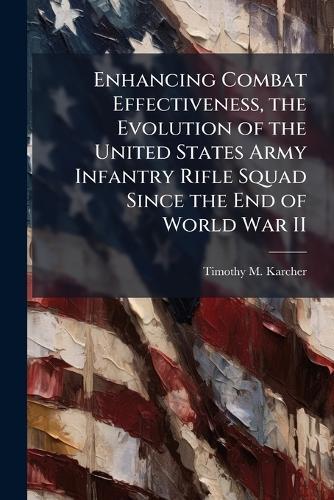
This study analyzes the organization of the US Army infantry rifle squad since the end of World War II, focusing on the attempt to gain and then maintain the capability of fire and maneuver at the squad level. Since the end of World War II, the US Army has conducted or commissioned at least nine studies, aimed at determining the optimum organization of the infantry rifle squad. Common trends affect all recent attempts at transforming the US Army and become evident when studying the evolution of the squad, but the goal must remain developing a combat effective unit. Combat effectiveness is determined by applying the evaluative criteria of control, sustainability, flexibility, and lethality. By applying these four criteria to analyze various squad organizations, one can determine the strengths and weaknesses inherent to these organizations, thereby recommending the most combat effective rifle squad organization. The US Army's current focus on strategic deployability and emerging weapons capabilities is not a new phenomenon, but potentially could cloud the essential issue, developing a military force for optimum combat effectiveness. This study concludes by recommending the optimum squad-level organization for the ""Objective Force."" This work has been selected by scholars as being culturally important, and is part of the knowledge base of civilization as we know it. This work was reproduced from the original artifact, and remains as true to the original work as possible. Therefore, you will see the original copyright references, library stamps (as most of these works have been housed in our most important libraries around the world), and other notations in the work. This work is in the public domain in the United States of America, and possibly other nations. Within the United States, you may freely copy and distribute this work, as no entity (individual or corporate) has a copyright on the body of the work. As a reproduction of a historical artifact, this work may contain missing or blurred pages, poor pictures, errant marks, etc. Scholars believe, and we concur, that this work is important enough to be preserved, reproduced, and made generally available to the public. We appreciate your support of the preservation process, and thank you for being an important part of keeping this knowledge alive and relevant.
Full Product Details
Author: Timothy M Karcher
Publisher: Hutson Street Press
Imprint: Hutson Street Press
Dimensions:
Width: 15.60cm
, Height: 0.60cm
, Length: 23.40cm
Weight: 0.159kg
ISBN: 9781025064574
ISBN 10: 1025064577
Pages: 106
Publication Date: 22 May 2025
Audience:
General/trade
,
General
Format: Paperback
Publisher's Status: Active
Availability: Available To Order

We have confirmation that this item is in stock with the supplier. It will be ordered in for you and dispatched immediately.