Overview
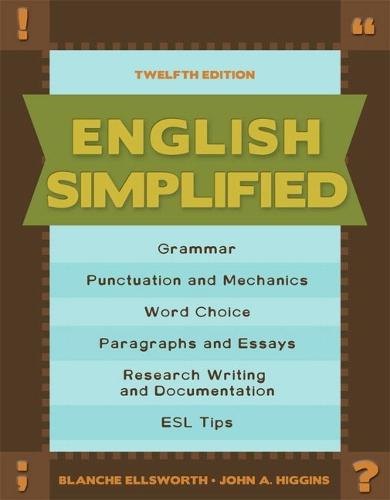
This handbook covers almost every major writing problem.
Full Product Details
Author: Blanche Ellsworth, (Late) , John A. Higgins
Publisher: Pearson Education (US)
Imprint: Pearson
Edition: 12th edition
Dimensions:
Width: 21.60cm
, Height: 0.30cm
, Length: 27.90cm
Weight: 0.168kg
ISBN: 9780205633296
ISBN 10: 0205633293
Pages: 80
Publication Date: 12 March 2009
Audience:
ELT/ESL
,
ELT General
Replaced By: 9780205879366
Format: Paperback
Publisher's Status: Out of Print
Availability: In Print 
Limited stock is available. It will be ordered for you and shipped pending supplier's limited stock.
Table of Contents
I. SENTENCES AND GRAMMAR (Sections 101-130) 101-103 Sentences 101 Parts: A-subject; B-verb (predicate) 102 Sentence pattern 103 Classifying: A-by purpose; B-by structure (clauses)--simple, compound, complex, compound-complex 104-109 Parts of Speech: Survey 104 A--nouns; B--pronouns 105 Verbs 106 A--adjectives; B--adverbs 107 A--conjunctions; B--prepositions 108 interjections 109 A word as different parts of speech 110 A word group as a part of speech 111-112 Using Nouns 111 Kinds: A-singular, plural; B-common, proper; C-concrete, abstract; D-collective; E-count, noncount 112 Uses: A-subject; B-complement (direct, indirect object; subjective, objective complement); C--object of preposition; D-appositive; E-direct address 113-118 Using Verbs 113 Identifying 114 Kinds: A-transitive; B-intransitive; C-linking; D-auxiliary 115 Principal parts: A-present, past, past participle; B-troublesome verbs 116 Tenses, forms: A-present; B-past; C-future; D-present perfect; E-past perfect; F-future perfect; G-conditional 117 Verbs vs. Verbals: A-infinitives; B-participles; C-gerunds 118 Verb errors: A-perfect and passive forms; B--tense shift; B-overused passive voice; C-mood shifts; D-confusion of similar verbs (see also 404) 119-120 Using Adjectives and Adverbs 119 Correct use: A-adverbs with action verbs; modifying adjectives, adverbs; B-adjectives after linking verbs; C-good vs. well, bad vs.badly; D-comparative, superlative; double comparative, superlative; illogical comparisons 120 Articles, determiners [ESL]: A-a vs.an; B-articles before nouns; C-limiting adjectives (determiners); D-order of adjectives 121-123 Using Pronouns 121 Kinds: A-personal (including gender problem); B-interrogative, relative: C-demonstrative; D-indefinite; E-reflexive, intensive 122 Case: A-subjective (nominative); B-objective;C-subjective-objective problems; D-who, whom (interrogative); E-who, whom (relative); F-possessive 123 Faulty reference: A-ambiguous; B-vague 124-125 Phrases, Clauses 124 Phrases: A-prepositional; B-verbal (infinitive, participial, absolute, gerund) 125 Clauses: A-kinds (independent, dependent); B-dependent kinds (adjective, adverb, noun); C-in sentences (simple, compound, complex) 126-127 Agreement 126 Subject-verb: A-person; B-number; C-intervening words; D-compound subjects; E-subjects with not; F--indefinite pronouns; G-collective nouns; H-linking verbs; I--singulars in plural form; J-there and it; K-titles, words as words; L-money and measures; M-relative pronouns 127 Pronoun-antecedent: A-shifts to you; B. singular pronouns; C-and, or, nor; D-collective nouns; E-demonstratives as adjectives; F-one of the 128-130 Effective Sentences 128 Creating sentences: A-varying; B-coordinating; C-compounding; D-subordinating (adjective, adverb, noun clauses); E-reduction; F-parallel structure; G-positioning main idea 129 Big three errors: A-fragments; B-comma splices, fused sentences 130 Gaining clarity: A--needless separation; B--misplaced or dangling modifiers (participles, gerunds, clauses, etc.); C-incomplete or illogical comparisons; D-illogical shifts; E-mixed or confused construction (is when, is where, others) II. PUNCTUATION (Sections 201-227) 201-203 Comma [,] 201 Comma (to set off): A-independent (main) clause; B-introductory clause, phrase; C-items in series; D-coordinate adjectives; E-parenthetical expressions; F-nonessential (nonrestrictive) clauses, phrases, appositives; G-absolute phrases; H-direct address; I-yes, no; J-mild interjections; K-direct quotations; L-such as, etc., contrasts 202 Comma: A-clarity; B-omitted, understood word; C-tag question; D-friendly letter; E-dates, addresses 203 No comma: A-between subject-verb, verb-object; B-between independent clauses; C--if not needed 204-205 Period [.] 204 Period: A-end of sentence; B-abbreviation, initial; C-outline; D-ellipsis, hesitation; E-nonsentence 205 No period after title 206-207 Question Mark [?] 206 Question mark: A-direct question; B-uncertainty 207 No question mark: A-indirect question; B-polite request; C-humor, irony 208-209 Exclamation Point [!] 208 Exclamation point: w. strong interjection 209 No exclamation point: A-mild interjection; B-beyond one 210 Semicolon [;]: A-joining clauses; B-conjunctive adverb; C-clauses, series with commas 211-213 Apostrophe ['] 211 Apostrophe with possessive nouns: A-singular; B-plural; C-before gerund; D-fine points; E--apostrophes and clarity 212 Apostrophe: A-contractions, omissions; B-letters, symbols 213 No apostrophe: A-personal pronouns; B-plurals, verbs; C-inanimate objects 214 Italics (Underlining): A-titles of long works; B-ships, etc.; C-art works; D-foreign words; E-words, etc. as such; F-emphasis 215-219 Quotation Marks [ ] 215 Double quotation marks: A-speaker's words; B-interrupted quotation; C-uninterrupted quotation; D-paragraphs; E-fragmentary quotation; F-omission (ellipsis); G-insertion in quotation; H-dialogue; I-poetry 216 Double quotation marks: A-titles of short works; B-definitions; C-words in special sense 217 Single quotation marks: quotation inside quotation 218 Quotation marks with other marks: A-periods, commas; B-colons, semicolons; C-others 219 No quotation marks: A-title of paper; B--irony, etc.; 220-221 Colon [:] 220 Colon (to introduce): A-list; B-long quotation; C-formal quotation, question; D-independent clause; E-business letter; F-announcement; G-resolution; H-play dialogue 221 Colon (to separate): A-title parts, etc.; bibliography parts 222 Dash [--]: A-break in thought; B-parenthetical element; C-appositive; D-quotation 223-224 Parentheses[( )] 223 Parentheses: A-incidental information; B-enclosing; C-accuracy; D-with other marks 224 No parentheses: A-deletions; B-editorial remarks 225 Brackets [[ ]]: A: editorial remarks; B-sic; C-stage directions; D-within parentheses 226 Hyphen[-]: A-compound words; B-compound adjective; C-numbers; D-clarification; E-ex-, self-, etc.; F-hesitation, etc.; G-word division 227 Slash (virgule) [/]: A-poetry; B-alternatives; C-per; D-fractions III. MECHANICS, WITH SPELLING (Sections 301-314) 301-303 Capitalization 301Capital: A-sentence beginning; B-poetry; C-nonsentence; D-after colon; E-outline; F-title; G-letter greeting, close; H-I, O 302 Proper noun capital: A-person, group, etc.; B-place; C-organization, brand; D-day, month, etc.; E-sacred name; F-historical event, etc.; G-school, etc.; H-flag, award; I-planet, etc.; J-ship, etc.; K-initial, etc.; L-personification; M-title 303 No capital: A-compass points; B-seasons; C-family; D-school subject; E-common noun; F-words from proper nouns; G-after semicolon; H-interrupted quotation; I-fragmentary quotation; J-compound word; K-emphasis; L-book part 304 Word division (syllabication): A-by pronunciation; B-compound word; C-one-syllable word; D-single letter 305-307 Numbers 305 In words: A-one or two words; B-compound adjective; C-fraction; D-beginning sentence 306 In figures: A-three or more words; B-special uses; C-groups in same passage 307 Money 308-309 Abbreviations 308 Abbreviation: A-title before name; B-title after name; C-with numeral; D-Latin phrase; E-organization 309 No abbreviation: A-state, day, etc.; B-name; C-street, company, etc.; D-and; E-school subject; F-book part 310-314 Spelling 310 Improvement techniques: A-visualizing; B-practicing; C-similar words; D-related words; E-memory devices 311 Basic rules: A-ie-ei; B-final e; C-final y; D-doubling; E-letting alone 312 Plurals: A-extra syllable (-es); B-y ending (-es); C-f, fe ending (-es); D-o ending (-es); E--is ending (-es); F-compound word; G-foreign plural; H-letter, symbol 313 Nonstandard, alternative spelling: A-nonstandard; B-preferred 314 One hundred problem words IV. WORD CHOICE (Sections 401-405) 401 Conciseness, clarity, originality: A-conciseness; B-specificity; C-connotation; D-originality 402 Standard, appropriate English: A-formal vs. informal; B-limited use words; C-expressions to avoid 403 Nondiscriminatory terms: A-nonsexist; B-other 404 Similar words often confused V. PARAGRAPHS AND PAPERS (Sections 501-510) 501 Manuscript Form: A-paper, typeface; B-spacing; C-title, paging; D-Justifying, word dividing; E-corrections 502-503 Paragraphs 502 Form, length [ESL] 503 Content: A-topic sentence; B-development; C-coherence (incl. transitions); D-unity, emphasis 504 Netiquette Guidelines 505-506 Essays 505 Before writing: A-topic; B-plan (prewriting, etc.); C-thesis; D-approach; E-outline 506 Writing, revising: A-first draft; B-revising, editing, proofreading; C-sample student essay 507-510 Research Papers 507 Planning, researching: A-topic; B-thesis (see 505C); C- locating sources (print, electronic, field); D-working bibliography; E-evaluating sources (objectivity, etc.); F-- note taking (paraphrase, etc.); G-pulling it all together 508 Citing sources: A-within paper (MLA, APA); B-plagiarism [ESL] 509 Works cited/references list: A-MLA; B-APA 510 Setting up pages: A-text (MLA, APA); B-works cited/references list (MLA, APA) Index (by section number) Correction Chart
Reviews
Author Information
Tab Content 6
Author Website:
Countries Available
All regions
|