Overview
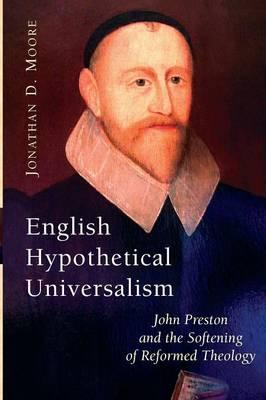
John Preston (1587-1628) stands as a key figure in the development of English Reformed orthodoxy in the courts of ElizabethaI and JamesaVI. Often cited as a favorite of the English and American Puritans who came after him, he nevertheless stood as a bridge between the crown and the nonconformists. Jonathan D. Moore retrieves Preston from his traditional place as one of the ""Calvinists against Calvin,"" provides a convincing argument for Preston's unique hypothetical universalism, and calls into question common misperceptions about Reformed theology and Puritanism.
Full Product Details
Author: Jonathan D. Moore
Publisher: William B Eerdmans Publishing Co
Imprint: William B Eerdmans Publishing Co
Dimensions:
Width: 15.90cm
, Height: 1.90cm
, Length: 22.90cm
Weight: 0.476kg
ISBN: 9780802820570
ISBN 10: 0802820573
Pages: 304
Publication Date: 25 June 2007
Audience:
College/higher education
,
Postgraduate, Research & Scholarly
Format: Paperback
Publisher's Status: Active
Availability: In Print

This item will be ordered in for you from one of our suppliers. Upon receipt, we will promptly dispatch it out to you. For in store availability, please contact us.
Reviews
Eamon Duffy -- University of Cambridge Historians of Stuart England have only recently come to grasp the centrality of the intricate controversies of Reformed theologians about sin and grace, divine sovereignty and human freedom, for the interaction of religion and society, and even for the alignments of local and national politics. Jonathan Moore's learned, subtle, and incisive exploration of the thought of one of the shapers of Protestant thought in the England of James VI and Charles I brings a new sophistication to the analysis of the place of theology in the intellectual history of early Stuart England. Fascinating in its own right as a study in the varieties of English Calvinism, his study is also an invaluable contribution to our understanding of the theological tensions that provide the context for the English Civil War. Anthony Milton -- University of Sheffield This subtle, shrewd, and learned study of a vitally important topic offers an important corrective to existing work on the period. Jonathan Moore makes a compelling case for John Preston's hypothetical universalism, and in the process provides a completely new slant not just on the York House Conference but on the whole Arminian dispute that rocked the Church of England in the 1620s. This sophisticated study should be required reading for anyone working on religious thought in the early Stuart period. Alan Ford -- University of Nottingham Essential reading for anyone interested in seventeenth-century religion. Clear, confident, and convincing, Jonathan Moore not only transforms our knowledge of John Preston but also reshapes the way in which we view the development of early modern Calvinist theology.
Eamon Duffy -- University of Cambridge Historians of Stuart England have only recently come to grasp the centrality of the intricate controversies of Reformed theologians about sin and grace, divine sovereignty and human freedom, for the interaction of religion and society, and even for the alignments of local and national politics. Jonathan Moore's learned, subtle, and incisive exploration of the thought of one of the shapers of Protestant thought in the England of James VI and Charles I brings a new sophistication to the analysis of the place of theology in the intellectual history of early Stuart England. Fascinating in its own right as a study in the varieties of English Calvinism, his study is also an invaluable contribution to our understanding of the theological tensions that provide the context for the English Civil War. Anthony Milton -- University of Sheffield This subtle, shrewd, and learned study of a vitally important topic offers an important corrective to existing work on the period. Jonathan Moore makes a compelling case for John Preston's hypothetical universalism, and in the process provides a completely new slant not just on the York House Conference but on the whole Arminian dispute that rocked the Church of England in the 1620s. This sophisticated study should be required reading for anyone working on religious thought in the early Stuart period. Alan Ford -- University of Nottingham Essential reading for anyone interested in seventeenth-century religion. Clear, confident, and convincing, Jonathan Moore not only transforms our knowledge of John Preston but also reshapes the way in which we view the development of early modern Calvinist theology.
Eamon Duffy University of Cambridge Historians of Stuart England have only recently come to grasp the centrality of the intricate controversies of Reformed theologians about sin and grace, divine sovereignty and human freedom, for the interaction of religion and society, and even for the alignments of local and national politics. Jonathan Moore's learned, subtle, and incisive exploration of the thought of one of the shapers of Protestant thought in the England of James VI and Charles I brings a new sophistication to the analysis of the place of theology in the intellectual history of early Stuart England. Fascinating in its own right as a study in the varieties of English Calvinism, his study is also an invaluable contribution to our understanding of the theological tensions that provide the context for the English Civil War. Anthony Milton University of Sheffield This subtle, shrewd, and learned study of a vitally important topic offers an important corrective to existing work on the period. Jonathan Moore makes a compelling case for John Preston's hypothetical universalism, and in the process provides a completely new slant not just on the York House Conference but on the whole Arminian dispute that rocked the Church of England in the 1620s. This sophisticated study should be required reading for anyone working on religious thought in the early Stuart period. Alan Ford University of Nottingham Essential reading for anyone interested in seventeenth-century religion. Clear, confident, and convincing, Jonathan Moore not only transforms our knowledge of John Preston but also reshapes the way in which we view the development of early modern Calvinist theology.
Author Information
Jonathan D Moore holds a PhD in Historical Theology from Emmanuel College, University of Cambridge. This is his first book.